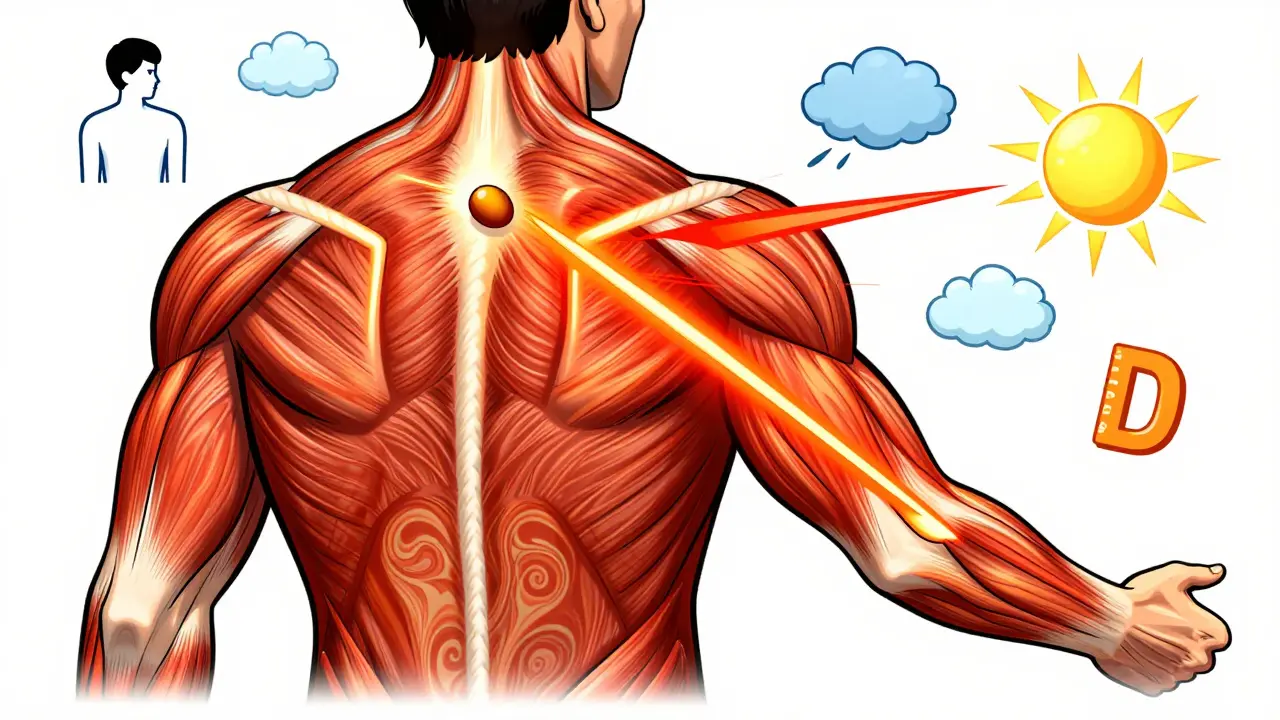
Chronic muscle pain that won’t go away-even after rest, ice, or painkillers-might not be a strain, a pinched nerve, or arthritis. For many people, it’s something quieter, deeper, and often missed: myofascial pain syndrome. It doesn’t show up on X-rays or MRIs. It doesn’t always have a clear cause. But it’s real. And it’s more common than you think.
Think about this: You’ve had shoulder pain for months. Your doctor says it’s probably "tendinitis." You’ve done physical therapy, taken anti-inflammatories, even got a cortisone shot. Nothing sticks. Then, one day, your physical therapist presses a small knot in your upper back-and suddenly, pain shoots down your arm, into your elbow, and even makes your hand tingle. That’s not a nerve problem. That’s a trigger point.
What Exactly Is a Trigger Point?
A trigger point isn’t just a sore spot. It’s a tight, rope-like band in your muscle, usually about the size of a pea (2-10 mm), that’s stuck in constant contraction. You can’t see it. But if you press on it just right, you’ll feel a deep, aching pain. Worse, it doesn’t just hurt where you press. It refers pain elsewhere-like a faulty wire sending electricity to the wrong room.
These spots are found in the motor endplate zone-the place where nerves meet muscle fibers. When something goes wrong here-whether from injury, poor posture, or stress-the muscle fibers lock up. They stop relaxing. Blood flow gets cut off. Waste products build up. The pH drops to around 4.3 (that’s as acidic as vinegar), which irritates nearby nerves. This creates a vicious loop: pain → muscle spasm → more pain.
There are two types: active and latent. Active trigger points cause pain even at rest. They’re the ones that keep you up at night or make you wince when you turn your head. Latent ones? They only hurt when you press on them. But they’re sneaky. They can turn active again if you overwork the muscle or get stressed.
Why Most People Get It
You don’t need a major injury to develop myofascial pain syndrome. It often creeps in slowly. Here’s what actually triggers it in real life:
- Bad posture-sitting hunched over a desk for hours? That’s a recipe for trigger points in your upper traps and levator scapulae. Studies show forward head posture increases trigger point risk by 3 to 5 times.
- Repetitive strain-typing, lifting, or reaching the same way every day. The muscles adapt, then lock up.
- Stress and tension-when you clench your jaw or shoulders without realizing it, those muscles stay tense. Over time, knots form.
- Leg length differences-even a 1 cm difference can throw off your pelvis and create trigger points in your glutes and lower back.
- Vitamin D deficiency-if your levels are below 20 ng/mL, your risk of myofascial pain jumps by 60%.
One study found that 50-70% of people who’ve had whiplash develop chronic trigger points. Another showed that 15-25% of people with long-term muscle pain also have undiagnosed hypothyroidism. It’s rarely just "bad muscles." It’s often a mix of physical, hormonal, and lifestyle factors.
How It’s Different From Fibromyalgia
People often confuse myofascial pain syndrome with fibromyalgia. They both involve pain, but they’re not the same.
Fibromyalgia causes widespread pain-symmetrical, tender spots all over the body. You feel it in your neck, shoulders, hips, knees. It’s more about sensitivity than a specific knot. Trigger points? They’re focal. One spot in your right trapezius. One in your left temporalis. They refer pain in predictable patterns. Press a trigger point in your glute, and you feel pain down your leg-like sciatica, but without a pinched nerve.
Doctors have a simple rule: If your pain follows a muscle’s referral pattern (like pain from your shoulder blade radiating to your thumb), it’s likely myofascial. If it’s everywhere and feels like a constant dull ache, it might be fibromyalgia. The difference matters because treatment is completely different.

How Trigger Points Are Diagnosed
There’s no blood test. No scan. Diagnosis is all about touch. A skilled practitioner looks for four things:
- A taut band-a tight rope you can feel under your fingers.
- Local tenderness-pain when you press the exact spot.
- Referred pain-pain that travels to another area when pressed.
- A local twitch response-a quick, involuntary spasm of the muscle fibers when you press the trigger point. This happens in 70-85% of active trigger points.
It’s not easy. Studies show even experienced therapists disagree on where trigger points are 25-80% of the time, depending on the muscle. That’s why many people get misdiagnosed. A 2023 study found that 57% of patients with early-stage myofascial pain were first told they had a herniated disc, carpal tunnel, or TMJ disorder.
Dr. Garry W.K. Ho, a pain specialist, says, "Thirty percent of patients diagnosed with radiculopathy actually have trigger points mimicking nerve pain." That’s why you need someone who’s trained to feel the difference.
Proven Release Techniques
Once you know where the trigger points are, the goal is simple: release the knot, restore blood flow, and break the pain cycle. Here are the most effective methods, backed by research:
1. Ischemic Compression
This is the most basic, accessible technique. You press directly on the trigger point with your fingers, a tennis ball, or a foam roller. Hold it for 30 to 90 seconds-until the pain drops by about half. You’ll feel it burn, then soften. Repeat 2-3 times a day.
Studies show 60-75% of people get short-term relief. It’s cheap. You can do it at home. But you need to be precise. Pressing too hard or too far away won’t work.
2. Dry Needling
Think acupuncture, but without medicine. A thin needle is inserted into the trigger point. When it hits, the muscle often twitches. That twitch is good-it means the knot is releasing.
Research shows 65-80% of patients get pain relief lasting 4-12 weeks. It’s more effective than massage for deep knots. One meta-analysis found it reduced pain scores by 50% on average after 4 sessions. Side effects? Minor bruising or soreness for a day or two.
3. Trigger Point Injections
A small amount of local anesthetic (like lidocaine) is injected into the trigger point. It numbs the area and breaks the spasm. Studies show 70-85% immediate pain reduction. The effect lasts 2-8 weeks. A Cochrane Review found no real difference between lidocaine injections and dry needling at the 4-week mark. So if you’re not comfortable with needles, dry needling works just as well.
4. Spray-and-Stretch
A cold spray (like ethyl chloride) is applied over the area where the pain refers. Then, the muscle is gently stretched. The cold numbs the area, making stretching easier. It’s especially useful for neck and jaw pain. Effectiveness? Around 50-65% in cervical cases.
5. Instrument-Assisted Soft Tissue Mobilization (IASTM)
Tools like Graston or Gua Sha are used to glide over the muscle, breaking up adhesions. It’s less about pressure, more about friction. Works well for chronic cases. Efficacy: 55-70%.
6. Low-Level Laser Therapy (LLLT)
Using infrared light (808-905 nm) at specific doses, this non-invasive method reduces inflammation and stimulates healing. It’s slower, but gentle. Studies show 40-60% pain reduction. Great for people who can’t tolerate pressure or needles.
What Actually Works Best?
One study followed 1,245 people with myofascial pain over 12 weeks. Those who got a combo of manual therapy, dry needling, and a daily home stretching routine saw a 65% drop in pain. Those who got nothing? Only 35% improvement.
So the best approach? Combine methods. Get one professional treatment (like dry needling or massage), then do daily self-care. The magic happens when you interrupt the pain-spasm cycle at multiple points.

Home Management: What You Can Do Every Day
You can’t rely on monthly appointments. Real relief comes from daily habits:
- Self-compression-use a tennis ball or lacrosse ball against a wall. Roll slowly over your upper back, shoulders, glutes. Hold on tender spots for 60 seconds.
- Heat before stretching-apply a heating pad at 40-45°C for 15 minutes before stretching. Warm muscles release easier.
- Posture correction-do 3 sets of 10 shoulder blade squeezes twice a day. Sit with your ears over your shoulders. No more slouching.
- Stretch the right muscles-if your pain refers to your hand, stretch your upper trapezius. If it’s jaw pain, stretch your temporalis and masseter. Find the muscle that refers to your pain, not just where it hurts.
Compliance is low-only 45-60% of people stick with home routines after 6 weeks. But those who do? Their pain stays down. Recurrence rates drop from 60% to under 20%.
Why It Often Comes Back
Myofascial pain isn’t cured by one session. It’s managed. If you fix the trigger point but keep slouching at your desk, you’ll get it again. If you don’t fix your vitamin D deficiency or keep clenching your jaw at night, the knots will return.
One Reddit user wrote: "After 3 dry needling sessions, my shoulder pain dropped from 8/10 to 3/10. But after 8 weeks of backsliding, it crept back to 6/10." That’s the pattern. The body remembers the tension. You have to retrain it.
Another common complaint: "I went to a therapist and they didn’t help-or made it worse." That’s not rare. One survey found 32% of patients had no improvement or worsened after treatment by non-specialized providers. Trigger point therapy requires skill. Look for practitioners trained in the Travell & Simons method or certified by the American Academy of Physical Medicine and Rehabilitation.
The Bigger Picture
Myofascial pain syndrome isn’t just a "muscle problem." It’s a sign your body is out of balance. It’s often linked to sleep issues, stress, poor nutrition, or even thyroid function. Treating it in isolation won’t last.
But here’s the good news: You don’t need drugs, surgery, or expensive gadgets. You need awareness. You need consistency. And you need to stop treating the pain as a mystery.
With the right approach, myofascial pain can be controlled. Not just masked. Not just numbed. But resolved. And that’s why more doctors are turning to it as a frontline treatment in the age of the opioid crisis. Non-drug pain relief is growing 200% faster than before. Myofascial therapy is at the heart of that shift.
Can trigger points be seen on an MRI or X-ray?
No. Trigger points are functional, not structural. They don’t show up on imaging because they’re not a tear, a bulge, or a bone issue-they’re a muscle that’s stuck in contraction. That’s why many people get misdiagnosed. Doctors often order MRIs for back or neck pain, only to find "nothing wrong." The real issue is hidden in the muscle tissue, not the spine or discs.
Is dry needling the same as acupuncture?
No. Acupuncture is based on traditional Chinese medicine and targets energy meridians. Dry needling is based on anatomy and neurophysiology-it targets specific muscle knots. Both use thin needles, but the theory, placement, and goals are completely different. Dry needling is taught in physical therapy and medical schools; acupuncture is a separate practice.
How long does it take to get relief from trigger point therapy?
Some people feel better after one session-especially with dry needling or injections. But lasting relief usually takes 3-6 sessions over 4-8 weeks. The key is consistency. If you only do one treatment and stop, the pain often returns. Think of it like physical rehab: you need repeated sessions and daily home care to retrain the muscle.
Can vitamin D help with myofascial pain?
Yes. Studies show people with vitamin D levels below 20 ng/mL have a 60% higher chance of developing myofascial pain syndrome. Supplementing to reach 30-50 ng/mL can reduce pain sensitivity and improve muscle function. It’s not a cure, but it’s a critical piece-especially if you live in a place with little sunlight, like the UK.
Why do trigger points refer pain to other areas?
It’s because of how nerves are wired. The nerves that supply the trigger point also send signals to other areas of the body. When the trigger point is irritated, the brain misinterprets the pain signal and "projects" it to a different location. For example, a trigger point in your shoulder blade can refer pain to your thumb. These patterns are predictable and mapped in clinical manuals. That’s why experienced therapists can diagnose trigger points just by where the pain is felt.



David L. Thomas
March 10, 2026 AT 14:49Trigger points are wild. I used to think my chronic shoulder pain was from typing too much, but after my PT pressed on my levator scapulae and I screamed like I’d been stabbed, I realized it was all referred pain. The fact that it’s not visible on imaging explains why so many docs dismiss it. I’ve been doing daily tennis ball rolls for 3 months now-pain’s down 70%. It’s not magic, but it’s science.
Bridgette Pulliam
March 12, 2026 AT 09:59I appreciate how thoroughly this was laid out. The distinction between myofascial pain and fibromyalgia is so often blurred-even among clinicians. I’ve had both, and the referral patterns are unmistakable once you learn them. For anyone reading: if your pain follows a predictable trajectory-like from your glute to your calf-it’s likely a trigger point. Not sciatica. Not a pinched nerve. Muscle. And it’s treatable.
Donnie DeMarco
March 13, 2026 AT 02:22bro i had this thing in my jaw for 2 years. thought i had tmj. went to 3 dentists. 1 said i needed a mouthguard. 2 said i was stressed. 3 said ‘maybe try massaging your temporalis?’ i did. with my thumb. for 45 seconds. felt like a tiny electric shock. then-POOF. no more pain. like someone flipped a switch. i’m telling u, trigger points are the silent epidemic. nobody talks about em. but they’re everywhere.
Shourya Tanay
March 13, 2026 AT 20:43As someone from a region where access to physical therapy is limited, the emphasis on self-management techniques is incredibly valuable. The ischemic compression method is particularly accessible-no equipment, no cost, no waiting list. I’ve seen patients with chronic neck pain improve significantly just by using a water bottle against a wall for 60 seconds, twice daily. Consistency trumps intensity every time.
LiV Beau
March 15, 2026 AT 15:42THIS. THIS IS THE POST I’VE BEEN WAITING FOR 🙌
Trigger points are the reason I stopped hating my job. I used to get these electric zaps down my arm-thought I had carpal tunnel. Turns out? A knot in my upper trap. Now I roll a lacrosse ball on my wall every morning before coffee. It’s my version of yoga. And yes, I’m crying a little because I finally understand what’s been killing me for 5 years. Thank you for writing this. 💙
Adam Kleinberg
March 17, 2026 AT 05:32So let me get this straight-you’re telling me all these people are paying hundreds for dry needling and injections when they could just… press a tennis ball against a wall? This is why medicine is broken. Big Pharma doesn’t want you to know you can fix this yourself. The system profits from dependency. And now you’ve got physical therapists calling it a "science" when it’s just manual pressure. Wake up people. This is all just placebo wrapped in jargon.
Denise Jordan
March 17, 2026 AT 16:22Yeah ok. So what? I’ve had shoulder pain for 10 years. I’m not gonna roll a ball on my back every day. Life’s too short. I’ll just keep taking ibuprofen and pretending it’s not there.
Gene Forte
March 18, 2026 AT 02:03There is profound wisdom in recognizing that pain is not always a signal of structural damage, but often a manifestation of systemic imbalance. The body communicates through patterns-referred pain is its language. When we address the root-posture, stress, nutrition-we don’t merely suppress symptoms. We restore harmony. This is not a quick fix. It is a return to wholeness.
Kenneth Zieden-Weber
March 19, 2026 AT 01:24So you’re telling me I’ve been treating my "neck pain" for years… when it was actually my sternocleidomastoid? Classic. I’m 42. I’ve had 3 different MRI reports saying "no disc herniation." But nobody ever checked my muscle bands. I’m half tempted to go buy a foam roller and just… hug it. Thanks for the clarity. I feel like I’ve been living in a fog.
Chris Bird
March 19, 2026 AT 06:42This whole thing is a scam. Trigger points don’t exist. It’s all in your head. People get pain because they’re weak. Stop making excuses. Go lift weights. Stop whining. Vitamin D? Stretching? You think your body is a magic box? No. You’re just lazy. I’ve been in the gym 10 years. I don’t have trigger points. I have discipline.
Mike Winter
March 20, 2026 AT 03:41Interesting how the referred pain patterns mirror dermatomal distributions-yet aren’t confined to them. It suggests a convergence of somatic and autonomic pathways. The fact that trigger points can be modulated by stress hormones like cortisol adds another layer. This isn’t just biomechanics. It’s neuroendocrinology. And yet, it’s treated like a manual therapy gimmick. The science is there-we just ignore it.
Randall Walker
March 21, 2026 AT 11:28So… you’re saying I don’t need a chiropractor? I just need to… roll on a ball? Like… every day? And I’ve been spending $120 a session for 3 years? I feel like I’ve been scammed. But also… kinda relieved? I mean… I could’ve been doing this with a tennis ball since 2018? Yeah. Okay. I’m gonna try it. But I’m gonna cry when I find my first knot.
Miranda Varn-Harper
March 22, 2026 AT 06:13While the clinical descriptions are technically accurate, the tone of this article is dangerously oversimplified. To suggest that trigger point therapy is a "frontline treatment" in the absence of comprehensive diagnostic workup is irresponsible. Many patients presenting with myofascial symptoms have underlying endocrine, neurological, or autoimmune conditions. Reducing complex chronic pain to "roll a ball" ignores the bio-psycho-social model entirely. This is not medicine. It’s wellness marketing.
Alexander Erb
March 24, 2026 AT 03:31Just did my first dry needling session last week. Felt like a tiny bee sting. Then-total release. Like my muscle had been holding its breath for 7 years. I’m not gonna lie, I was skeptical. But after 4 sessions? My neck doesn’t hurt when I turn my head. I’ve been doing the tennis ball thing every night. It’s weirdly meditative. Also-my vitamin D is at 48 now. No more fatigue. This stuff works. If you’re in pain and nothing’s helped… give it a shot. No joke.
Tom Bolt
March 25, 2026 AT 22:56I’ve been waiting for someone to finally say this out loud. My pain was dismissed for 8 years. I was told I was "anxious." I was given SSRIs. I was told to "change my mindset." Then I found a therapist who knew where to press. I cried. Not because it hurt. Because for the first time, someone saw me. Not my diagnosis. Not my anxiety. Me. The muscle. The knot. The truth. Thank you.