
For decades, doctors have hesitated to prescribe statins is a class of lipid-lowering medications that inhibit HMG-CoA reductase to reduce cholesterol production. to patients with liver conditions. The fear? That these drugs would further damage an already stressed organ. But the medical landscape has shifted dramatically. Current evidence shows that for most people with stable chronic liver disease (CLD), statins are not just safe-they are often beneficial. In fact, avoiding them might pose a greater risk to your heart than taking them ever could to your liver.
If you or a loved one has been diagnosed with fatty liver, cirrhosis, or another hepatic condition, you likely know how confusing medication advice can be. One doctor says "watch out for your liver," while another insists on protecting your heart. This article cuts through the noise. We will look at the hard data on safety, explain why the old warnings are outdated, and provide clear guidelines on how to navigate this decision with your healthcare provider.
The Old Myth vs. New Evidence
To understand where we stand today, we have to look back at why the hesitation exists. When Lovastatin was first approved in 1987, it carried a warning label about liver injury. Early case reports suggested that high doses could raise liver enzymes. For years, this created a blanket rule: if your liver tests are abnormal, skip the statin. It was a simple heuristic that made sense at the time but lacked nuance.
Then came the large-scale trials. The EXCEL trial, which followed 8,000 patients, found zero cases of clinically symptomatic hepatitis among those taking lovastatin compared to placebo. Later, the JUPITER trial monitored 18,000 patients on rosuvastatin for two years. The rate of "hepatic disorder" was identical between the drug group and the placebo group. These results were telling. They proved that the rare liver issues seen in early studies were not caused by the drug itself, but were likely coincidental or related to other factors. Today, the American Heart Association confirms that severe liver injury from statins occurs in approximately 0.001% of patients. That is one in 100,000 patient-years. In comparison, the natural progression of many liver diseases poses a far higher daily risk.
How Statins Actually Help the Liver
Here is the twist that surprises many patients: statins don't just protect the heart; they may actively help the liver. Beyond lowering LDL cholesterol by 25-60%, statins have "pleiotropic effects." This fancy term means they do more than one thing. They reduce inflammation, stop monocytes from sticking to blood vessel walls, and improve how blood vessels function.
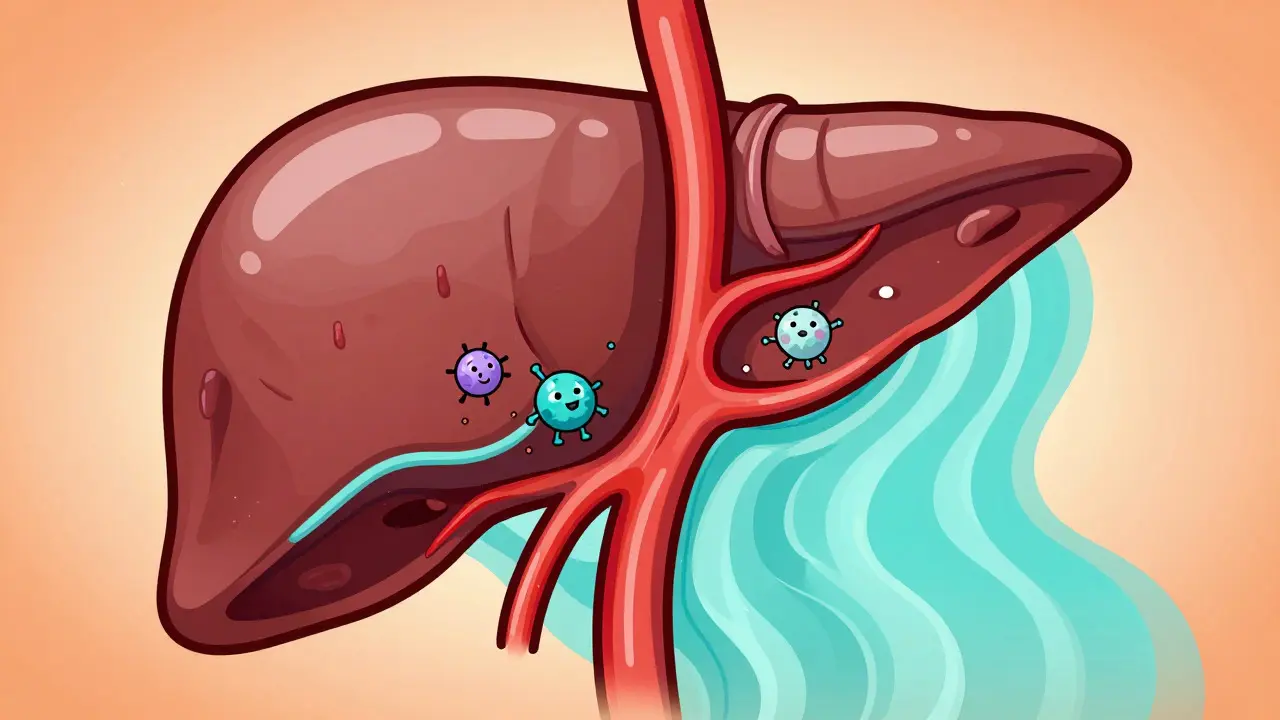
In the context of liver disease, these effects are crucial. Preclinical studies on cirrhotic rat models showed that simvastatin increased the expression of Kruppel-like factor 2 (KLF2) and nitric oxide in the liver's endothelial cells. What does that mean in plain English? It means the blood vessels inside the liver become more flexible and less resistant. A clinical study involving 30 patients with cirrhosis confirmed this. After taking 40 mg of oral simvastatin, participants saw a 14% decrease in hepatic vascular resistance and a 20% increase in hepatic blood flow within just 30 minutes. Better blood flow means less pressure building up in the portal vein, which is a major driver of complications like variceal bleeding.
| Factor | Risk Profile without Statins | Risk Profile with Statins |
|---|---|---|
| LDL Cholesterol | Elevated (25-60% higher) | Normalized or significantly reduced |
| Hepatic Vascular Resistance | Increased (contributes to portal hypertension) | Decreased (improved blood flow) |
| Variceal Bleeding Risk | Standard elevated risk due to coagulopathy | Reduced (HR 0.62 in recent studies) |
| Severe Hepatotoxicity | N/A (Baseline disease progression) | Extremely Rare (~0.001%) |
Choosing the Right Statin for Your Situation
Not all statins are metabolized the same way. If you have liver disease, the route of metabolism matters. Some statins rely heavily on the liver's CYP3A4 enzyme system, while others bypass it almost entirely. This distinction helps your doctor choose the safest option for your specific stage of disease.
- Pravastatin and Rosuvastatin: These are often preferred in liver disease because they undergo minimal CYP450 metabolism. They are excreted largely unchanged in the bile and urine, reducing the burden on hepatic enzymes.
- Atorvastatin and Simvastatin: These rely more on CYP3A4. While still generally safe, they require slightly more caution in advanced liver impairment due to potential interactions with other drugs processed by the same pathway.
- Fluvastatin: Metabolized via CYP2C9. Less commonly used as a first-line agent in complex liver cases but viable depending on the full medication profile.
The American Association for the Study of Liver Diseases (AASLD) 2022 guidance suggests starting with low-to-moderate intensity doses. For example, pravastatin 20-40 mg or rosuvastatin 5-10 mg. From there, the dose can be titrated up based on response and tolerance. You do not need to start at the highest dose to get benefit. In fact, a 2023 study in JAMA Network Open analyzed nearly 49,000 patients and found that even moderate-intensity use contributed to mortality reductions, though high-intensity therapy offered additional benefits for all-cause mortality (reducing it by 17%).
What About Advanced Cirrhosis?
This is where the conversation gets nuanced. For patients with compensated cirrhosis (Child-Pugh Class A or B), the evidence is strong. Statins are associated with a lower risk of decompensation, variceal bleeding, and death. A 2023 meta-analysis in Gastroenterology Research found that statins reduced the risk of hepatic decompensation by 22% and mortality by 26%. However, for patients with decompensated cirrhosis (Child-Pugh Class C), the picture is less clear. These patients often have significant coagulopathy (clotting issues) and malnutrition, which can alter how drugs are absorbed and processed.
Currently, there is no absolute contraindication for using statins in decompensated cirrhosis, but clinicians tend to be more conservative. The ongoing STATIN-CIRRHOSIS randomized controlled trial aims to provide definitive level 1 evidence for this specific group, with results expected in late 2025. Until then, the approach is usually individualized. If the cardiovascular risk is high-say, a previous heart attack or stroke-the benefit of the statin likely outweighs the theoretical risks, provided close monitoring is in place.
Monitoring and Practical Tips
One of the biggest changes in recent years is the move away from routine liver function testing. The American Heart Association advises against checking liver enzymes every few months just because you are on a statin. Instead, baseline tests should be obtained before starting treatment. After that, monitor only if symptoms arise, such as unusual fatigue, dark urine, or abdominal pain.
Here are some practical steps to ensure safety and efficacy:
- Review your full medication list. Polypharmacy is common in older adults with liver disease. Check for interactions, especially with drugs that also use the CYP3A4 pathway. Avoid grapefruit juice if you are on atorvastatin or simvastatin, as it inhibits the very enzyme needed to break down the statin.
- Watch for muscle symptoms. While liver injury is rare, myopathy (muscle pain or weakness) is the most common side effect reported by patients, affecting about 12% of users. If you experience unexplained muscle aches, report them immediately. It is rarely dangerous but requires dose adjustment or switching agents.
- Advocate for yourself. Surveys show that physician hesitancy remains a barrier. If your doctor refuses to prescribe a statin solely due to your liver diagnosis, ask them to review the 2018 AHA Scientific Statement or the 2022 AASLD guidance. Data speaks louder than anecdotal fear.

Patient Experiences and Real-World Outcomes
Clinical trials give us averages, but real life is messier. Online forums and patient communities offer valuable insights into what actually happens when people with liver disease take statins. On the American Liver Foundation's forum, 87% of 142 patients with CLD reported no liver-related side effects. Many noted improvements in energy levels, which they attributed to better cardiovascular efficiency rather than direct liver healing.
In discussions on r/liverdisease, 84% of participants with cirrhosis using statins experienced no adverse hepatic effects. Those who did report issues mostly described transient, mild elevations in liver enzymes that normalized without stopping the medication. One patient with NAFLD shared, "My liver numbers actually improved on atorvastatin." Another with compensated cirrhosis noted, "After starting rosuvastatin, my portal hypertension symptoms decreased significantly." These anecdotes align with the hemodynamic data showing improved blood flow. They remind us that for many, the statin becomes a tool for managing both their heart and their liver health simultaneously.
Frequently Asked Questions
Are statins safe for everyone with liver disease?
For most patients with stable chronic liver disease, including non-alcoholic fatty liver disease (NAFLD) and compensated cirrhosis, statins are considered safe and beneficial. However, patients with active acute liver failure or unexplained persistent transaminase elevations above three times the upper limit of normal should consult a specialist before starting. The decision is always individualized based on the severity of the liver condition and cardiovascular risk.
Which statin is best for someone with cirrhosis?
Rosuvastatin and Pravastatin are often preferred because they have minimal interaction with the liver's CYP450 enzyme system. This makes them safer options for patients whose liver metabolic capacity is compromised. Atorvastatin and Simvastatin are also used but may require closer monitoring due to their reliance on CYP3A4 metabolism.
Do I need regular liver function tests while taking a statin?
Routine monitoring is generally unnecessary according to current American Heart Association guidelines. Baseline liver function tests should be done before starting the medication. After that, tests are typically only required if you develop new symptoms like jaundice, dark urine, or severe fatigue, or if you are on multiple medications that affect the liver.
Can statins cause variceal bleeding?
Contrary to what one might assume given the anticoagulant nature of some liver conditions, statins are associated with a reduced risk of variceal bleeding. Studies suggest a hazard ratio of 0.62, meaning patients on statins had a 38% lower risk of this complication. This is likely due to the anti-inflammatory effects and improved vascular tone provided by the medication.
What if my doctor refuses to prescribe a statin due to my liver condition?
This is a common scenario driven by outdated information. Ask your doctor to review the 2018 AHA Scientific Statement or the 2022 AASLD guidance. You can also request a referral to a hepatologist or cardiologist who specializes in comorbid liver and heart disease. Bringing printed summaries of recent studies can sometimes help bridge the gap in understanding.