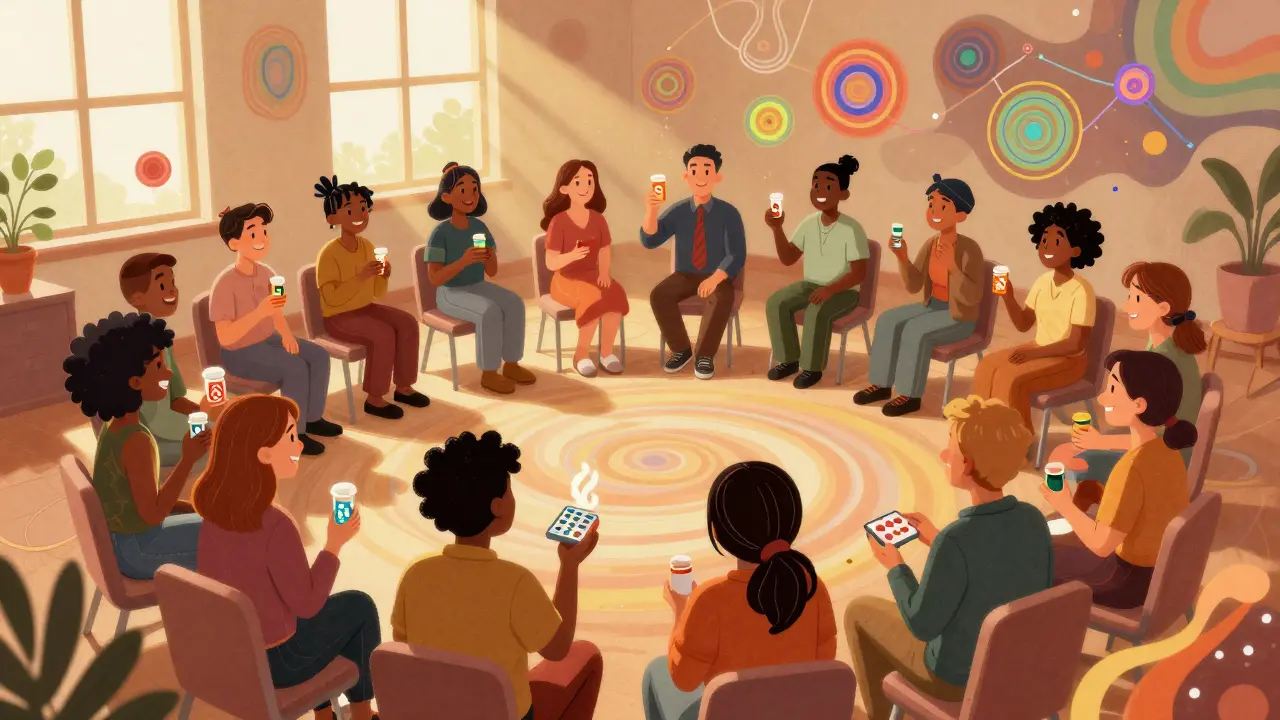
Half of all people taking medication for chronic conditions like diabetes, high blood pressure, or depression miss doses. Not because they don’t care. Not because they’re lazy. But because it’s hard. Life gets busy. Side effects creep in. Pills pile up. And without someone to remind you, listen to you, or walk beside you, it’s easy to fall off track. That’s where support groups and community programs come in-not as nice-to-have extras, but as proven tools that change outcomes.
Why Peer Support Works When Education Alone Fails
You’ve probably seen the brochures: "Take your pill every morning." "Don’t skip doses." "Call your doctor if you feel unwell." But studies show these simple reminders barely move the needle. A 2020 review in the Journal of Medical Care found that educational materials alone improved adherence by just 15%. Meanwhile, peer-led support groups boosted adherence by 40%-a difference that translates to fewer hospital visits, lower costs, and better quality of life.What’s the secret? It’s not just information. It’s connection. When someone who’s been there says, "I had the same side effects. I switched to taking it with food, and it stopped the nausea," that’s more powerful than a doctor’s pamphlet. People don’t just need to know what to do. They need to feel understood. Supported. Seen.
How These Programs Actually Work
Not all support programs are the same. There are three main types, each with different strengths:- Group meetings-Usually held weekly or biweekly in clinics, libraries, or community centers. Groups are small (8-12 people), led by trained peers who’ve managed their own condition for at least two years. These aren’t therapy sessions. They’re practical: "How do you remember your 10 pills?" "What worked when you got a new prescription?"
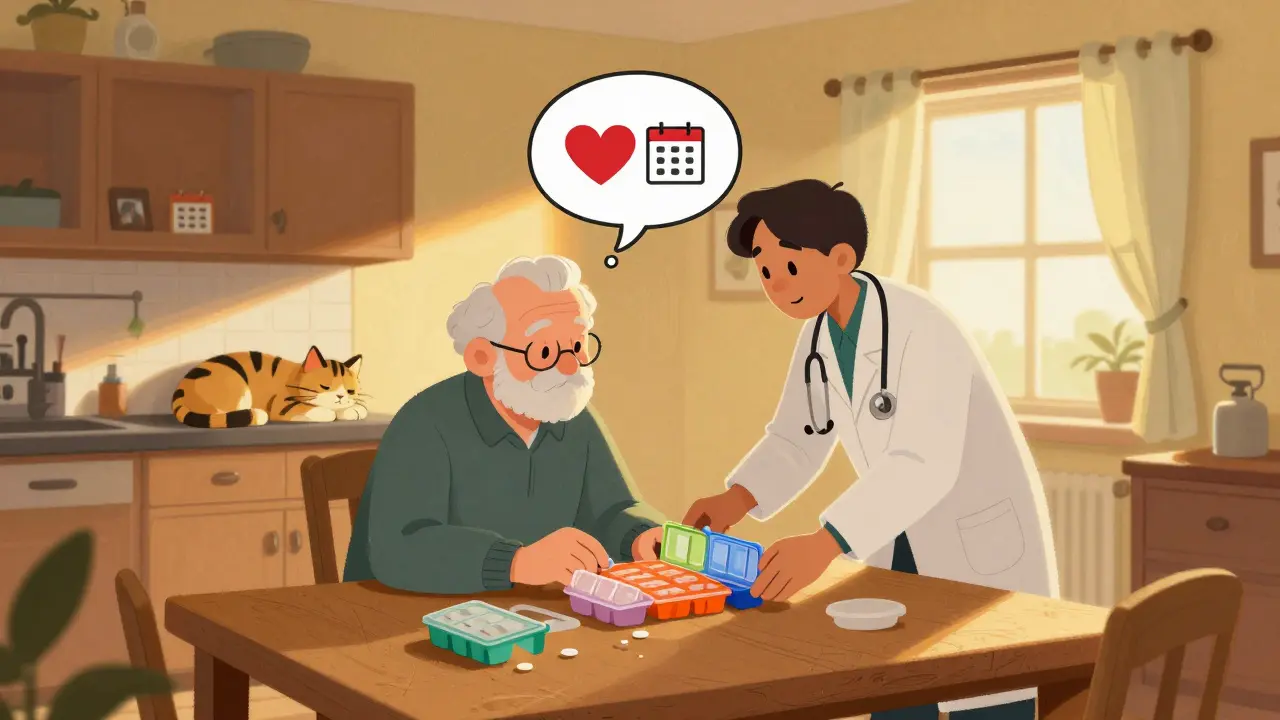
- Home visits by community health workers-Especially helpful for older adults or those with mobility issues. These workers come to your home, check in, help organize pills, and answer questions. A typical program lasts 3-6 months with 4-12 visits. One study found patients who received home visits were 30% less likely to be readmitted to the hospital.
- Digital peer platforms-Apps and online forums where people connect 24/7. Some, like the American Heart Association’s Heart360, pair users with certified peer mentors. Others, like PatientsLikeMe, let people share experiences anonymously. These work well for convenience but miss the emotional depth of face-to-face interaction.
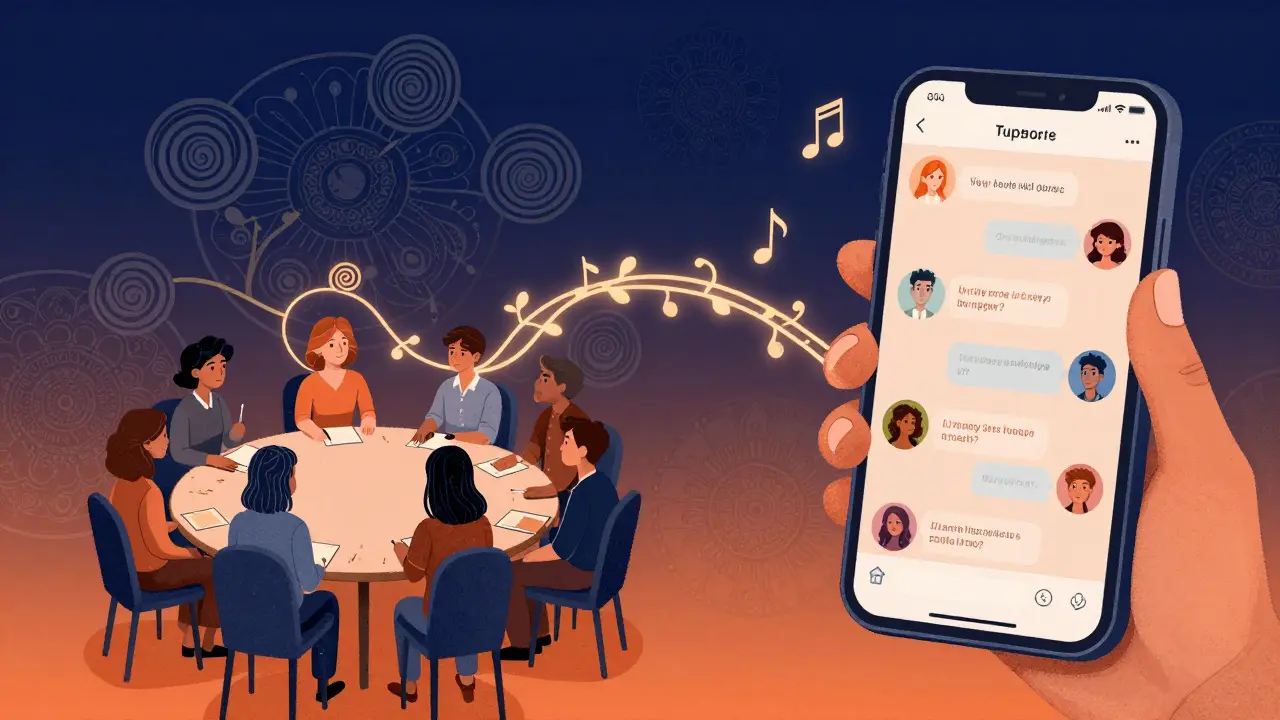
One of the most effective models? Hybrid. A 2023 study in Frontiers in Pharmacology showed that combining weekly in-person meetings with daily text reminders raised adherence rates by 34% in people with high blood pressure. The tech reminds you. The group keeps you accountable.
Who Benefits the Most
These programs don’t work equally for everyone-but they work best for people who feel isolated.People with mental health conditions, like depression or schizophrenia, often struggle with stigma. Support groups give them a safe space to talk openly. A 2022 survey of 12,450 users on PatientsLikeMe found 78% said their medication adherence improved after joining a condition-specific group. The top reason? "Hearing how others manage side effects."
Family involvement makes a huge difference too. A 2021 review of 14 studies showed that when a spouse, child, or parent helped remind someone to take pills, adherence jumped. Not because they nagged-but because they became part of the routine. "My daughter puts my pills in my lunchbox," one man shared. "Now I can’t leave without them."
But culture matters. A 2022 study in BMC Health Services Research found African American participants in hypertension groups were 35% more satisfied when facilitators shared their cultural background. Language, food, beliefs about medicine-all of it affects trust. Programs that hire bilingual staff or partner with local churches and community centers see higher participation.
The Hidden Costs of Doing Nothing
Medication non-adherence isn’t just a personal problem. It’s a $528 billion problem for the U.S. healthcare system every year. That’s more than the entire budget of the Department of Education. It shows up in emergency rooms, hospital readmissions, and avoidable complications.Here’s what happens when people stop taking their meds:
- Diabetes patients miss doses → higher A1c → nerve damage, kidney failure, amputations.
- Hypertension patients skip pills → spikes in blood pressure → stroke, heart attack.
- Psychiatric patients stop antipsychotics → relapse → hospitalization, homelessness.
Support programs cut those risks. The Veterans Health Administration, which runs peer support in 140 facilities, saw hospital readmissions drop by 25% in participants. Kaiser Permanente’s support groups reduced ER visits by 18%. For every dollar spent on these programs, studies show $18 in savings from avoided care.
What Makes a Program Actually Work
Not every group is created equal. Many fail because they skip the basics.Effective programs have:
- Trained facilitators-Not volunteers with good intentions. People who’ve completed at least 40 hours of training in active listening, medication knowledge, and cultural sensitivity. Programs with less than 20 hours of training were 37% less effective.
- Structured sessions-No rambling. Clear agendas: check-ins, topic discussion, problem-solving, action steps.
- Pharmacist involvement-73% of successful programs include a pharmacist. They can explain drug interactions, adjust timing, or help simplify regimens.
- Follow-up-Text reminders, phone check-ins, or home visits after the first month. Programs with follow-up saw 15% lower dropout rates.
And they track results. Only 38% of community programs use validated tools like the Morisky Medication Adherence Scale. That’s a problem. If you can’t measure it, you can’t improve it.
Where These Programs Fall Short
They’re not perfect. And they’re not everywhere.Rural areas have 47% fewer programs than cities. People in small towns often drive 50 miles to find a group. Some try to go virtual-but if you don’t have reliable internet or a smartphone, that doesn’t help.
Language is another barrier. Twenty-five percent of Americans have limited English proficiency. But only 22% of support programs offer materials or facilitators in Spanish, Mandarin, Vietnamese, or other languages.
And then there’s the timing. A 2021 survey from the National Alliance on Mental Illness found 42% of participants quit because meetings didn’t fit their schedule. A single mom working two jobs can’t make a 6 p.m. meeting. Flexibility matters.
Some people just don’t like groups. Twenty-nine percent said they felt uncomfortable sharing in front of others. That’s why hybrid models-mixing online forums with one-on-one check-ins-are gaining traction.
What You Can Do Right Now
If you or someone you care about is struggling to stay on track with meds:- Ask your doctor-Many clinics now partner with local support groups. Ask: "Do you have a medication adherence program?"
- Check with your pharmacy-Pharmacists are often trained in adherence counseling. Some even host small groups.
- Search online-Organizations like the American Heart Association, American Diabetes Association, and National Alliance on Mental Illness offer directories.
- Try a digital option-Apps like Medisafe or MyTherapy offer reminders and peer forums. They’re not a replacement for human connection, but they help fill the gap.
- Start small-If group settings feel overwhelming, find one person. A neighbor. A cousin. Someone who’ll text you: "Did you take your pill today?"
What’s Next
The future of medication adherence isn’t just about pills. It’s about people. CMS launched a $50 million program in 2023 to train community health workers to support dual-eligible Medicare/Medicaid patients. Medicare Advantage plans now cover adherence support in 63% of their offerings. And startups are building tech that connects patients to peer coaches in real time.But the core hasn’t changed. People stick with treatment when they feel supported. When they know they’re not alone. When someone says, "I’ve been there too."
Are support groups only for people with mental health conditions?
No. While mental health groups are common, support programs exist for almost every chronic condition: diabetes, heart disease, high blood pressure, asthma, HIV, epilepsy, and more. The goal is the same: help people stick to their treatment plan. Many programs are condition-specific, so you’ll find groups tailored to your diagnosis.
Do I need to pay to join a support group?
Most community-based programs are free. They’re funded by grants, nonprofits, hospitals, or government programs. Hospital-based groups might be covered under your insurance. Digital apps often have free versions with basic features. Be cautious of programs asking for monthly fees-legitimate peer support doesn’t charge participants.
Can I join a support group if I’m not sure I’m taking my meds correctly?
Yes. In fact, that’s exactly who these groups are for. People join because they’re confused, overwhelmed, or worried they’re doing it wrong. There’s no judgment. Facilitators help you understand your meds, sort out your pill organizer, and troubleshoot problems like side effects or cost barriers.
How long does it take to see results from a support group?
Many people notice improvements in 4-6 weeks. One study showed participants reduced missed doses by half within two months. Long-term adherence-sticking with it for over a year-requires ongoing participation. The strongest results come from people who stay involved for six months or more.
What if I don’t like the group I tried?
It’s okay to leave. Not every group is a fit. Try a different one. Maybe a different time of day. A different location. Or switch to a digital platform. Some people do better with one-on-one coaching than group settings. The key is to keep trying until you find the right support.
If you’re taking meds for a chronic condition, you’re not alone. And you don’t have to figure it out by yourself.

jared baker
March 19, 2026 AT 17:31Simple truth: taking meds is hard. Not because people are lazy. Because life is messy. A 60-year-old with diabetes and two jobs? They’re not forgetting pills on purpose. They’re drowning. Support groups don’t fix the system. But they give people a life raft. That’s enough.
And yeah - pharmacists should be in these groups. Not as experts. As teammates. They know what the pills do. And they know what the pills cost. That’s the real talk.
One study showed 73% of successful programs had a pharmacist. That’s not a bonus. That’s the baseline. Stop treating adherence like a personal failure. It’s a systems problem.
Also - digital apps help. But they’re not magic. A reminder doesn’t replace a human saying, "I did this too."
Bottom line: connection > education. Always.
David Robinson
March 21, 2026 AT 11:10Let’s be real - most of these programs are run by underpaid volunteers who got 20 hours of training and a clipboard. The ‘trained facilitators’? Half of them can’t tell the difference between a beta-blocker and a statin. I’ve been to three of these ‘peer support’ groups. Two were just gossip circles with a whiteboard. One had a guy who yelled at people for not taking their meds like they were bad kids.
And don’t get me started on the ‘hybrid model.’ Text reminders? My phone dies. My data’s slow. My mom’s phone is a flip phone. So now what? You’re telling me the solution is to buy a smartphone and a data plan? That’s not support. That’s a tech scam dressed up as compassion.
Here’s what actually works: free transportation. Free pills. Free meals. Not more meetings. Not more apps. Not more ‘peer mentors’ who’ve been on metformin for 3 years. We’re treating symptoms while the whole damn system is rotting.
And yes - $18 return on investment? That’s just the math. What about the human cost? The guy who lost his leg because he couldn’t get to the clinic? No one tracks that.
This isn’t about adherence. It’s about poverty. And we’re pretending we can fix it with group hugs.
Michelle Jackson
March 23, 2026 AT 00:37Oh wow. Another feel-good article about how we need more ‘connection’ to fix healthcare. How cute. Let’s all hold hands and sing Kumbaya while people die from uncontrolled hypertension.
Did you mention cost? No. Did you mention insurance? No. Did you mention how 40% of Americans can’t afford their prescriptions? No. You just want us to join a group and ‘feel seen.’
My aunt took her meds for 10 years. Then her insulin went from $30 to $400. She stopped. Not because she ‘fell off track.’ Because she had to choose between food and life.
Stop romanticizing peer support. It’s a Band-Aid on a hemorrhage. And you’re the one holding the Band-Aid.
Also - ‘bilingual staff’? Please. If you can’t afford to pay a pharmacist $50/hour, you can’t afford to hire someone who speaks Spanish. This is performative diversity with no funding.
I’m done. Let me know when you have a real solution. Not a pep rally.
Nicole Blain
March 24, 2026 AT 06:55❤️ I joined a diabetes group last year. I cried the first time someone said, ‘I skip my meds too.’ No one judged. No one preached. Just… yeah. Me too.
Now I take my pills after coffee. My group taught me that. Not my doctor.
Still not perfect. Still hard. But I’m not alone anymore. That’s everything.
Amadi Kenneth
March 25, 2026 AT 19:40You think this is about meds? Nah. This is about control. The system wants you to think you’re failing - so you’ll keep coming back for ‘support.’ Meanwhile, the pharmaceutical companies are raking in billions while you’re stuck in a circle of ‘how do I remember my pills?’
Why don’t they just lower the prices? Why don’t they make one pill a day? Why don’t they fix the system? Because then they’d lose money.
And those ‘trained facilitators’? Half of them are ex-pharma reps in disguise. They’re gathering data. They’re tracking who skips. They’re feeding it to insurers.
I’ve seen it. I’ve been in those rooms. They ask about your job. Your income. Your family. Then suddenly - your premiums go up.
Don’t be fooled. This isn’t help. It’s surveillance with a smile.
And don’t tell me ‘it’s free.’ Everything has a price.
Wake up.
They’re not here to save you. They’re here to manage you.
Nilesh Khedekar
March 25, 2026 AT 20:12Bro i been takin my meds for 5 yrs now. My group? We meet at the mosque. We eat samosas. We talk about how the pills make us sleepy. We swap tips. One guy says he puts his in his shoe so he remembers. LOL.
My doc? He says ‘take it daily.’
My group? They say ‘hey man, i got a new script - try it with yogurt.’
That’s the difference.
Also - no one in my group has a smartphone. We use paper calendars. And it works. So stop actin like tech is the answer. Real life ain’t an app.
gemeika hernandez
March 25, 2026 AT 20:53Oh my god. I’ve been in 7 different support groups. I’ve been the ‘quiet one.’ I’ve been the ‘over-sharer.’ I’ve been the one who cried because I couldn’t afford my pills.
Let me tell you what no one says: some people just can’t be in groups. I tried. I felt judged. Like I was a problem to be fixed. So I left.
Then I found one person. Just one. My neighbor. She texts me every morning. ‘Pill?’ I say ‘yes.’ She says ‘good.’ That’s it.
That’s all I needed.
Not a group. Not a program. Not a facilitator.
One person who shows up.
And if you’re reading this and you’re struggling? Find your one person. It doesn’t have to be perfect. Just be there.
Prathamesh Ghodke
March 26, 2026 AT 02:23Here’s the thing nobody talks about: most of these programs are designed for people who already have a safety net.
What about the single mom working two shifts? The undocumented immigrant? The guy living in his car?
They don’t have time for weekly meetings. They don’t have internet. They don’t have a phone that works. They don’t have transportation.
So we give them a pamphlet. And a smile. And call it ‘adherence support.’
It’s not that they don’t care. It’s that the system doesn’t care enough to meet them where they are.
Real support? It’s not a group. It’s a ride to the pharmacy. It’s a free pill organizer. It’s a worker who shows up at 7 a.m. because you work nights.
Stop romanticizing. Start showing up.
Stephen Habegger
March 26, 2026 AT 18:59Just wanted to say - this stuff works. I’ve seen it. My dad had heart failure. He was skipping meds. Then he joined a group. Not because he ‘needed connection.’ Because he got a free ride to the clinic, and someone asked him how his week went.
He’s alive today. Not because of tech. Not because of education. Because someone remembered his name.
That’s the magic. Not the program. The person.
Justin Archuletta
March 28, 2026 AT 01:55YESSSS!!! I’ve been doing this for 2 years now. My group meets at the library. We bring snacks. We vent. We laugh. We cry. We help each other figure out how to afford our meds. One lady taught me how to use a pill organizer. Another got me a discount card.
It’s not perfect. But it’s real.
And yeah - the pharmacist who came in? She changed my life. She told me my pills could be cheaper if I switched brands. I saved $200/month.
Stop making it complicated. Just help people. One at a time.
Aileen Nasywa Shabira
March 28, 2026 AT 02:27Oh wow. Another ‘magic bullet’ article. Let me guess - you’re one of those people who thinks ‘community’ is the answer to capitalism’s failures?
Let me tell you what’s really happening: hospitals and insurers are outsourcing their responsibility. Instead of paying for meds, they’re asking volunteers to ‘remind’ people. Instead of fixing the system, they’re creating a new class of unpaid healthcare workers.
And you call this ‘progress’?
It’s not ‘peer support.’ It’s exploitation with a heart emoji.
Also - 34% adherence increase? That’s not a miracle. That’s still 66% of people failing. So what’s Plan B? More groups? More texts? More guilt?
Wake up. This isn’t a solution. It’s a distraction.
Kathy Underhill
March 30, 2026 AT 00:07People stick with treatment when they feel seen.
Not when they’re lectured.
Not when they’re reminded.
Not when they’re tracked.
When someone says, ‘I’ve been there.’
That’s the moment.
Not the program.
Not the app.
Not the facilitator.
Just a human voice.
That’s all it takes.
Linda Olsson
March 30, 2026 AT 07:11Let’s be honest - most of these ‘support groups’ are just glorified church groups with a clipboard. You think the ‘bilingual staff’ really care? Or are they just checking off a diversity box?
And why are we so obsessed with ‘peer-led’? Why not let the doctors lead? They’re trained. They’re licensed. They’re paid to know this stuff.
Peer support sounds nice. But it’s not science. It’s sentiment.
And don’t get me started on the ‘hybrid model.’ You can’t replace human connection with a text message. That’s like saying a video call is the same as a hug.
This isn’t innovation. It’s wishful thinking wrapped in jargon.
David Robinson
April 1, 2026 AT 06:26Reply to 8121: You’re right. But you’re also naive.
People don’t just need to be seen.
They need to be fed. To be housed. To be paid. To be free.
One human voice won’t fix a system that charges $1,200 for a month of insulin.
So yes - a kind word helps.
But it doesn’t fix the machine that’s crushing them.