When you pick up a prescription for generic metformin or ibuprofen, you probably don’t think about who moved it from the factory to your pharmacy. But behind every cheap pill is a complex, high-stakes economic system-where a few giant companies control the flow of medicine, and profits don’t always go where you’d expect.
The Three-Tier System That Runs Your Medicines
The U.S. generic drug supply chain isn’t a straight line. It’s a three-layer system: manufacturers make the pills, wholesalers move them, and pharmacies sell them. This structure was formalized in 1987 by the Prescription Drug Marketing Act, but its real power lies in how it shapes profits.Here’s the twist: generic drugs make up 90% of prescriptions filled in the U.S., but only about 15% of total drug spending. Yet, they’re the biggest profit engine for wholesalers. In 2009, generics generated just 9% of wholesale revenue-but 56% of their gross profits. That’s because manufacturers sell generics at rock-bottom prices to win contracts, leaving wholesalers with room to mark up margins.
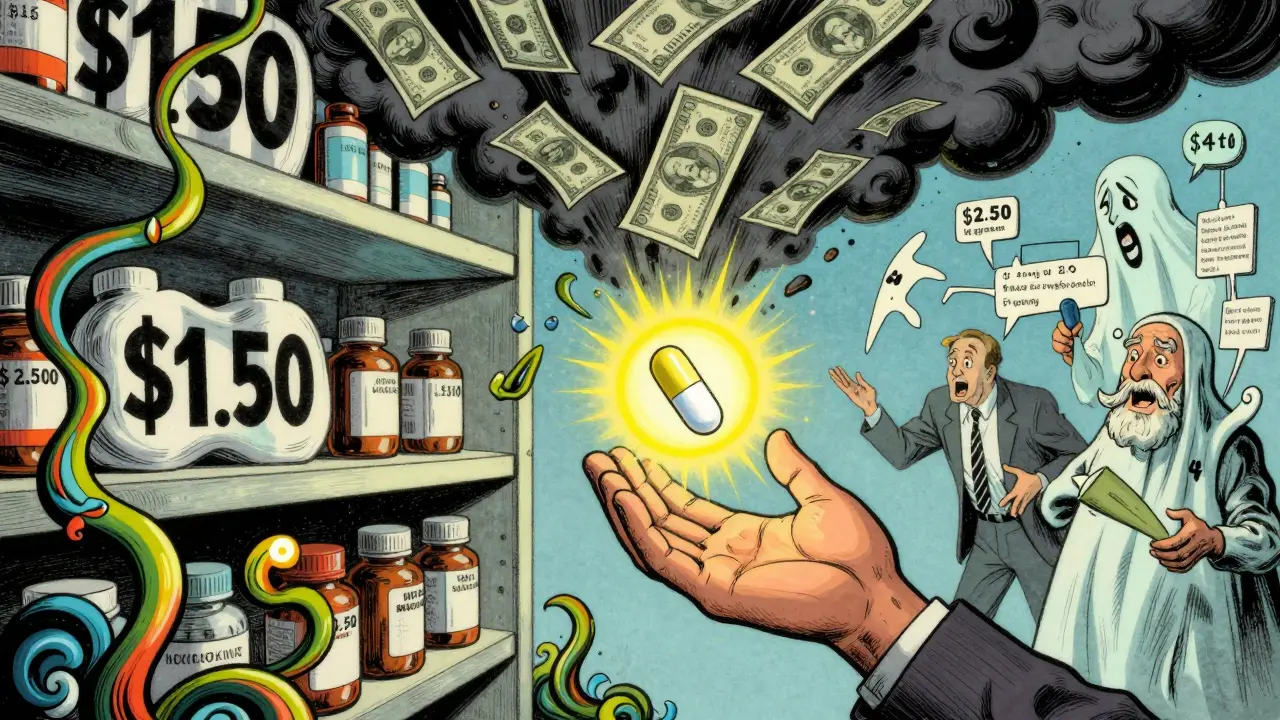
Think of it this way: a manufacturer might sell a bottle of 100 generic 10mg lisinopril tablets for $1.50. The wholesaler buys it, adds a few cents for handling and shipping, then sells it to a pharmacy for $2.50. The pharmacy then sells it to you for $4. The manufacturer’s gross margin? Around 49.8%. The wholesaler’s? Less than 1%. But here’s the catch: they sell millions of these bottles. And on each dollar spent on generics, wholesalers make eleven times more profit than they do on brand-name drugs.
Why Wholesalers Profit More on Generics
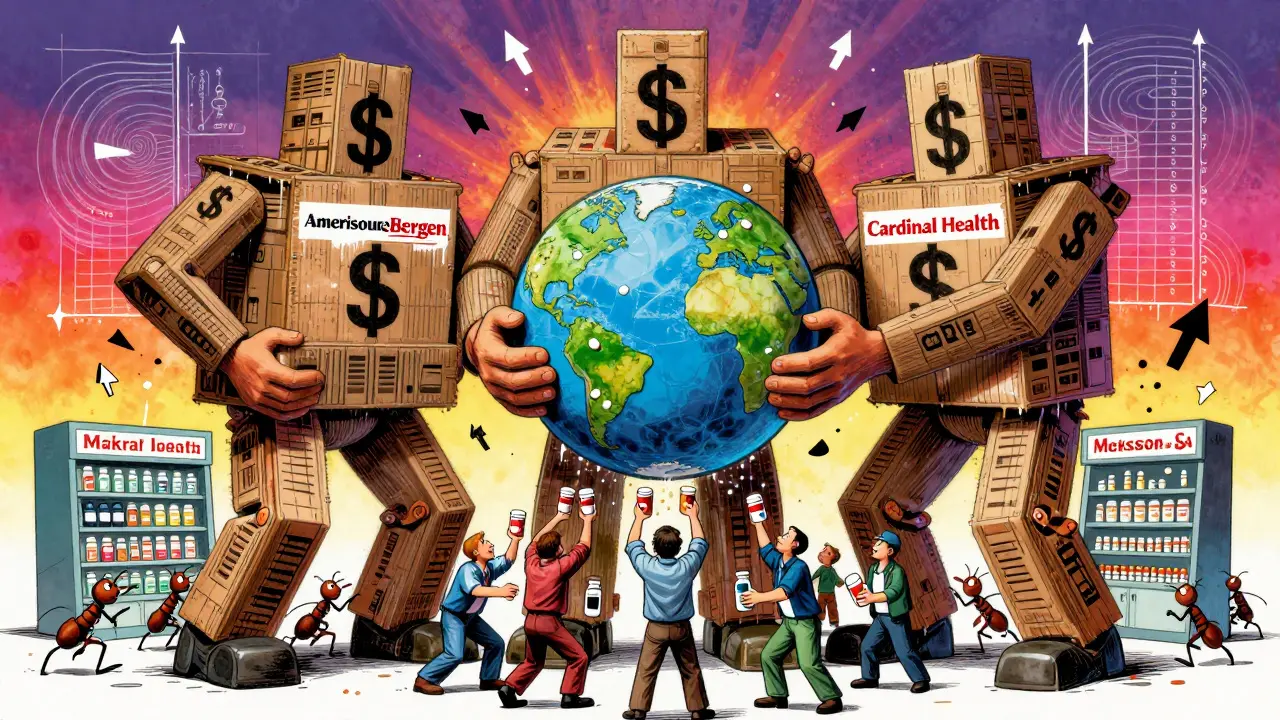
It’s not about the price. It’s about control.The three big players-AmerisourceBergen, Cardinal Health, and McKesson-control 85% of the U.S. pharmaceutical wholesale market. That kind of dominance gives them massive leverage. When a generic drug comes to market, dozens of manufacturers compete to supply it. The wholesalers pick the lowest bidder. That drives manufacturer margins down to near-zero. But because wholesalers buy in bulk and have exclusive contracts with pharmacies, they hold all the cards.
Unlike branded drugs, where manufacturers spend billions on marketing and patents, generics have no advertising, no exclusivity, no R&D costs. The only thing that matters is price. And that’s where wholesalers win. They don’t need high per-unit margins. They need volume. And they get it.
Compare that to branded drugs: manufacturers make $58 in gross profit per unit, while wholesalers make just $3. But on generics, the numbers flip. Wholesalers make $32 per unit. Pharmacies make $32. The manufacturer? Only $18. The system is designed so that the middlemen-those who move the drugs-capture most of the value, not the ones who make them.
How Pricing Actually Works Behind the Scenes
Wholesalers don’t just slap a markup on the price. They use four main strategies, and one dominates: tiered pricing.Let’s say a generic antibiotic costs $10 per unit to produce. The wholesaler might charge $10 for orders under 100 units. But if a pharmacy orders 100-500 units, the price drops to $8. If they order over 500, it’s $6.50. That’s not generosity. It’s a trap. Pharmacies are forced to buy in bulk to get the discount, tying up cash and warehouse space. The wholesaler, meanwhile, moves inventory faster and reduces storage costs per unit.
Shipping costs are baked in, too. If the drug costs $10 and shipping adds $2 per unit, the wholesaler won’t sell for $12 unless they’re sure they’ll move it quickly. Otherwise, they’ll price it higher to cover the risk of slow turnover.
Cost-plus pricing (cost + fixed profit) is common for niche generics. Market-based pricing means matching competitors-especially when multiple manufacturers are flooding the market. Value-based pricing? Rare. There’s no “value” in a generic pill. It’s chemically identical to the brand. So pricing is almost always about volume, speed, and scale.
The Inflation-Deflation Rollercoaster
Generic drug prices aren’t stable. They swing wildly based on supply.During the pandemic in 2020, raw material shortages and factory shutdowns caused prices to spike. Then, in 2021 and 2022, the market flooded with new manufacturers. Prices collapsed. A drug that cost $50 a bottle in 2020 might drop to $8 by 2022.
But in 2023, things changed again. Drug shortages returned-especially for antibiotics, injectables, and blood pressure meds. Why? Because when prices drop too low, manufacturers stop making the drug. It’s not profitable. So production stops. Then demand outstrips supply. Prices jump.
This cycle repeats. When prices are too low, supply vanishes. When prices rise, new manufacturers enter. Then they undercut each other. The result? A market that’s constantly in flux. And pharmacies? They’re stuck in the middle, scrambling to keep shelves stocked without going bankrupt.
Who Really Benefits-and Who Gets Left Behind
The system works brilliantly for wholesalers. They make more money on generics than on branded drugs, even though the drugs cost less. They have scale, contracts, and control over distribution networks.Manufacturers? They’re squeezed. The profit margin on generics is 49.8%-half of what they make on branded drugs. But they can’t raise prices. If they do, pharmacies switch to another supplier. So they compete on cost, not quality.
Pharmacies make big margins too-up to 42.7% on generics. But they’re dependent on wholesalers. If a wholesaler delays a shipment or raises prices suddenly, the pharmacy can’t easily switch. The Big Three have exclusive deals. Smaller distributors can’t compete on volume.
Patients? They pay the least per pill-but the system adds up. A single generic prescription might cost $4. But multiply that by 4 billion prescriptions a year in the U.S., and you’re talking about hundreds of billions flowing through this system. And most of it doesn’t go to the people who make the medicine.
The Future: More Scrutiny, More Pressure
Regulators are starting to pay attention. The Commonwealth Fund warned in 2022 that wholesalers influence drug shortages, set prices behind closed doors, and benefit from list-price inflation-even on generics. Policymakers are asking: Why do middlemen make eleven times more profit on generics than manufacturers?Some states are exploring direct manufacturer-to-pharmacy distribution to cut out wholesalers. Others are pushing for price transparency laws. But the Big Three have deep pockets and political influence. Change won’t come fast.
One thing is clear: the current model rewards volume over fairness. It works because no one sees the full picture. You see a $3 pill. But behind it? A billion-dollar game of supply, scale, and silent control.
Until the system is forced to open up, the cheapest drugs won’t mean cheaper care. They’ll just mean bigger profits for those who move them-not make them.
![Quibron‑T (Theophylline) Uses, Dosage, Side Effects, Interactions [2025 Guide]](/uploads/2025/09/thumbnail-quibron-t-theophylline-uses-dosage-side-effects-interactions-2025-guide.webp)


Jacob Cathro
January 19, 2026 AT 13:06bro this system is straight up rigged. wholesalers are just sitting there like vultures, making 11x more profit on generics than the actual manufacturers? that’s not capitalism, that’s feudalism with pill bottles. 😭
Paul Barnes
January 19, 2026 AT 23:39The structural inefficiencies in the pharmaceutical supply chain are well-documented, yet regulatory intervention remains minimal due to entrenched lobbying interests. The profit distribution asymmetry between manufacturers and distributors is statistically significant and ethically indefensible.
pragya mishra
January 20, 2026 AT 05:30Why are we letting American companies control medicine like this? In India, we have 500+ generic manufacturers competing-prices are lower, access is better. This monopoly is pure exploitation. Fix it or we will.
kumar kc
January 21, 2026 AT 13:18Manufacturers get squeezed. Wholesalers win. Patients pay less. System works.
Thomas Varner
January 23, 2026 AT 09:22Okay, so let me get this straight… the people who actually make the pills make barely anything, but the middlemen-who just… move them-make 11x more? Like, what?!!?? That’s insane. I mean, I knew it was weird, but this? This is like paying a guy $500 to carry a sandwich from one room to another. And the sandwich is $1. 😅
Art Gar
January 25, 2026 AT 05:58One must consider the historical context of the Prescription Drug Marketing Act of 1987, which was designed to ensure supply chain integrity, not to optimize profit distribution. The current outcome, while economically efficient for distributors, may not align with public health imperatives.
Carolyn Rose Meszaros
January 25, 2026 AT 23:00This made me so mad but also so curious 😔 I had no idea the system worked like this. I just thought generics were cheap because they’re ‘copycats’… but now I see it’s like a rigged game. Who even profits from this? 🤔
Renee Stringer
January 26, 2026 AT 02:37The lack of transparency is troubling. If patients knew how little manufacturers earned, would they still accept this as normal?
Manoj Kumar Billigunta
January 26, 2026 AT 17:06It’s not just about money-it’s about access. When manufacturers can’t make a living making generics, they stop. Then people can’t get their blood pressure meds. We need to fix this so no one has to choose between rent and medicine.
Andy Thompson
January 28, 2026 AT 10:06Big Pharma + Big Wholesalers = One big cartel. You think this is coincidence? Nah. This is how they control the whole system. And now they’re pushing ‘drug pricing reform’ to look good while keeping the profits. #DeepStatePharma 🇺🇸💊
sagar sanadi
January 29, 2026 AT 23:48So the guy who makes the pill gets $18, the guy who moves it gets $32… and the guy who sells it gets $32? Cool. So the pharmacy is just a vending machine. Who’s the real boss? The guy who owns the vending machine? Or the guy who owns the vending machine company? 🤷♂️
Shane McGriff
January 31, 2026 AT 05:58Man, I’ve been on metformin for years and never thought about this. It’s wild how something so simple-like a pill-has this whole invisible economy behind it. Makes you wonder what else we’re not seeing.
Edith Brederode
January 31, 2026 AT 18:28This is so eye-opening 💗 I’m gonna share this with my mom-she’s on 6 generics and always complains about ‘price hikes.’ Now I know why. Thanks for explaining it so clearly.
clifford hoang
February 1, 2026 AT 08:50Think about it… what if the wholesalers are just front companies for the same people who own the manufacturers? What if McKesson, Cardinal, and AmerisourceBergen are all owned by the same hedge fund? What if this whole ‘competition’ is fake? 🤫 The real profit isn’t in the markup-it’s in the consolidation. They’re not just moving pills… they’re controlling the entire medical supply chain like a puppet show. And you’re all just watching the strings move. 🎭
Arlene Mathison
February 3, 2026 AT 01:11Let’s not forget: this is why we need community pharmacies to push back. Local pharmacists are the real heroes-they fight the system daily to keep meds affordable. Support your local pharmacy. They’re the last line of defense. 💪💊