
It’s not just about getting drunk. Mixing alcohol with your prescription meds can quietly turn a routine night into a medical emergency - even if you only have one drink. You might think it’s harmless, especially if your doctor never warned you. But the truth is, alcohol and prescription drugs can team up in ways that are deadly, and most people have no idea how common or dangerous it really is.
How Alcohol Changes Your Medicines
Alcohol doesn’t just make you sleepy or clumsy. It changes how your body handles medications - sometimes making them stronger, sometimes weaker, and sometimes turning them into toxins. There are two main ways this happens.
First, alcohol messes with your liver. That’s where most drugs and alcohol get broken down. When you drink regularly, your liver starts producing more of a specific enzyme called CYP2E1. This speeds up how fast some drugs leave your body. For example, if you’re on propranolol for high blood pressure, drinking more than 7 drinks a week can knock its effectiveness down by 30-50%. That means your blood pressure isn’t controlled - and you don’t even know it.
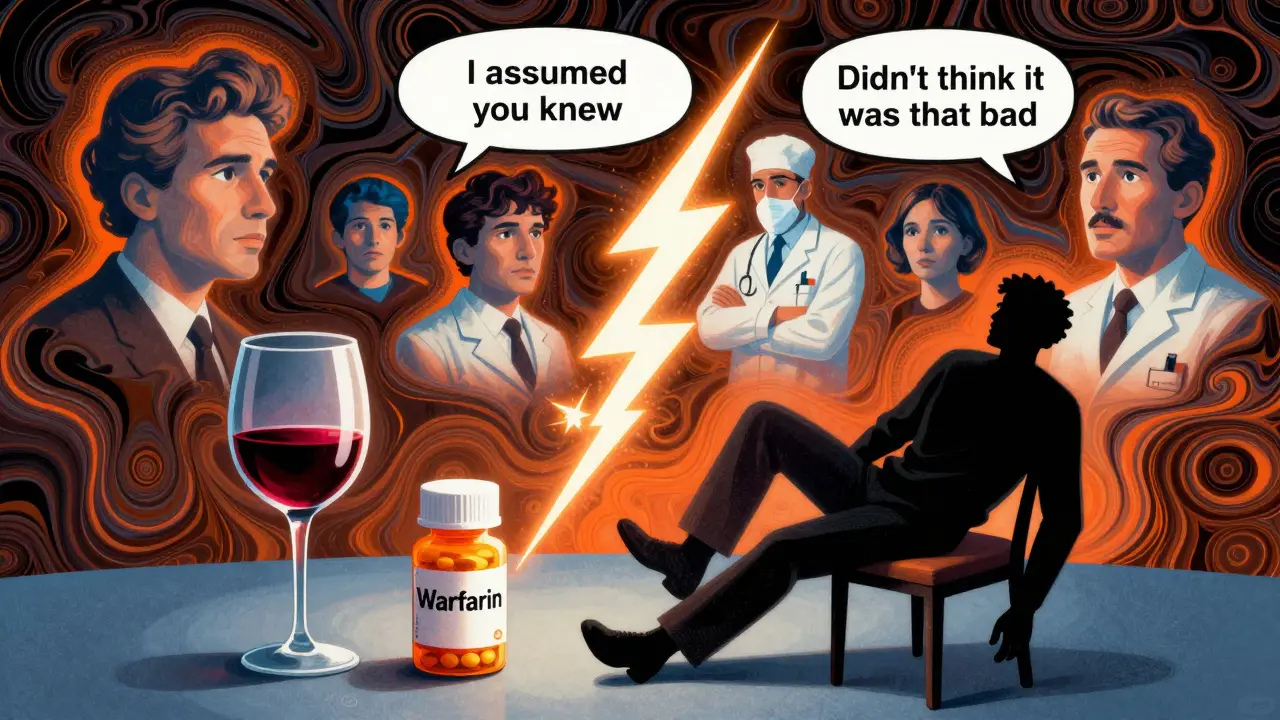
On the flip side, if you drink just once - say, a glass of wine with dinner - your liver gets overwhelmed. It can’t process the drug fast enough. That causes the drug to build up in your blood. Warfarin, a blood thinner, can spike by up to 35% after just one drink. That raises your risk of bleeding, even from a minor bump or cut.
The second way alcohol interferes is by amplifying the drug’s effect on your brain. This is especially dangerous with anything that slows down your nervous system - like painkillers, anxiety meds, or sleep aids. Alcohol and these drugs both act as depressants. Together, they don’t just add up - they multiply.
The Deadliest Combinations
Some combinations are so risky that even one drink can be life-threatening.
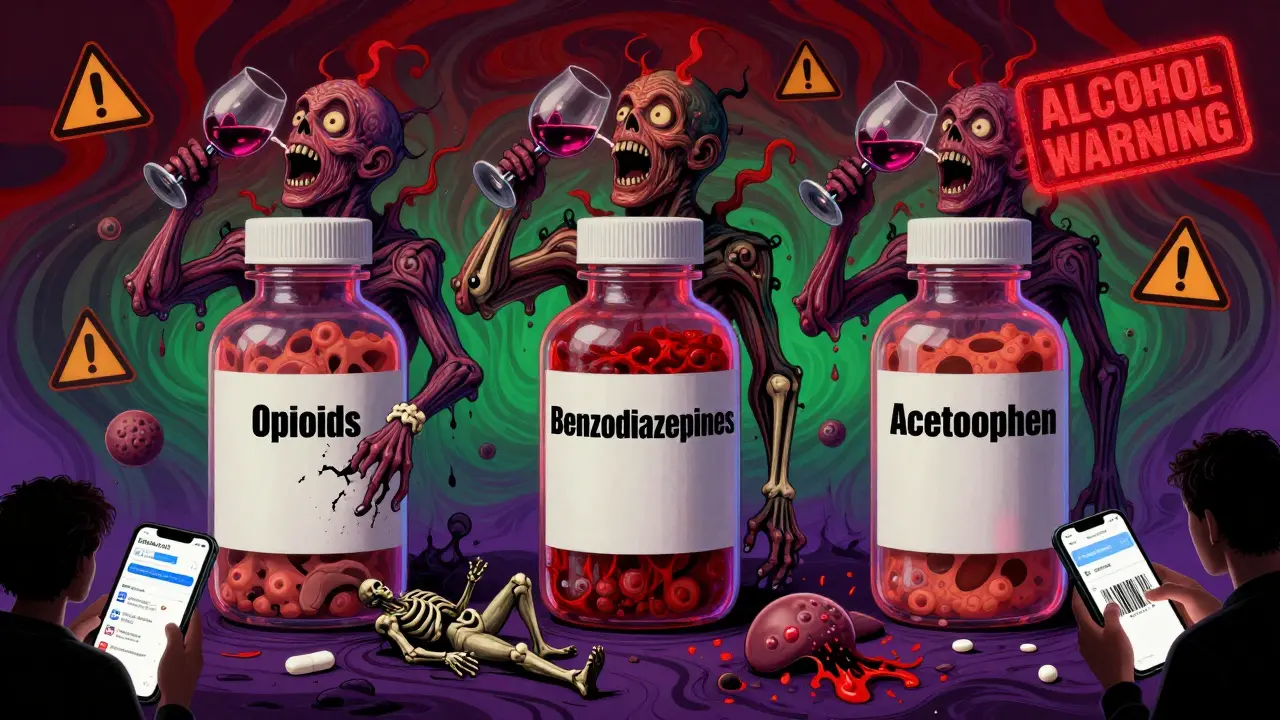
Opioids - like oxycodone, hydrocodone, or codeine - are the most dangerous when mixed with alcohol. The CDC found that alcohol-opioid combinations caused over 2,300 overdose deaths in 2022. One drink can double your risk of a fatal crash or breathing failure. It doesn’t matter if you’re taking your dose as prescribed. The alcohol turns a safe dose into a dangerous one.
Benzodiazepines - such as Xanax, Valium, or Ativan - are next on the list. These are often prescribed for anxiety or insomnia. Alcohol makes them work 400% harder. That means extreme drowsiness, confusion, loss of coordination, and sometimes total respiratory failure. In older adults, this combo increases the chance of a fall by 50%. One study found that 78% of falls in nursing homes involving sedatives happened in people who’d had alcohol within six hours.
Acetaminophen - the active ingredient in Tylenol - is another silent killer. If you drink regularly and take acetaminophen, even at normal doses, you’re putting serious stress on your liver. The FDA says 1 in 200 regular drinkers who take acetaminophen end up with acute liver failure. That’s not rare. That’s predictable.
NSAIDs - like ibuprofen or naproxen - may seem harmless, but with alcohol, they can cause severe stomach bleeding. A study of 200,000 patients showed that heavy drinkers (three or more drinks a day) who took NSAIDs had a 300% higher risk of internal bleeding. That’s not just an upset stomach - it’s hospital-level damage.
Who’s at Highest Risk?
It’s not just about how much you drink. Who you are matters too.
People over 65 are 3.2 times more likely to have a severe reaction. Why? Their livers don’t process alcohol or drugs as quickly. Their bodies have less water, so alcohol stays concentrated longer. Many seniors take multiple prescriptions - and don’t realize how many of them clash with alcohol.
Women are 20% more vulnerable than men. Even if they weigh the same, women have less body water. That means alcohol hits harder and faster. A woman who drinks one glass of wine with her blood pressure pill might feel dizzy - while a man with the same dose feels nothing.
If you have liver disease, your risk skyrockets. Even small amounts of alcohol with acetaminophen or certain antibiotics can cause rapid liver failure. People with depression or anxiety are also at higher risk - because they’re more likely to be on SSRIs or benzodiazepines, which already cause drowsiness. Add alcohol, and you’re looking at severe dizziness, poor judgment, and a 35% chance of falling.
What About ‘Safe’ Medications?
Some people think, ‘My antibiotic is fine with alcohol.’ That’s a myth.
Amoxicillin? Yes, it’s mostly safe. But isoniazid - used for tuberculosis - can cause liver damage in 15% of people who drink while taking it. Even if your doctor says it’s okay, don’t assume.
Some medications have no clear warning, but still cause problems. Beta-blockers for heart conditions can drop your blood pressure too far when mixed with alcohol. You might feel faint, dizzy, or pass out. Calcium channel blockers can do the same. You might not realize it’s the alcohol until you’re already on the floor.
And don’t forget about antidepressants. SSRIs like sertraline or fluoxetine don’t cause liver damage, but they make you sleepy. Alcohol makes that worse. A clinical pharmacist study found 35% of patients over 65 who drank even one drink a day with their SSRI felt so drowsy they nearly fell. That’s not ‘just tired’ - that’s a fall waiting to happen.
Why Don’t Doctors Tell You?
Here’s the uncomfortable truth: most patients aren’t warned.
A survey of over 12,000 patients found that 68% were never told alcohol could interact with their benzodiazepines. Another study showed only 38% of prescriptions for anxiety meds had clear alcohol warnings on the label. Many doctors assume patients know. Or they forget. Or they think, ‘They won’t drink anyway.’
And it’s not just doctors. Pharmacists are often the last line of defense - but even they’re stretched thin. In private practices, only 32% have systems in place to screen for alcohol-drug interactions. At VA hospitals? 89%. That’s a huge gap.
One patient in a Walgreens review said her pharmacist refused to fill her lorazepam prescription because she admitted to drinking. She didn’t understand why - until she found out later that the combo could stop her breathing. She called it ‘probably saved my life.’
What You Can Do Right Now
You don’t need to be a doctor to protect yourself. Here’s what works:
- Check the label. Look for the word ‘alcohol’ on your prescription bottle. If it’s not there, don’t assume it’s safe. Many high-risk meds still don’t have warnings.
- Ask your pharmacist. They’re trained to catch these interactions. Use the four-question screening tool: ‘Do you drink alcohol? How often? How much? Are you taking any other meds?’
- Use a free app. The NIAAA’s ‘Alcohol Medication Check’ app lets you scan your prescription barcode and instantly see if alcohol is risky with that drug. It covers over 2,300 medications.
- Look for color codes. Some pharmacies now use red, yellow, green labels. Red = don’t drink. Yellow = talk to your doctor. Green = probably safe. Ask if your pharmacy uses them.
It takes 15 to 20 minutes of real conversation to understand your risk. Don’t let it be a 30-second refill. Push for time. Bring a list of everything you take - including supplements and over-the-counter pills.
What’s Changing?
There’s real progress. In 2022, a new law required ‘ALCOHOL WARNING’ labels on high-risk prescriptions. That affects 147 million prescriptions a year. Hospitals are using AI tools that flag dangerous combos in real time. Epic Systems’ system, launched in 2024, predicts your personal risk with 89% accuracy by analyzing your age, weight, liver function, and drinking habits.
Forty-two states now require doctors to take continuing education on alcohol-drug interactions to keep their license. The CDC’s goal? Cut overdose deaths from this cause by 50% by 2025.
But here’s the catch: even with all this, only 28% of high-risk patients actually stop drinking. Why? Because they don’t believe it applies to them. Or they think ‘one drink won’t hurt.’ Or they’re afraid to ask.
Final Reality Check
Alcohol isn’t the enemy. But pretending it’s harmless with your meds is dangerous. You don’t have to quit drinking forever. But if you’re on opioids, benzodiazepines, acetaminophen, or blood thinners - skip it. No exceptions.
If you’re on a beta-blocker, NSAID, or antidepressant? Talk to your pharmacist. Don’t guess. Don’t assume. Don’t wait until you’re dizzy on the bathroom floor.
One drink might seem small. But with the wrong drug, it’s not a drink. It’s a trigger.
Can I have one drink with my prescription medication?
It depends on the medication. With opioids or benzodiazepines, even one drink can be deadly. With blood thinners like warfarin, it can cause dangerous bleeding. With acetaminophen, it raises your risk of liver failure. For some medications like amoxicillin, one drink is likely safe - but you shouldn’t assume. Always check with your pharmacist. The only way to be sure is to ask.
Why didn’t my doctor warn me about alcohol?
Many doctors don’t bring it up because they assume patients know, or they’re pressed for time. Studies show 68% of patients prescribed benzodiazepines weren’t warned about alcohol. Only 38% of prescriptions carry clear alcohol warnings. It’s not your fault - it’s a system failure. That’s why you need to ask. Don’t wait for them to tell you.
Is it safe to drink on weekends if I take medication weekdays?
No. Many medications build up in your system and stay active for days. For example, warfarin’s effects last for days after you take it. Alcohol on the weekend can still interfere. Even if you don’t take your pill on Saturday, the drug is still in your blood. The risk isn’t about timing - it’s about whether the drug and alcohol are both present in your body at the same time.
Can alcohol make my medication less effective?
Yes. Chronic drinking - more than 14 drinks a week for men or 7 for women - can make your liver break down some drugs too fast. This lowers their effectiveness. Propranolol, for example, can lose 30-50% of its power if you drink regularly. That means your blood pressure or heart rate isn’t controlled, even if you’re taking your pill every day.
What should I do if I already mixed alcohol and medication?
If you feel dizzy, confused, have trouble breathing, or feel like you might pass out - call emergency services immediately. Don’t wait. If you feel fine but are worried, contact your pharmacist or doctor right away. Bring the name of the medication and how much alcohol you drank. They can tell you if you’re at risk. Better safe than sorry.
Are there apps that can help me check for interactions?
Yes. The National Institute on Alcohol Abuse and Alcoholism (NIAAA) offers a free app called ‘Alcohol Medication Check.’ You can scan your prescription barcode and get an instant risk assessment. It covers over 2,300 medications. Other apps like GoodRx and Medscape also have interaction checkers - but NIAAA’s is the only one designed specifically for alcohol-drug risks and backed by federal health data.
shivam utkresth
January 25, 2026 AT 17:34Man, this hit different coming from India where everyone just sips chai with their pills and calls it a day. I had a cousin mix whiskey with his blood thinner and ended up in ICU for a week. No one told him it was dangerous - just ‘oh, it’s just one drink.’ The system here doesn’t even flag these combos. We need apps like NIAAA’s to be mandatory in every pharmacy. Seriously, this isn’t just Western problem.
Kipper Pickens
January 26, 2026 AT 04:34From a clinical pharmacology standpoint, the CYP2E1 induction mechanism is well-documented, but the real issue is polypharmacy in geriatric populations. The pharmacokinetic alterations are non-linear, especially with warfarin’s narrow therapeutic index. The 35% plasma concentration spike post-alcohol is corroborated by multiple cohort studies - but most prescribers still rely on outdated guidelines from the 90s. We need real-time CDS integration in EHRs, not just labels.
Aurelie L.
January 26, 2026 AT 16:40One drink. That’s all it took. My dad died. No warning. No nothing.
Josh josh
January 27, 2026 AT 10:46bro i took tylenol after a beer last night and im fine so chill out lol
Geoff Miskinis
January 29, 2026 AT 09:10How quaint. The entire premise rests on anecdotal epidemiology and fearmongering. The CDC’s 2,300 opioid-alcohol deaths? That’s a fraction of total opioid fatalities - and the vast majority involve illicit fentanyl. You’re conflating correlation with causation. Meanwhile, the real public health crisis is the over-medicalization of normal human behavior. Drinking a glass of wine with your antidepressant isn’t ‘dangerous’ - it’s human. Pathologizing pleasure is the real toxin here.
Allie Lehto
January 31, 2026 AT 04:08My therapist said alcohol is just a crutch for people who don’t want to face their trauma 😔 I’ve been sober 14 months and my anxiety is 10x better. If you’re mixing meds and booze, you’re not just risking your liver - you’re avoiding your healing. I used to think one glass was fine… until I blacked out and woke up on my bathroom floor. God didn’t save me. My pharmacist did. 🙏
Henry Jenkins
January 31, 2026 AT 17:04This is the most comprehensive breakdown I’ve ever read on alcohol-drug interactions. I’m a med student, and honestly, this should be required reading in first-year pharmacology. The liver enzyme dynamics alone - CYP2E1 induction versus acute inhibition - is such a nuanced topic, and you explained it in a way that even my grandma could understand. I’ve already shared this with my family. My uncle’s on propranolol and drinks three beers a night. I showed him the 30-50% efficacy drop stat. He just stared at his glass for ten minutes and said, ‘I guess I’m switching to soda.’ That’s the power of clear information. Also, the NIAAA app is legit - I scanned my mom’s lisinopril and it flagged alcohol as ‘yellow.’ We called her pharmacist and they confirmed it. She’s been avoiding it since. This isn’t just education - it’s prevention. More of this, please.
Ashley Porter
February 2, 2026 AT 07:18Been on sertraline for 8 years. One glass of wine with dinner, no issues. My doc said it’s fine. Maybe it’s about the person? Not all meds are equal. Also, my liver’s fine, I’m 32, don’t drink daily. Maybe the fear is overblown for some of us?
Peter Sharplin
February 2, 2026 AT 21:18As a pharmacist for 17 years, I’ve seen this play out too many times. I once refused to fill a prescription for lorazepam for a woman who said she only had wine on weekends. She got mad, left, then came back two days later with her husband. He said, ‘She doesn’t know what she’s risking.’ Turns out she’d had two falls in the past month. We sat down, went through her meds - statins, metformin, gabapentin, and that benzodiazepine. Alcohol + gabapentin = dizziness. Alcohol + benzos = respiratory depression. She cried. We called her doctor. She switched to a non-sedating anti-anxiety med. Now she drinks herbal tea at dinner. No more falls. No more ER visits. It’s not about taking away joy. It’s about protecting it. Ask your pharmacist. Seriously. We’re here for this.
John Wippler
February 4, 2026 AT 11:58Let’s not forget - alcohol isn’t evil. It’s the silence around it that kills. We live in a culture where ‘just one drink’ is normal, but ‘ask your pharmacist’ is awkward. We’ve turned medical advice into a secret handshake. The real revolution isn’t the NIAAA app or the new labeling laws - it’s the moment someone says, ‘Hey, I’m on this med, and I like a glass of wine. Is that okay?’ and gets a real answer. Not a shrug. Not a ‘probably fine.’ A real, honest, human answer. That’s the change. That’s the healing. Start the conversation. Even if it’s scary. Even if it’s awkward. You’re not being dramatic - you’re being alive.
Joanna Domżalska
February 5, 2026 AT 13:50So if I take a painkiller after a beer, I’m a danger to society? What about people who use alcohol to cope with chronic pain? Are we just supposed to suffer silently? This reads like a PSA from a puritanical cult. Not everyone has access to therapy or non-addictive meds. Sometimes a drink is the only thing that lets someone sleep. You’re not solving the problem - you’re just adding shame.
Betty Bomber
February 7, 2026 AT 01:06My mom’s on warfarin. She drinks one glass of red wine every Friday. Her INR’s always perfect. Her doctor says it’s fine. Maybe it’s not as black and white as this article makes it seem?