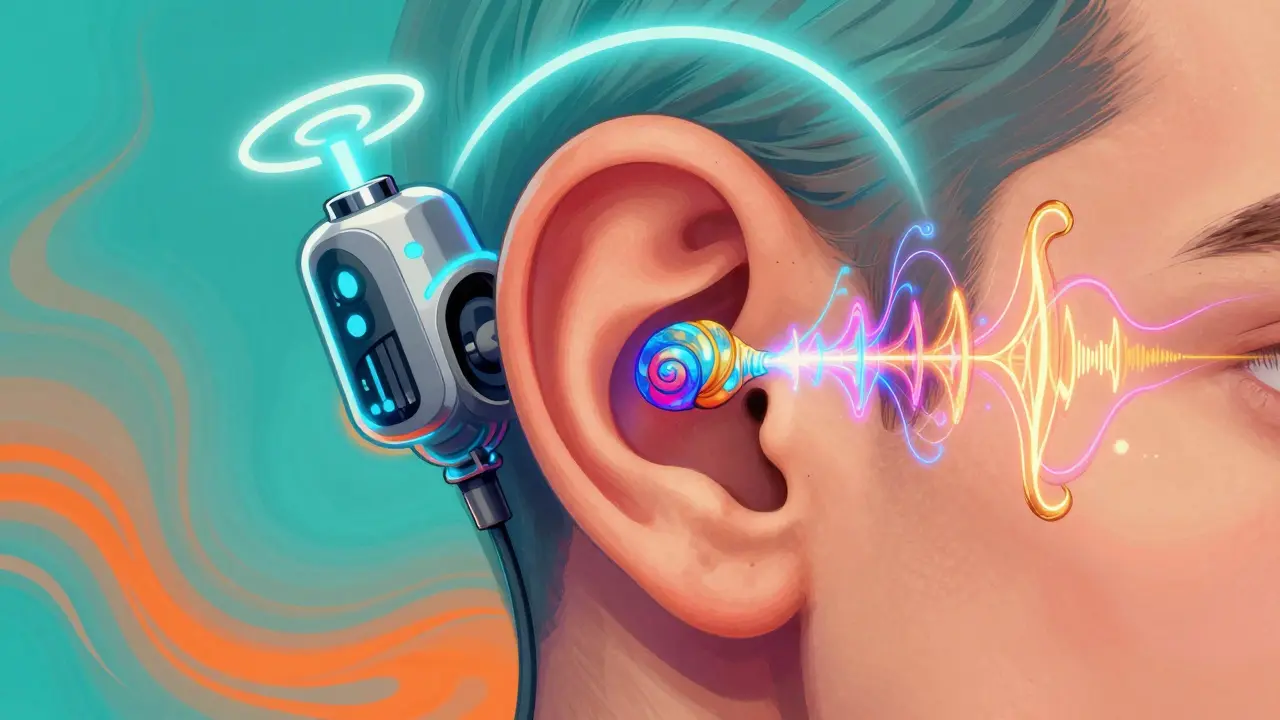
When someone loses their hearing completely-when even the loudest sounds become silent-it’s not just about missing conversations. It’s about losing the sound of a child’s laugh, the rustle of leaves, or even your own voice. For people with profound deafness, hearing aids often don’t help. That’s where cochlear implants come in. Unlike hearing aids that just make sounds louder, cochlear implants bypass damaged parts of the ear and directly stimulate the auditory nerve. They don’t restore normal hearing, but they give people back the ability to understand speech, recognize alarms, and reconnect with the world around them.
How Cochlear Implants Work
Cochlear implants are made of two parts: an external device and an internal one. The external part sits behind the ear and includes a microphone, a sound processor, and a transmitter coil. It picks up sound from the environment, turns it into digital signals, and sends them through the skin to the internal part. The internal part, surgically placed under the skin, has a receiver-stimulator and a thin electrode array that’s threaded into the cochlea-the snail-shaped part of the inner ear.
Here’s the key difference from hearing aids: cochlear implants don’t rely on working hair cells. In profound deafness, those hair cells are often destroyed by noise, aging, or disease. Instead, the implant turns sound into electrical pulses that travel directly along the auditory nerve to the brain. The electrode array has between 12 and 22 tiny contacts, each tuned to a different pitch. Higher frequencies are stimulated near the base of the cochlea, lower ones near the tip-just like natural hearing. This lets the brain interpret sounds in a more organized way.
Who Gets a Cochlear Implant?
Not everyone with hearing loss is a candidate. Implants are designed for people with severe-to-profound sensorineural hearing loss who get little to no benefit from hearing aids. In adults, this usually means they can’t understand speech even with the best hearing aids-often scoring below 50% on sentence recognition tests at 60 decibels. For children, the criteria are more about development: if a child isn’t learning speech or language at the expected rate, even with hearing aids, an implant may be recommended.
Today, implants are approved for children as young as 9 to 12 months. The earlier a child receives one, the better their chances of developing near-normal speech and language skills. Adults who have lost hearing after learning to speak (post-lingual deafness) also do very well. Even people with single-sided deafness or auditory neuropathy are now being considered, thanks to advances in technology and surgical techniques.
The Surgery Process
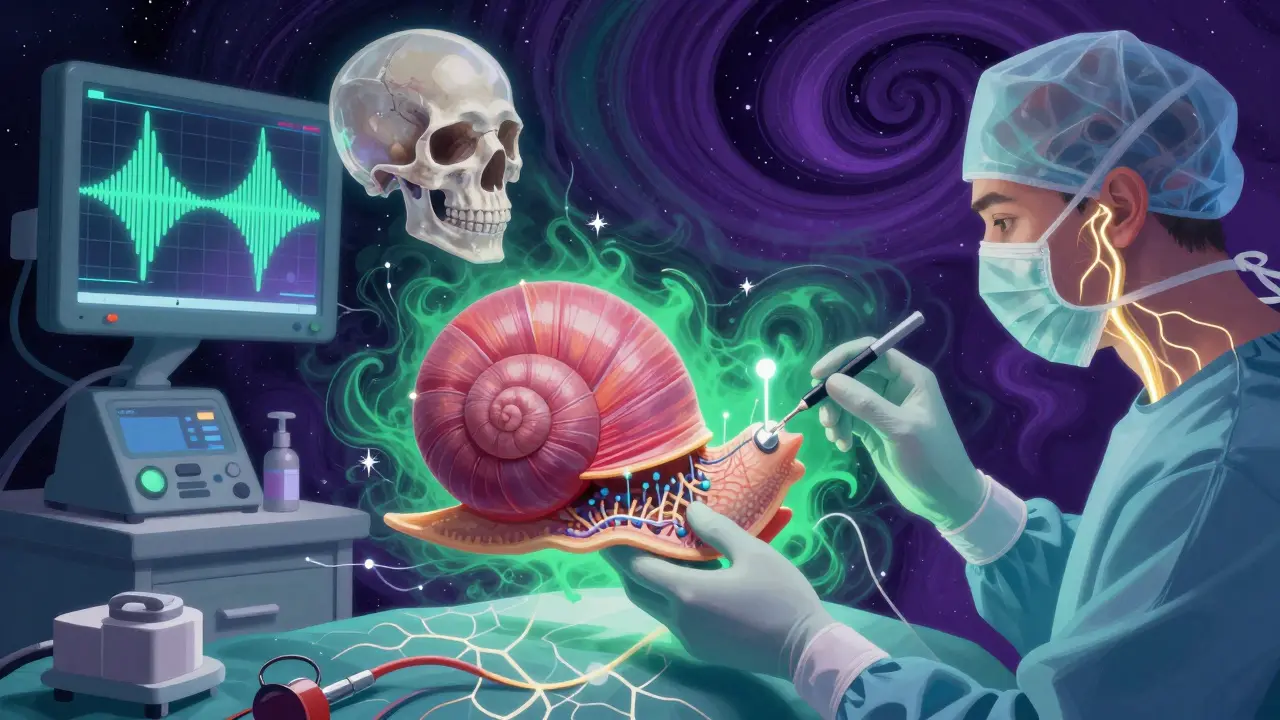
The surgery takes about 2 hours and is done under general anesthesia. A surgeon makes a 4- to 6-centimeter incision behind the ear, then drills into the mastoid bone to reach the middle ear. From there, they open the cochlea-either through the round window or by making a small hole called a cochleostomy-and carefully insert the electrode array. The receiver-stimulator is then placed in a pocket either in the skull bone or under the muscle.
Safety is critical. Surgeons use facial nerve monitoring to avoid accidentally damaging the nerve that controls facial movement. If the nerve fires at a current above 0.05 milliamperes, the surgeon stops and adjusts. Complications are rare-under 5% overall-with serious issues like facial paralysis occurring in less than 1% of cases when performed by experienced teams.
After surgery, patients go home the same day or stay overnight. There’s some swelling and numbness around the ear, which fades in a few weeks. Pain is usually mild and managed with over-the-counter medicine. The implant doesn’t work right away. The body needs time to heal, so activation happens 2 to 4 weeks later.

What Happens After Activation?
Activation is when the external processor is programmed for the first time. Audiologists use software to set the levels of electrical stimulation for each electrode. At first, sounds often feel strange-like robotic, mechanical, or underwater. One adult recipient described it as “hearing tinny beeps.” But the brain is incredibly adaptable. With consistent use, most people start recognizing speech within weeks.
Studies show that 80% of adult users achieve 80% or better sentence recognition in quiet rooms after a year. That’s a huge jump from the 20% or less most get with hearing aids. Children implanted before age 2 often catch up to their hearing peers in language skills by school age. But progress isn’t automatic. It takes daily listening practice, speech therapy, and patience. A child may need 1 to 2 years of therapy to speak clearly. Adults need regular check-ins to fine-tune the device as their hearing adapts.
Limitations and Challenges
Cochlear implants aren’t magic. They don’t give back perfect hearing. Music often sounds flat or distorted. Many users report difficulty understanding speech in noisy places like restaurants or crowded rooms. In those settings, speech recognition can drop from 80% down to 30-50%. That’s why many users still rely on lip-reading or captioning.
Device failure happens in 5-10% of cases. The internal part is designed to last 20-30 years, but if the electronics fail, revision surgery is needed. Some users deal with ongoing dizziness or tinnitus after implantation, though these usually improve over time. And not everyone qualifies. If the auditory nerve is damaged or missing, the implant won’t work. In those cases, bone conduction devices might be a better option.
Technology Advances
The last few years have brought big improvements. Older implants required surgery to remove a magnet before an MRI scan. Now, newer models like the SYNCHRONY 2 from MED-EL allow full 3.0 Tesla MRI scans without any surgery. That’s a major win for long-term care.
Hybrid implants are another breakthrough. These combine electrical stimulation for high frequencies with a hearing aid component that amplifies low frequencies. This helps people who still have some natural hearing in the low range but lose it in the highs.
Future devices are expected to use artificial intelligence to automatically adjust to noisy environments, reduce background noise, and enhance speech. Researchers are also testing drug-coated electrodes to prevent scar tissue buildup, which can block signal quality over time.
Real Impact
The difference an implant makes isn’t just clinical-it’s emotional. One mother, deaf for 15 years, said hearing her granddaughter say “I love you” for the first time brought her to tears. A teenager who had never heard birds chirping now notices them every morning. A veteran who lost hearing after combat now talks to his wife without asking her to repeat herself.
These aren’t rare stories. The FDA estimates over 324,000 people worldwide have cochlear implants. In the U.S. alone, about 58,000 adults and 38,000 children have them. Insurance typically covers the cost if you meet the criteria: severe hearing loss, limited benefit from hearing aids, and a medical evaluation confirming you’re a good candidate.
Is It Right for You?
If you or someone you know has profound deafness and hearing aids aren’t helping, it’s worth asking about cochlear implants. Talk to an audiologist and an ear specialist. Get a hearing test, a speech recognition test, and possibly a CT or MRI scan to check the structure of your inner ear. Don’t assume you’re too old, too late, or not “bad enough.” The criteria have expanded. Many people who thought they had no options find a new world of sound waiting for them.
Are cochlear implants the same as hearing aids?
No. Hearing aids amplify sounds for people who still have some natural hearing. Cochlear implants bypass damaged parts of the ear and send electrical signals directly to the auditory nerve. They’re for people who get little or no benefit from hearing aids, usually because their inner ear hair cells are too damaged.
Can children get cochlear implants?
Yes. Children as young as 9 to 12 months can receive cochlear implants. Early implantation-before age 2-gives the best chance for developing normal speech and language skills. Many children implanted young go on to attend mainstream schools and communicate without sign language.
How long does it take to hear well after the implant is activated?
It varies. Most people notice improvement within a few weeks, but it takes 3 to 6 months of consistent use and therapy to start understanding speech clearly. Children may need 1 to 2 years of auditory training to reach age-appropriate language levels. The brain needs time to learn how to interpret the new signals.
Can you have an MRI with a cochlear implant?
Yes, but only with newer models. Older implants required surgery to remove a magnet before an MRI. Today’s implants like the SYNCHRONY 2 are designed to be safe for full 3.0 Tesla MRI scans without any surgery. Always check with your implant manufacturer and radiologist before scheduling an MRI.
Do cochlear implants last forever?
The internal part is designed to last 20-30 years and rarely needs replacement. The external processor, however, can be upgraded as technology improves-no surgery needed. If the internal device fails, revision surgery is possible but uncommon. Most people use their original implant for decades.





Devin Ersoy
March 15, 2026 AT 06:24Look, I get it - cochlear implants sound like sci-fi magic until you realize they turn your mom’s voice into a robot reading a phone book. I know a guy who got one and now says he hears birds as ‘electronic chirps’ and music as ‘a fax machine having a seizure.’ Sure, he can talk to his wife, but he misses the crackle of vinyl. Sometimes I wonder if we’re fixing what wasn’t broken - or just making deafness more expensive.
Scott Smith
March 16, 2026 AT 02:15The real miracle isn’t the device - it’s neuroplasticity. The brain doesn’t just receive signals; it rewires itself to interpret them. Kids implanted before age two don’t just learn to hear - they learn to listen. That’s not engineering. That’s biology outperforming expectations. And yes, it takes years of therapy. But so does learning to ride a bike. The payoff? A child who asks why the sky is blue - and actually hears the answer.
Kathy Leslie
March 17, 2026 AT 03:26I work with a woman who got her implant at 58 after 20 years of silence. She told me the first thing she heard after activation was her cat purring. She cried for an hour. Not because it was loud - because it was *there*. That’s the thing no statistic captures. It’s not about speech scores. It’s about the quiet things you didn’t realize you missed until they came back.
Amisha Patel
March 17, 2026 AT 13:33My cousin got one as a toddler. Now she’s in college, studies music education. She says she doesn’t hear like hearing people - but she hears differently. She feels vibrations in her ribs when she sings. She says the bass in a symphony feels like a hug. I never thought about sound that way before. Just… wow.
Elsa Rodriguez
March 18, 2026 AT 23:22Ugh I just saw a TikTok of a kid hearing her mom say ‘I love you’ for the first time and I lost it. Like, why does this always happen in slow motion with piano music? It’s beautiful but also so manipulative. Like, what about the people who get implants and still can’t understand their own kids? Nobody talks about that. Or the ones who regret it. Or the ones who say it felt like a betrayal of Deaf culture. Why is this always a tearjerker and never a debate?
Serena Petrie
March 20, 2026 AT 17:13It works. Good. Done.
Buddy Nataatmadja
March 22, 2026 AT 04:27In Indonesia, access to this tech is still rare. Most people with profound deafness rely on family, sign language, and community. But I’ve met a few who got implants through NGOs. One man said hearing his own laugh was the weirdest thing - like meeting himself for the first time. Culture changes how we experience sound. Not everyone wants to ‘fix’ deafness. But for those who do? It’s life-changing.
mir yasir
March 22, 2026 AT 21:53While the technological advancements in cochlear implantology are indeed laudable, one must critically assess the underlying epistemological assumption that auditory normalization constitutes an unequivocal improvement in human experience. The ontological privileging of spoken language over visual-kinesthetic modalities raises profound ethical concerns regarding cultural erasure, particularly within Deaf communities whose linguistic identity is inextricably bound to sign language.
Stephanie Paluch
March 23, 2026 AT 15:16my sister got one last year and now she hears her own heartbeat. like literally. she says it sounds like a tiny drum. it freaked her out at first 😅 but now she says it’s comforting. also she finally understood why people say ‘the wind whispers’ - it’s not a metaphor, it’s a sound. 🌬️✨
tynece roberts
March 24, 2026 AT 04:48so i know this girl who got an implant when she was 10 and she said the first thing she heard was her dog barking and she screamed and ran out of the room because she thought it was a robot. like, the whole thing is wild. she still hates music, says it sounds like nails on a metal roof, but she can talk to her dad on the phone now without him having to shout. also she cried when she heard her own voice for the first time. like, who knew your voice sounded like that? anyway, it’s not perfect but it’s something. i think we should stop acting like it’s a cure and just call it a tool. like glasses. not magic. just science.