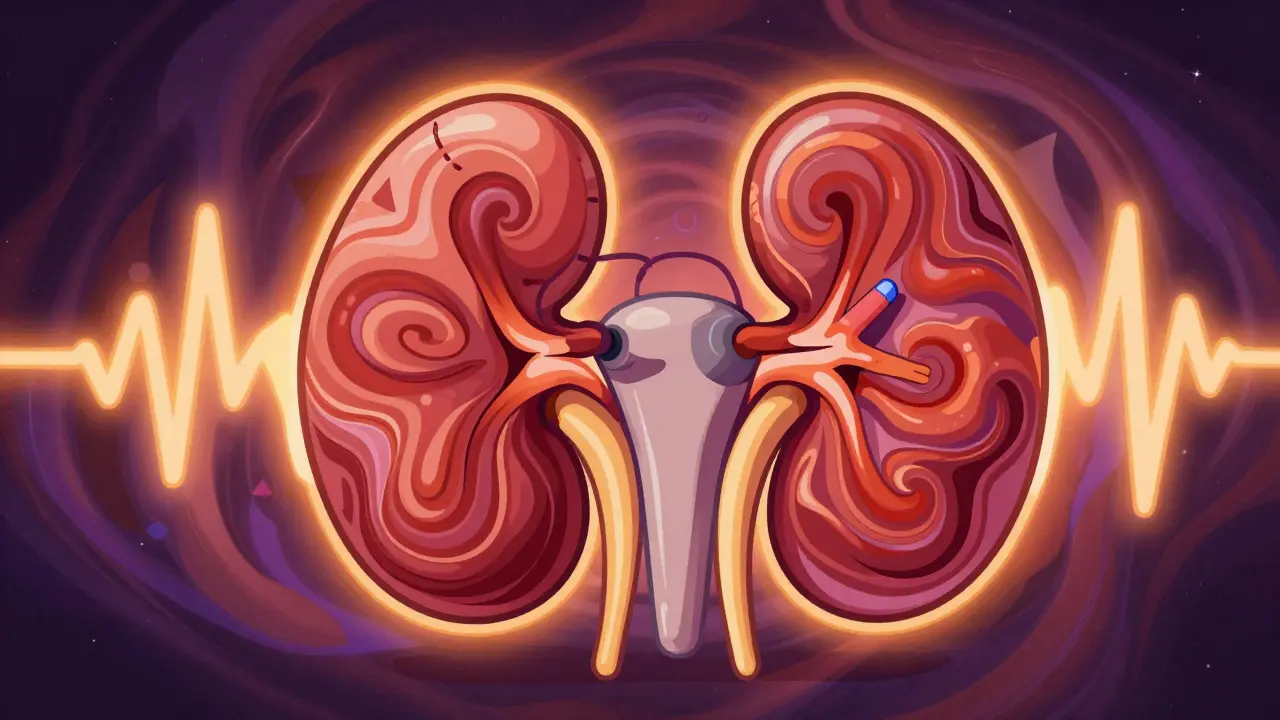
When your doctor suspects a blockage in your urinary tract or wants to check if your kidneys are the right size, renal ultrasound is often the first test they order. It’s quick, safe, and doesn’t use radiation-unlike CT scans or X-rays. This simple imaging tool can tell you a lot: whether your kidney is swollen from backed-up urine, if it’s shrinking due to long-term damage, or if there’s a stone stuck in the ureter. In emergency rooms, hospitals, and even outpatient clinics, renal ultrasound has become the go-to method for evaluating kidney obstruction and size because it’s fast, cheap, and reliable when done right.
How Renal Ultrasound Works
Renal ultrasound uses high-frequency sound waves to create images of your kidneys and bladder. A technician moves a small device called a transducer over your abdomen or back. The transducer sends out sound waves that bounce off your internal organs and return as echoes. These echoes are turned into real-time images on a screen. No needles, no radiation, no contrast dye-just sound waves and a little gel.
The procedure usually takes between 15 and 30 minutes. You don’t need to fast or do anything special beforehand, though being well-hydrated helps. The technician will look at both kidneys, comparing their size, shape, and position. They’ll check for swelling in the renal pelvis-the part where urine collects before moving to the bladder. That swelling is called hydronephrosis, and it’s a clear sign of obstruction.
Measuring Kidney Size: What’s Normal?
A healthy adult kidney is typically 9 to 13 centimeters long. That’s about the size of a fist. If one kidney is significantly smaller-say, under 8 cm-it might mean chronic damage from high blood pressure, diabetes, or long-standing obstruction. On the other hand, if a kidney is enlarged, it could be due to an acute blockage, infection, or even a tumor.
Cortical thickness matters too. The outer layer of the kidney, called the cortex, should be at least 1 centimeter thick. If it’s thinner than that, especially on both sides, it’s a red flag for long-term kidney disease. In advanced cases, the cortex can become so thin it’s barely visible on ultrasound.
Spotting Obstruction: Hydronephrosis and Beyond
Hydronephrosis is graded from mild to severe. The Society for Fetal Urology system is commonly used: Grade 1 is slight dilation of the renal pelvis. Grade 2 adds dilation of the calyces. Grade 3 shows more dilation and thinning of the cortex. Grade 4 is severe-kidneys look bloated, and the cortex is stretched thin. This grading helps doctors decide if surgery is needed or if they can wait and monitor.
But ultrasound doesn’t just show swelling. It also measures the anteroposterior diameter of the renal pelvis. In adults, anything over 7 millimeters is considered abnormal. In children, the cutoff is lower, around 4-5 mm. A dilation of 10 mm or more in an adult almost always means there’s a blockage somewhere-maybe a kidney stone, a blood clot, or even a tumor pressing on the ureter.
The Resistive Index: A Hidden Clue
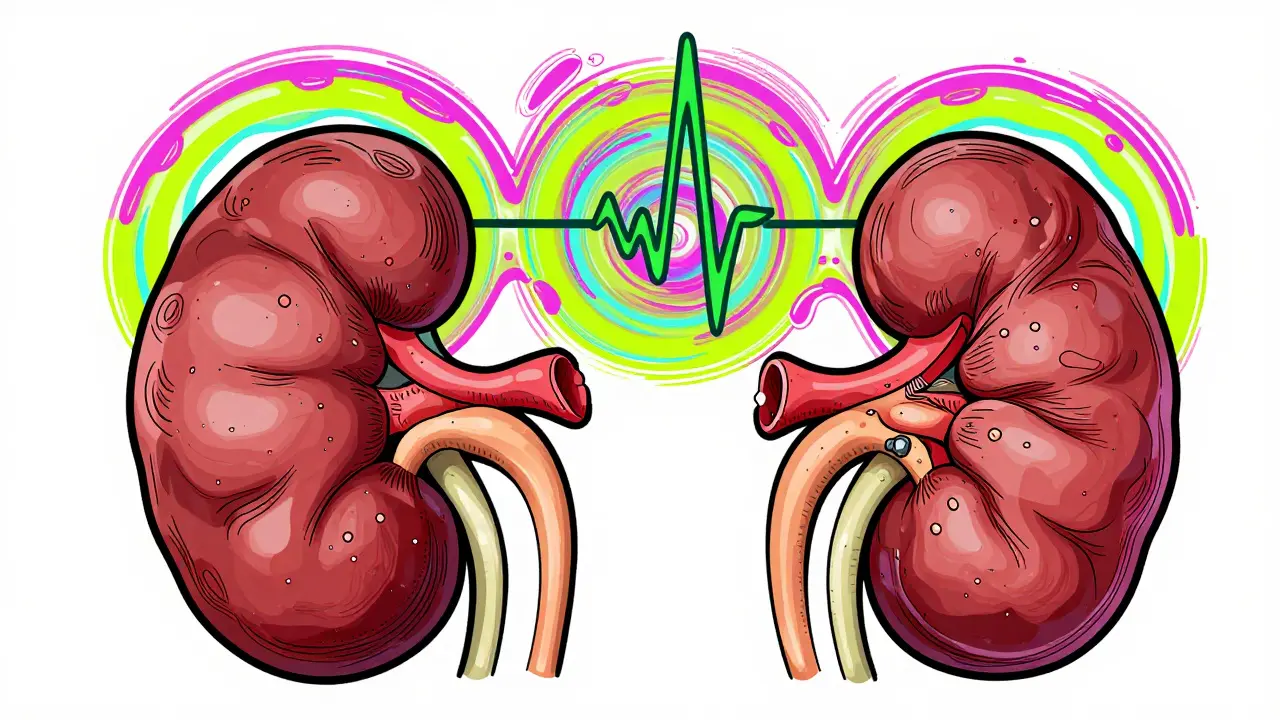
One of the most powerful tools in renal ultrasound isn’t a picture-it’s a number. It’s called the resistive index (RI). This is calculated using Doppler ultrasound, which measures how fast blood flows through the kidney’s arteries. The formula is simple: (peak systolic velocity minus end diastolic velocity) divided by peak systolic velocity.
A normal RI is usually below 0.70. When obstruction blocks urine flow, pressure builds up in the kidney. That pressure affects blood flow, and the RI rises. A 2015 study in the Nigerian Journal of Clinical Practice found that an RI of 0.70 or higher had 86.7% sensitivity and 90% specificity for diagnosing obstruction. That means if your RI is above 0.70, there’s a very good chance something is blocking your urinary tract.
But RI isn’t perfect. It can be elevated in other conditions like kidney infections or scarring. That’s why doctors look at it alongside other findings: kidney size, cortical thickness, and hydronephrosis grade. Together, they paint a clearer picture.
Ultrasound vs. CT vs. MRI: What’s the Difference?
Many people assume a CT scan is the best way to check for kidney stones. And yes, CT can spot stones as small as 1-2 mm. But ultrasound finds about 80% of stones larger than 3 mm-and it does it without radiation. A single CT urography exposes you to about 10 millisieverts of radiation. That’s roughly the same as three years of natural background radiation.
Ultrasound wins in safety. That’s why it’s the first choice for pregnant women, children, and people who need repeated scans. A urologist I spoke with once said, “I track hydronephrosis weekly in post-op UPJ patients with bedside ultrasound instead of exposing them to repeated radiation.” That’s the real advantage.
MRI and nuclear scans have their uses. MRU gives amazing detail of soft tissues and can show how urine flows through the system. But it costs 3 to 5 times more than ultrasound and takes longer. Nuclear scans measure kidney function but involve radioactive tracers and give fuzzy images.
Here’s the bottom line: If you’re in the ER with flank pain, ultrasound is the fastest way to rule out obstruction. If you need to see tiny stones or plan surgery, CT might follow. But ultrasound? It’s the first step-and often the only one you need.
Limitations: When Ultrasound Falls Short
Ultrasound isn’t magic. It has limits. If you have a high BMI-especially above 35-the sound waves can’t penetrate deep enough. The image gets blurry. In those cases, doctors often turn to CT or MRI.
Another issue? Operator skill. A 2018 study found that inexperienced sonographers could be off by up to 20% when measuring kidney length. That’s why training matters. The American Institute of Ultrasound in Medicine recommends at least 40 supervised exams before someone is considered competent.
Also, ultrasound can’t tell you how fast urine is draining. CT scans with special algorithms can measure drainage rates. But ultrasound can still show if drainage is happening at all-by seeing if the pelvis is getting bigger or staying the same over time.
And bowel gas? It’s a nuisance. About 15-20% of abdominal ultrasounds get blocked by gas. That’s why technicians sometimes ask you to roll onto your side or hold your breath-to get a better angle.

The Future: AI, Elastography, and Super-Resolution
Ultrasound isn’t standing still. New tech is making it smarter. Shear-wave elastography (SWE) measures how stiff the kidney tissue is. When urine backs up, pressure builds and makes the kidney stiffer. Studies show stiffness increases linearly with obstruction severity. This could one day replace invasive pressure tests.
Then there’s AI. Mayo Clinic is testing software that automatically grades hydronephrosis. Instead of a radiologist eyeballing a scan, the software counts dilation and compares it to thousands of past cases. Early results are promising.
And the most exciting frontier? Super-resolution ultrasound. Researchers are now using advanced algorithms to visualize individual blood vessels in the kidney. In the future, this might let us see microvascular damage before the kidney even starts failing. That’s huge for catching disease early.
Who Gets This Test?
Renal ultrasound is used for:
- Patients with sudden flank pain (possible kidney stones)
- People with unexplained high blood pressure or kidney failure
- Children with urinary tract infections or prenatal hydronephrosis
- Pregnant women with urinary symptoms
- Patients with known UPJ obstruction or post-surgical follow-up
- Those needing to avoid radiation (children, young adults, frequent scans)
It’s not for everyone. If you’re obese, have severe gas, or need to see a tiny stone, your doctor might skip to CT. But for most people, ultrasound gives all the answers they need.
What Happens After the Scan?
If your ultrasound shows mild hydronephrosis and normal kidney size, your doctor might just monitor you. Repeat scans every few weeks can show if things are improving-or getting worse.
If the RI is high and the pelvis is dilated, they’ll look for the cause. A stone? Maybe they’ll prescribe pain meds and wait. A tumor? They’ll order a CT. A narrowing at the ureteropelvic junction? Surgery might be needed.
And if your kidneys are small and the cortex is thin? That’s a sign of chronic kidney disease. You’ll likely be referred to a nephrologist for long-term management.
Can renal ultrasound detect kidney stones?
Yes, but not all of them. Ultrasound detects about 80% of kidney stones larger than 3 mm. Smaller stones, especially those under 2 mm, often slip through. CT scans are better at finding tiny stones, but ultrasound is still the first test because it’s safe, quick, and doesn’t use radiation. If a stone is suspected but not seen on ultrasound, a CT is usually ordered next.
Is renal ultrasound safe during pregnancy?
Absolutely. Renal ultrasound is the safest imaging option for pregnant women. Unlike CT or X-rays, it uses no ionizing radiation. It’s commonly used to evaluate kidney swelling, urinary tract infections, or suspected obstruction in pregnancy. Many OB-GYNs and emergency doctors rely on it for kidney-related issues during pregnancy.
Why is kidney size important?
Kidney size tells you about long-term health. A normal kidney is 9-13 cm long. If one is much smaller, it may have been damaged by chronic disease like high blood pressure or diabetes. If both kidneys are small, it suggests advanced kidney disease. Enlarged kidneys, on the other hand, often point to recent obstruction, infection, or swelling from blockage.
What is hydronephrosis, and why does it matter?
Hydronephrosis is swelling of the kidney caused by urine buildup due to blockage. It’s not a disease itself-it’s a sign of something else. If left untreated, it can damage the kidney over time. Ultrasound measures the degree of swelling (graded from 1 to 4) and helps doctors decide if the blockage needs urgent treatment or can be monitored.
Can obesity affect the accuracy of a renal ultrasound?
Yes. When a patient has a BMI over 35, the ultrasound waves struggle to penetrate deep enough to get a clear image. The kidneys may appear blurry or not visible at all. In these cases, doctors often switch to CT or MRI for better visualization. This is one of the main reasons ultrasound isn’t always enough on its own.
How long does it take to learn to read a renal ultrasound?
Becoming proficient takes time. According to the American College of Radiology, a sonographer needs about 50 supervised exams to reliably measure kidney size, detect hydronephrosis, and calculate the resistive index accurately. Many radiology residents say it’s moderately difficult to master, especially when interpreting Doppler waveforms. Experience matters more than equipment.
Renal ultrasound isn’t flashy. But in the world of medical imaging, it’s one of the most reliable tools we have. It answers the most urgent questions-Is there a blockage? Is the kidney swollen? Is it still healthy?-without putting patients at risk. As new technologies like AI and elastography evolve, it’s only getting better. For now, it remains the safest, fastest, and most widely used way to check your kidneys.



Rachidi Toupé GAGNON
February 11, 2026 AT 20:22Sophia Nelson
February 12, 2026 AT 17:44Ojus Save
February 13, 2026 AT 20:13Reggie McIntyre
February 14, 2026 AT 18:41Carla McKinney
February 16, 2026 AT 09:23Jack Havard
February 17, 2026 AT 01:58Neha Motiwala
February 17, 2026 AT 08:52Alyssa Williams
February 17, 2026 AT 11:33Gabriella Adams
February 18, 2026 AT 01:54Vamsi Krishna
February 19, 2026 AT 04:30Brad Ralph
February 19, 2026 AT 20:00christian jon
February 20, 2026 AT 15:19Autumn Frankart
February 21, 2026 AT 02:43Pat Mun
February 21, 2026 AT 23:51Skilken Awe
February 22, 2026 AT 09:50