
Acid-Reducing Medication Interaction Checker
Check if your heartburn medication might reduce the effectiveness of other prescription drugs. Based on FDA warnings and clinical studies.
Why Your Heartburn Med Might Be Ruining Your Other Medications
If you take medication for acid reflux, heartburn, or ulcers, you might think you’re doing everything right. But what if your stomach medicine is quietly making your other drugs less effective? It’s not a myth. Proton pump inhibitors (PPIs) like omeprazole and H2 blockers like famotidine are among the most commonly prescribed drugs in the U.S. - and they’re changing how your body absorbs everything from HIV meds to cancer drugs.
The problem isn’t about side effects like bloating or headaches. It’s about acid-reducing medications raising the pH in your stomach, turning it from a harsh acid bath into something closer to water. And that small change can wreck the absorption of dozens of other drugs.
How Stomach Acid Helps Drugs Work
Your stomach isn’t just there to digest food. It’s also a key gatekeeper for how well oral medications enter your bloodstream. Most drugs need to dissolve before they can be absorbed. And for many of them, that only happens in acidic conditions.
Drugs that are weak bases - meaning they’re more likely to dissolve in acid - make up about 70% of all oral medications. Think HIV drugs like atazanavir, leukemia meds like dasatinib, and antifungals like ketoconazole. These drugs rely on stomach acid to stay soluble. When acid levels drop, they turn into a form that doesn’t dissolve well. They sit there, unchanged, and pass right through your system without being absorbed.
It’s not just about stomach acid, though. Most drugs are absorbed in the small intestine, not the stomach. But if they don’t dissolve properly in the stomach first, they never make it to the intestine in the right form. That’s why even though only 10% of absorption happens in the stomach, it’s still the make-or-break step.
The Real Culprits: PPIs vs. H2 Blockers
Not all acid reducers are created equal. Proton pump inhibitors (PPIs) like omeprazole, esomeprazole, and pantoprazole are far more powerful than H2 blockers like ranitidine or famotidine.
PPIs shut down acid production almost completely, keeping stomach pH above 4 for 14 to 18 hours a day. H2 blockers only do it for 8 to 12 hours. That difference might sound small, but in drug terms, it’s huge.
Studies show PPIs reduce absorption of weak base drugs by 40% to 80%. H2 blockers? More like 20% to 40%. That’s why doctors now warn against using PPIs with certain medications - not just as a caution, but as a hard rule.
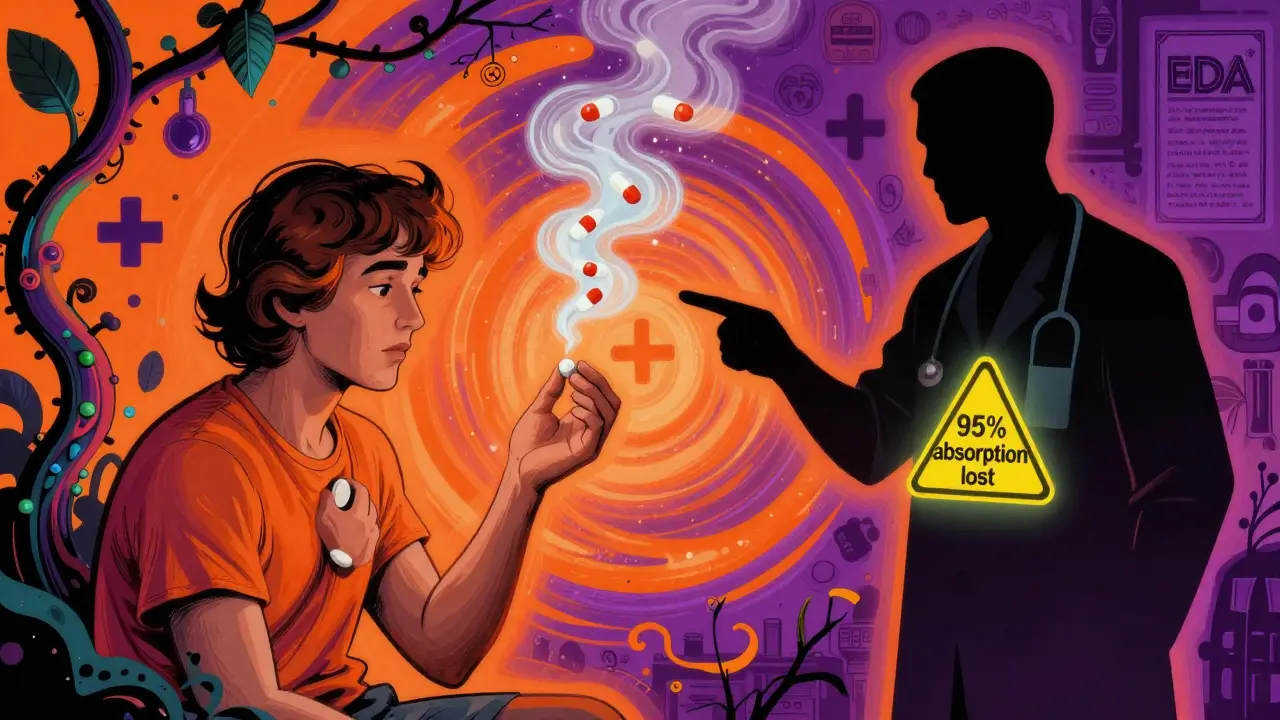
Take atazanavir, an HIV drug. When taken with a PPI, its blood levels drop by up to 95%. That’s not a slight dip - that’s treatment failure. Patients have gone from undetectable viral loads to over 12,000 copies per milliliter after starting omeprazole. One patient on Reddit described it like this: “My infectious disease doctor said this is the #1 interaction we test for in pharmacy school.”
The Top 5 Drugs Most Affected
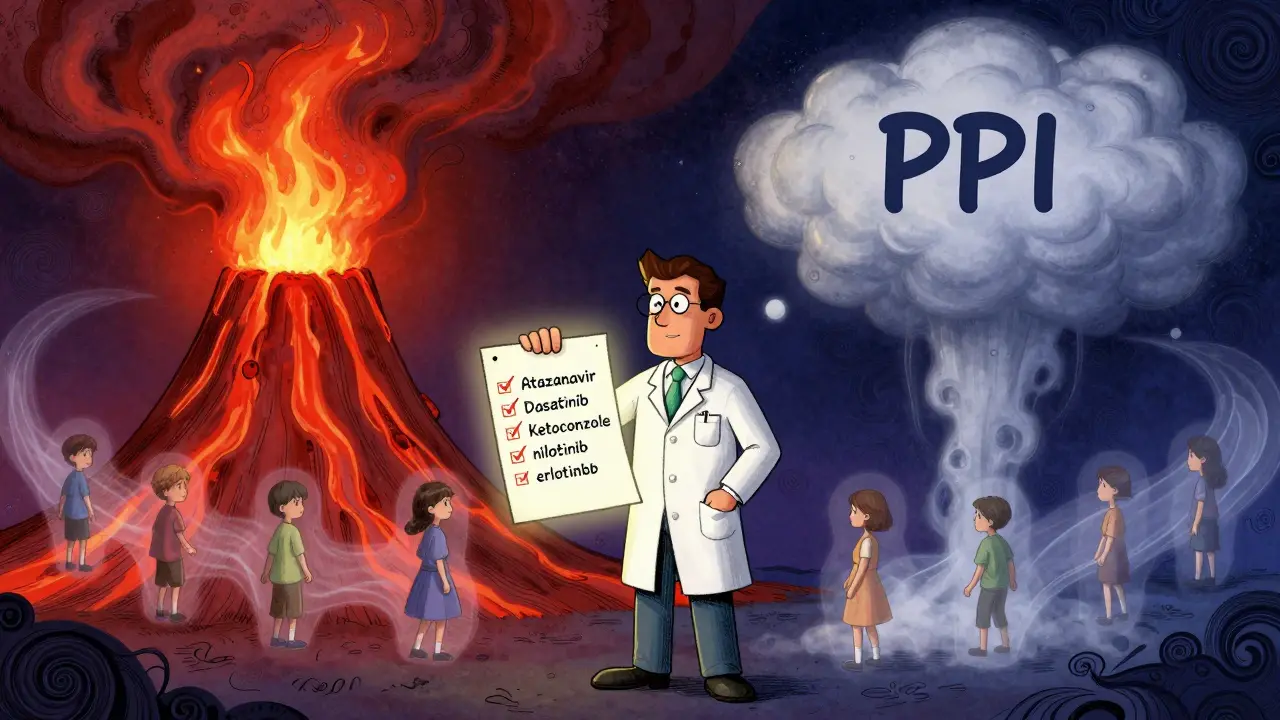
These five medications are the most dangerous to combine with acid reducers:
- Atazanavir - HIV treatment. PPIs cut absorption by 74-95%. FDA says: Do not use together.
- Dasatinib - Leukemia drug. Absorption drops 60%. Dose adjustments or staggered timing may help, but it’s risky.
- Ketoconazole - Antifungal. Absorption falls 75%. Often becomes completely ineffective.
- Nilotinib - Another leukemia drug. Similar to dasatinib; requires careful management.
- Erlotinib - Lung cancer drug. Reduced absorption linked to lower survival rates in studies.
The FDA now requires 28 drug labels to warn about acid-reducing interactions - up from just 12 in the past five years. These aren’t theoretical risks. Between 2020 and 2023, over 1,200 reports were filed to the FDA’s adverse event system about therapeutic failure linked to these combinations.
What About Acidic Drugs? Are They Safe?
You might assume that if weak bases are hurt by less acid, then weak acids - like aspirin or ibuprofen - would be helped. And technically, yes. They dissolve better in higher pH.
But here’s the catch: most acidic drugs don’t need help. They absorb well even in acidic stomachs. Even when their absorption increases slightly - say, by 15-25% - it rarely causes problems. The real danger is with drugs that have a narrow therapeutic index: where a small drop in blood levels means treatment fails, and a small rise means toxicity.
Drugs like dasiglucagon (for low blood sugar) might absorb a bit more with PPIs, but since their safety margin is wide, doctors don’t adjust doses. The focus stays on the high-risk weak bases.
What Can You Do? Practical Steps
If you’re on one of these high-risk drugs and need acid control, here’s what works:
- Avoid PPIs entirely. If you’re on atazanavir, dasatinib, or ketoconazole, don’t take omeprazole, esomeprazole, or lansoprazole. Ask your doctor for alternatives.
- Try H2 blockers instead. Famotidine (Pepcid) is less likely to interfere. Still, check with your provider - it’s not risk-free.
- Time it right. If you must take both, take the affected drug at least 2 hours before the acid reducer. This helps, but it’s not perfect - only cuts interaction risk by 30-40%.
- Use antacids sparingly. Tums or Maalox can be used with a 4-hour gap, but they only last 1-2 hours. Not practical for daily use.
- Ask your pharmacist. A 2023 study showed pharmacist-led reviews cut inappropriate PPI co-prescribing by 62% in older adults.
Many people don’t realize they’re on a risky combo. One user on Drugs.com wrote: “My doctor didn’t tell me Nexium would interfere with my blood pressure meds - my readings were consistently 20 points higher until we figured it out.”
Why This Is a Bigger Problem Than You Think
About 15% of adults in the U.S. and UK take acid-reducing meds long-term. Many don’t even need them. The American College of Gastroenterology says 30-50% of long-term PPI users have no valid reason to be on them.
That’s a huge pool of people unknowingly sabotaging their other meds. In the U.S. alone, an estimated 15,000-20,000 cases of therapeutic failure each year are linked to unnecessary PPI use. That means people with HIV, cancer, or fungal infections aren’t getting better - not because the drugs don’t work, but because they’re not being absorbed.
And the cost? Over $1.2 billion annually in wasted healthcare spending on failed treatments, repeat visits, and hospitalizations.
What’s Changing Now?
Doctors and regulators are waking up. The FDA’s 2023 guidance now requires drug makers to test new medications across a full pH range (1.0 to 7.5) to see how they behave with acid reducers. If a new drug is a weak base with low solubility above pH 5, it must carry a warning.
Hospitals are updating their electronic systems. Epic Systems reports 78% of doctors now follow automated alerts when a PPI is prescribed with a risky drug.
And the future? More drugs are being designed to work without relying on stomach acid. Around 37% of new drugs in development now use special coatings or delivery systems to bypass pH dependence entirely. AI tools are also being trained to predict interactions - Google Health’s prototype is 89% accurate.
By 2027, experts predict a 25% drop in inappropriate PPI use. That could prevent 5,000-7,000 cases of treatment failure every year.
Final Advice: Don’t Assume It’s Safe
If you’re on any prescription medication - especially for HIV, cancer, or chronic infections - and you’ve started taking an acid reducer, talk to your doctor or pharmacist. Don’t wait for symptoms. Ask: “Could this heartburn pill affect my other meds?”
It’s not about avoiding acid control altogether. It’s about choosing the right tool for the job. Sometimes, lifestyle changes - eating smaller meals, avoiding late-night snacks, losing weight - can reduce heartburn without touching a pill.
And if you do need medication? There are safer options. You just have to ask the right questions.


Bridget Molokomme
February 2, 2026 AT 23:19Vatsal Srivastava
February 3, 2026 AT 15:50Brittany Marioni
February 4, 2026 AT 23:27Monica Slypig
February 6, 2026 AT 10:10Becky M.
February 6, 2026 AT 16:36jay patel
February 8, 2026 AT 05:02Ansley Mayson
February 8, 2026 AT 07:07phara don
February 9, 2026 AT 03:08Hannah Gliane
February 10, 2026 AT 06:59Murarikar Satishwar
February 12, 2026 AT 01:56Dan Pearson
February 12, 2026 AT 02:50Bob Hynes
February 12, 2026 AT 08:05Eli Kiseop
February 14, 2026 AT 07:10