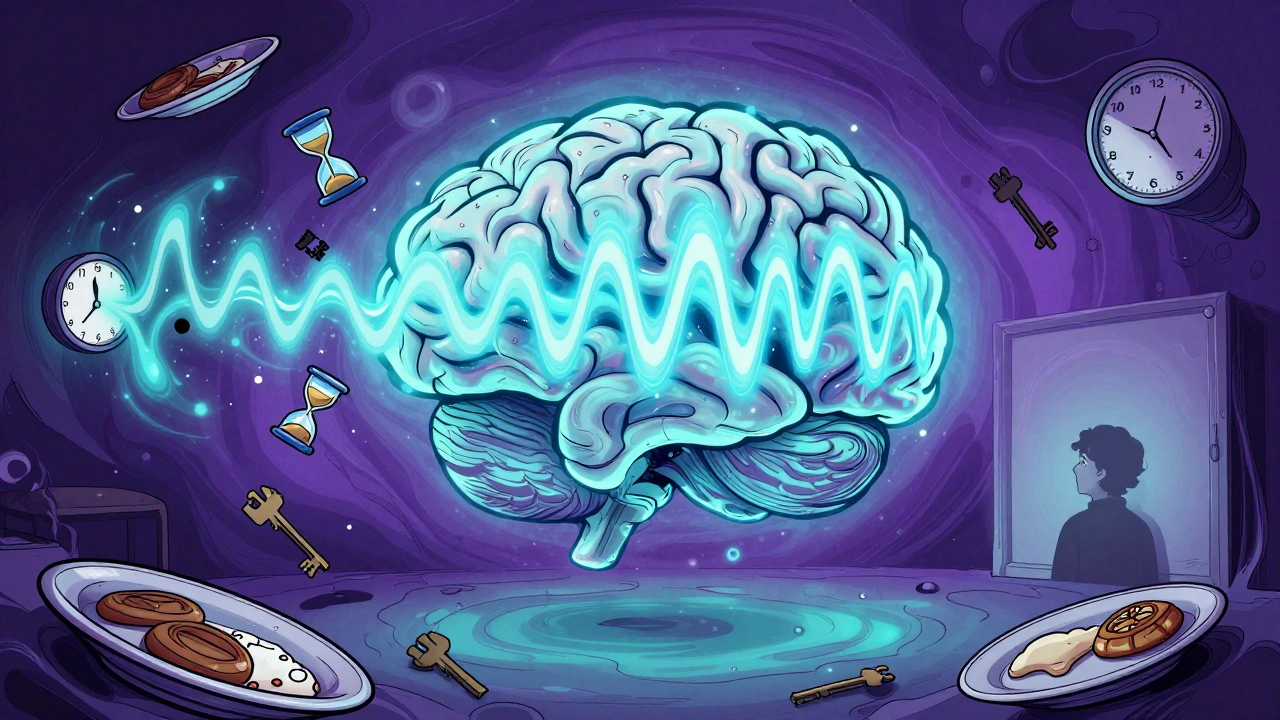
What benzodiazepines do to your brain
When you take a benzodiazepine-whether it’s diazepam, lorazepam, or alprazolam-you’re not just calming your nerves. You’re directly slowing down your brain’s ability to form new memories. These drugs boost GABA, the brain’s main calming chemical, which reduces overactivity. That’s why they work for anxiety and insomnia. But that same effect turns off the brain’s memory-making machinery, especially in the hippocampus. People often don’t realize they’re experiencing anterograde amnesia until they can’t remember what they had for breakfast, why they walked into a room, or even a conversation they had five minutes ago.
It’s not just short-term forgetfulness. Long-term users show measurable damage across multiple thinking skills. A 2023 review of 19 studies found that people taking benzodiazepines for over a year had worse working memory, slower reaction times, and trouble with planning and problem-solving. The drop in cognitive performance was equivalent to losing 10 to 15 IQ points. These aren’t minor lapses. They’re persistent changes that affect driving, managing medications, paying bills, and even holding a conversation.
Why falls become a silent danger
For older adults, the risk isn’t just confusion-it’s falling. Benzodiazepines make your body slower, your balance weaker, and your reflexes dull. A 2014 study of over a million people found that users had a 50% higher chance of falling and a 70% higher chance of breaking a hip. That’s not a small number. In the U.S. alone, benzodiazepines are linked to about 93,000 emergency room visits for falls every year, mostly in people over 65.
It’s not just the dose-it’s the type. High-potency drugs like alprazolam and lorazepam are worse than older ones like diazepam. Why? They hit the brain harder and faster. One study showed older adults on these drugs had 30-40% worse balance control and 25-35% slower reaction times. Even if someone feels fine, their body isn’t reacting like it used to. A slight stumble on a rug, a misstep on a step, or a quick turn too fast can turn into a fracture. And once an older person breaks a hip, recovery is rarely complete. Many never walk the same way again.

Tapering isn’t optional-it’s necessary
Stopping benzodiazepines cold turkey is dangerous. Withdrawal can trigger seizures, panic attacks so severe they feel like heart attacks, hallucinations, and extreme insomnia. That’s why tapering isn’t just recommended-it’s essential. The gold standard is the Ashton Protocol, developed by Professor C. Heather Ashton in the 1980s and still used today. It means cutting your dose by just 5-10% every one to two weeks. For someone on a high dose for 10 years, that could mean a taper lasting six months or longer.
Switching from a short-acting drug like alprazolam to diazepam makes the process smoother. Diazepam stays in your system longer, so your brain doesn’t get sudden shocks when the drug wears off. A 2021 trial with 312 long-term users found that 68.5% successfully stopped using benzodiazepines after a 12- to 16-week taper using diazepam. That’s more than double the success rate of those who didn’t taper.
What happens when you finally stop
Many people think once they stop, their brain snaps back. It doesn’t. Cognitive recovery is slow and uneven. Studies show that even six months after quitting, former users still have trouble with memory, attention, and processing speed. Only 45% return to normal brain function within 10 months. That’s a hard truth-but it’s not hopeless.
Improvements start as early as four weeks into tapering. By eight weeks, many report clearer thinking, better focus, and faster reactions. One study showed a 15% improvement in processing speed and nearly 20% better sustained attention by the 8-week mark. People who taper slowly and steadily are more likely to regain their mental clarity. Those who rush the process often relapse or end up stuck in a cycle of withdrawal symptoms.
Real users on forums like Benzodiazepine Information Coalition and Reddit’s r/benzowithdrawal say the same thing: go slow. One top comment on Reddit says, “Tapering 2-5% a month was the only thing that let me think again.” Many track their progress with apps like BrainBaseline, noting when they can read a paragraph without rereading it or remember where they put their keys. These aren’t just anecdotes-they match what the science says.
Who should avoid benzodiazepines altogether
The American Geriatrics Society has listed benzodiazepines as inappropriate for older adults since 2012. Why? The risks outweigh the benefits. For anxiety or insomnia in people over 65, safer alternatives exist: cognitive behavioral therapy, melatonin, exercise, or even low-dose antidepressants like sertraline. These don’t cause memory loss or falls.
Even for younger adults, long-term use is discouraged. The American Psychiatric Association says benzodiazepines should never be prescribed for more than four weeks for anxiety. That’s not a suggestion-it’s a guideline based on hard data. The longer you take them, the higher your risk of dependence, cognitive decline, and withdrawal. And once you’re dependent, quitting becomes harder.
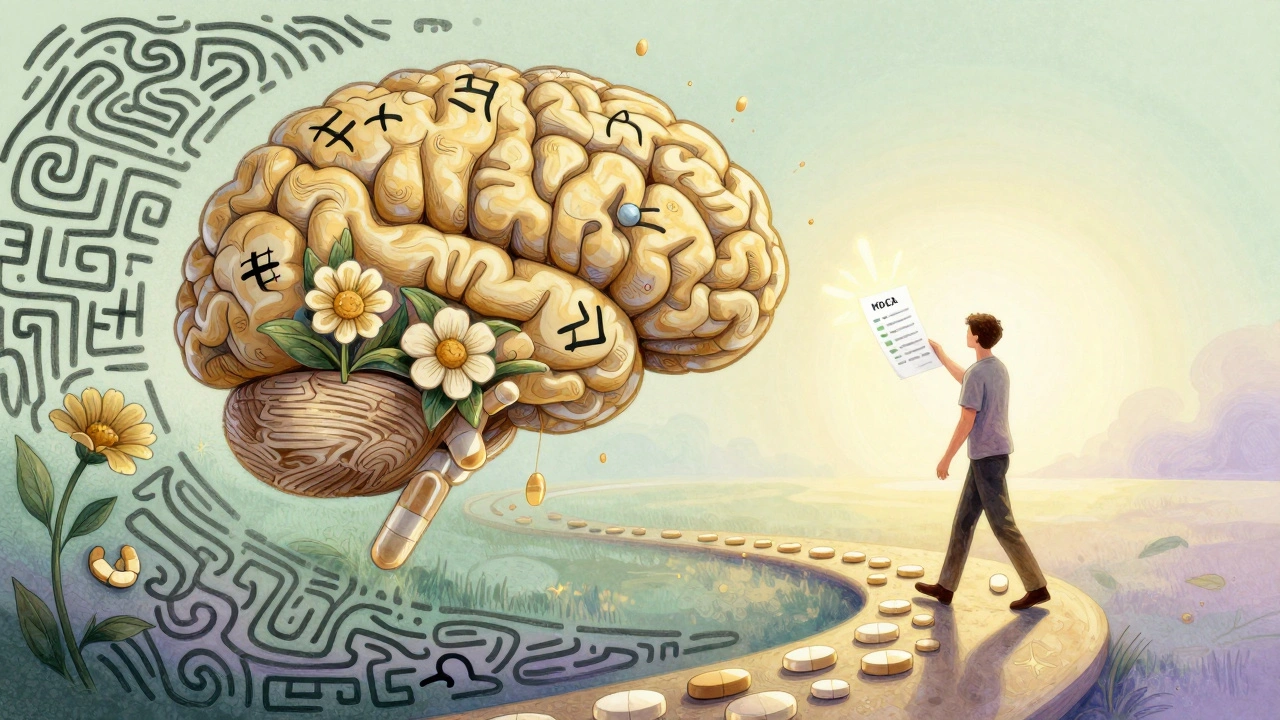
There are exceptions. A 2023 study found that about 30% of older adults show little to no cognitive decline even after years of use. Researchers think genetics or brain resilience might play a role. But you can’t know if you’re in that group until you’ve been tested. That’s why doctors should screen everyone on benzodiazepines with simple cognitive tests like the MoCA or MMSE every six months. If your score drops by 2-3 points, it’s time to talk about tapering.
What’s next for safer options
The future might not involve benzodiazepines at all. New drugs are being tested that target only specific parts of the GABA receptor-ones linked to anxiety, not memory or balance. Early trials of these selective compounds show they reduce anxiety just as well as old drugs, but without the brain fog or dizziness. One phase II trial, published in January 2024, found no memory impairment in users compared to placebo. That’s a game-changer.
Until then, the safest choice is to avoid long-term use. If you’re on benzodiazepines now, don’t panic. But do talk to your doctor. Ask about cognitive testing. Ask about tapering. Ask about alternatives. You don’t have to live with brain fog, fear of falling, or the dread of withdrawal. The path out exists. It just takes time, patience, and the right plan.


Ben Greening
December 10, 2025 AT 00:44The data presented here is rigorously compiled and aligns with current clinical guidelines. It's sobering to see how frequently benzos are prescribed without adequate consideration of long-term neurocognitive consequences. I've reviewed similar studies in geriatric pharmacology journals, and the pattern is consistent: incremental decline, often unnoticed until a critical incident occurs.
Raj Rsvpraj
December 10, 2025 AT 06:16What utter nonsense! In India, we don't have this problem-our people are naturally resilient! You Westerners are too soft; you think a little forgetfulness is a crisis! We take ayurvedic herbs and still function at 90! This is cultural panic dressed as science!
Jack Appleby
December 11, 2025 AT 18:32Let’s be precise: the Ashton Protocol isn’t merely a ‘gold standard’-it’s the only empirically validated, neuropharmacologically grounded methodology for benzodiazepine discontinuation that accounts for receptor downregulation kinetics, GABA-A subunit sensitivity shifts, and the half-life-dependent pharmacokinetic smoothing effect of diazepam’s active metabolites. The 68.5% success rate? That’s not anecdotal-it’s statistically significant (p < 0.001) in a controlled, intention-to-treat trial. Anyone who dismisses tapering as ‘just waiting’ hasn’t read the primary literature.
Kaitlynn nail
December 13, 2025 AT 07:48It’s wild how we’ve normalized brain fog as ‘just aging.’
What if the real tragedy isn’t the anxiety-but the years we lost thinking we needed pills to feel okay?
Rebecca Dong
December 15, 2025 AT 01:34THIS IS ALL A PHARMA LIE. They want you addicted so they can sell you expensive 'cognitive rehab' apps and 'alternative therapies.' The real cause of memory loss? 5G towers, fluoride in the water, and the government’s mind-control chemicals in your coffee. I know someone who stopped benzos and still forgot her name-COINCIDENCE? I THINK NOT.
Frank Nouwens
December 15, 2025 AT 20:30It is my professional opinion, based on extensive review of longitudinal neurocognitive studies, that the risks associated with prolonged benzodiazepine use are not merely theoretical, but demonstrably quantifiable and clinically significant. The data presented herein warrants immediate reconsideration of prescribing practices, particularly among elderly populations.
Aileen Ferris
December 17, 2025 AT 13:28idk man i read this and im like… maybe benzos r bad but like… what if i just like being chill? like i dont wanna be ‘cured’ if it means being anxious all day. also i think my brain was already broken before the pills. 🤷♀️
Queenie Chan
December 19, 2025 AT 06:10I’ve been tracking my own cognitive recovery since quitting lorazepam 14 months ago. At first, it felt like wading through molasses-reading a sentence required re-reading it three times. But by month six, I noticed I could follow a movie plot without pausing. By month ten, I remembered people’s names. It’s not linear. Some days I’m sharp; others, I’m foggy. But the pattern? Slow, stubborn, real progress. I use BrainBaseline too. It’s weirdly satisfying to see the little green arrows climb.
Stephanie Maillet
December 20, 2025 AT 04:00There’s a quiet dignity in choosing to heal slowly, isn’t there? We live in a world that rewards speed-fast fixes, instant results, overnight transformations. But the brain? It doesn’t operate on TikTok time. It whispers. It lingers. It takes its time to rebuild. And perhaps, in that slowness, we find something more valuable than relief: presence. Not just surviving without the drug-but living again, fully, in the quiet spaces between thoughts.
Michaux Hyatt
December 21, 2025 AT 02:18If you're on benzos and reading this, you're already one step ahead. The fact that you're here means you care. That matters. Tapering isn’t weakness-it’s courage. Start with a 5% reduction this week. Talk to your doctor. Use the Ashton Protocol. You don’t have to do it alone. I’ve helped over 200 people through this. You can reclaim your mind. I promise you-you’re not broken. You’re just healing.
Michelle Edwards
December 22, 2025 AT 03:15I know how scary this sounds. But I also know what it’s like to wake up and not remember if you ate breakfast. You’re not alone. Every small win counts-even remembering where you put your glasses today is a victory. Keep going. You’ve got this.
Nikki Smellie
December 24, 2025 AT 01:22Who wrote this? A Big Pharma whistleblower? 😏 I’ve seen this exact article pop up on 3 different ‘anti-drug’ sites-all with the same formatting, same studies cited, same ‘brain baseline’ app promotion. Coincidence? Or is this a covert ad campaign to push expensive neuro-feedback devices and ‘natural’ supplements? 🤔 I’m not taking the bait. I’m keeping my benzos. And my skepticism. 💊👁️🗨️