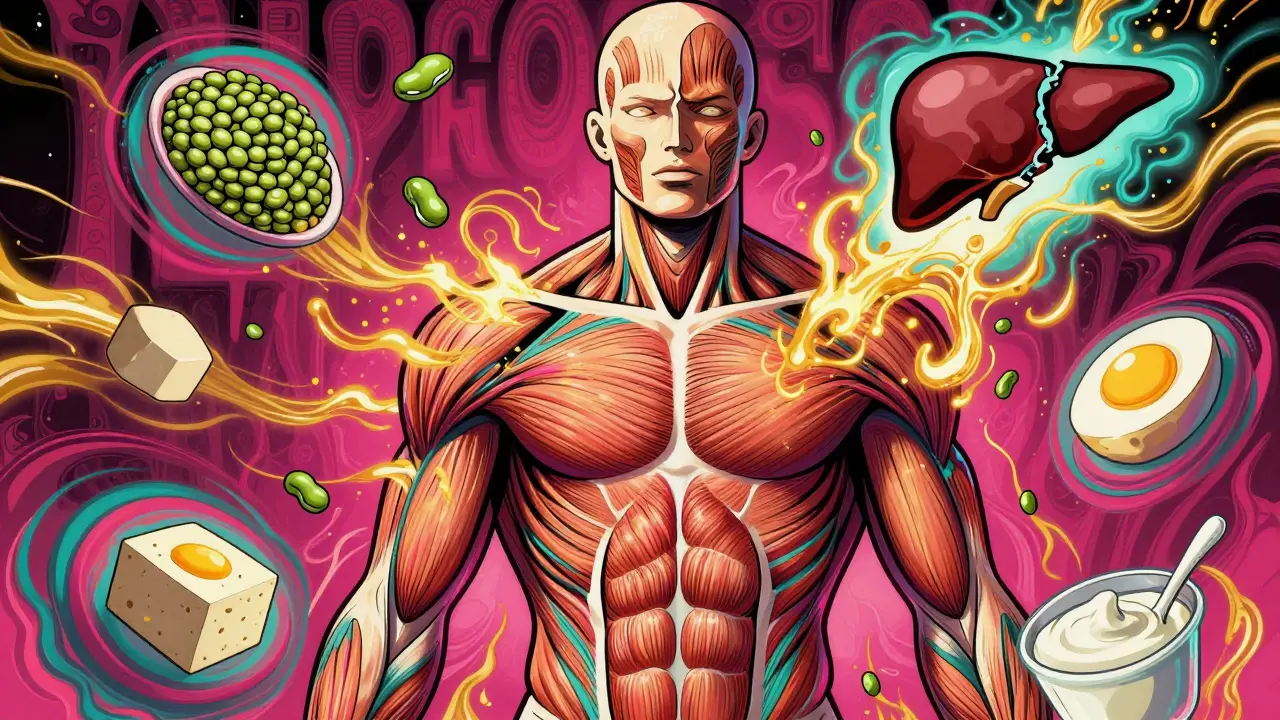
When your liver is damaged by cirrhosis, your body doesn’t just struggle to filter toxins-it starts breaking down your own muscle. This isn’t just about weakness. It’s about survival. Up to 70% of people with cirrhosis lose so much muscle that their risk of dying jumps by two to three times. And for decades, doctors told them to eat less protein to protect their brain. That advice was wrong. Today, the science is clear: protein is your best defense against muscle loss in cirrhosis-not your enemy.
Why Protein Isn’t the Problem-It’s the Solution
For years, the standard advice for cirrhosis patients with hepatic encephalopathy (HE) was to cut protein. The logic was simple: protein breaks down into ammonia, and a damaged liver can’t clear it. So less protein = less ammonia = less confusion. But that thinking ignored a bigger problem: when you starve your body of protein, it starts eating its own muscle to survive. And muscle loss doesn’t just make you weak-it kills.
A landmark 2004 study changed everything. Researchers gave one group of cirrhosis patients just 0.5 grams of protein per kilogram of body weight per day-far below what most people need. Another group got 1.2 grams. The low-protein group didn’t have fewer episodes of confusion. But they lost muscle faster. Their bodies were literally cannibalizing themselves. That study, backed by decades of follow-up research, ended the myth that protein causes HE. The American Association for the Study of Liver Diseases (AASLD) now says protein restriction is harmful. Not just unnecessary-harmful.
How Much Protein Do You Actually Need?
You don’t need to eat like a bodybuilder. But you do need to eat enough. The target is 1.2 to 1.5 grams of protein per kilogram of your dry body weight. That means you subtract fluid retention. If you have swelling in your belly or legs, your scale weight is misleading. A 70-kilogram person (about 154 pounds) should aim for 84 to 105 grams of protein a day. If you’re already losing muscle, shoot for the higher end.
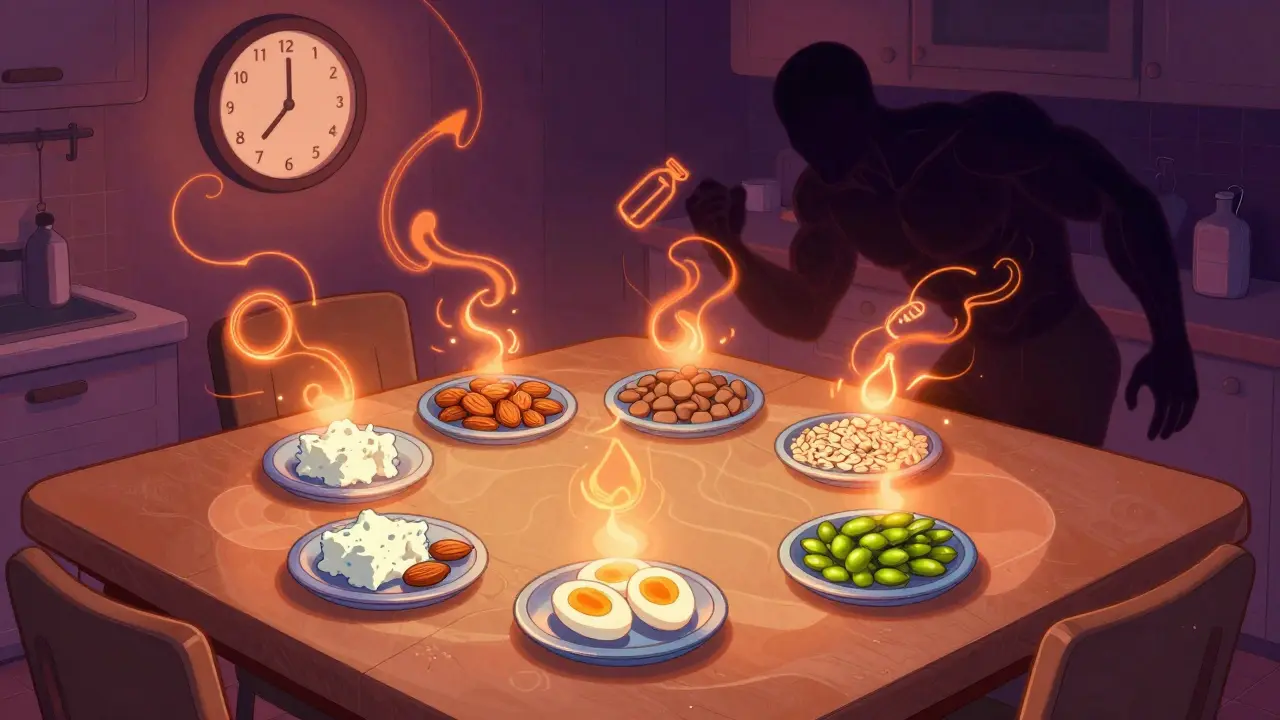
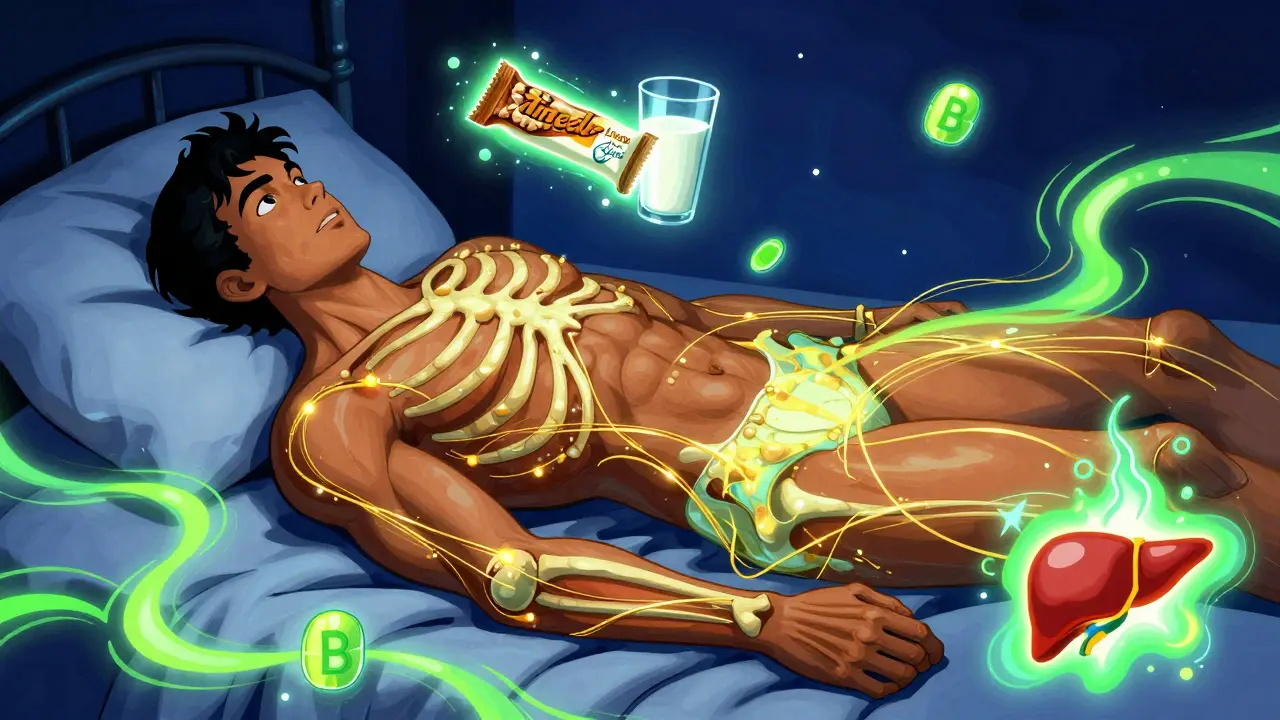
For people who are very sick or hospitalized, the range goes up to 1.2 to 2.0 grams per kilogram. That’s because illness makes your body burn through protein even faster. The key is consistency. Don’t try to get all your protein in one meal. Spread it out. Eat every 3 to 4 hours while you’re awake. And don’t skip the bedtime snack. Overnight fasting is one of the worst things you can do. Your body breaks down muscle while you sleep. A high-protein snack before bed helps stop that.
Not All Protein Is Created Equal
It’s not just about how much you eat-it’s where it comes from. Meat-based proteins like beef, chicken, and fish are fine in moderation. But plant and dairy sources are better tolerated, especially if you have hepatic encephalopathy. Why? They produce less ammonia during digestion and are easier on your liver.
Focus on:
- Eggs (6 grams per large egg)
- Low-salt cheese and yogurt
- Milk (8 grams per 8 ounces)
- Lentils, beans, and peas
- Tofu, edamame, and soy milk
- Nuts and seeds
- Oatmeal and wild rice
These foods give you protein without the heavy load. A 3-ounce chicken breast has 27 grams of protein, but a cup of lentils gives you 18 grams-and fiber, too. If you’re struggling to hit your numbers, high-protein snacks like Clif Builder’s Bars (68 grams per bar) or Nature Valley Protein bars (40 grams) can help bridge the gap. Talk to your dietitian about supplements if food alone isn’t enough.
Calories Matter Just as Much as Protein
Protein can’t do its job if you’re not eating enough calories. Your body will use protein for energy instead of rebuilding muscle. That’s why you need at least 35 calories per kilogram of dry weight per day if your BMI is normal. If you’re overweight (BMI 30-40), aim for 25-35 calories per kilogram. If you’re severely overweight (BMI over 40), 20-25 calories per kilogram is enough.
But here’s the catch: you might not feel hungry. Cirrhosis causes early fullness because fluid in your belly pushes on your stomach. That’s why you need nutrient-dense foods. Choose whole milk over skim. Add olive oil to your vegetables. Eat dried fruit instead of juice. A handful of almonds gives you more calories and protein than a cup of applesauce. If you’re losing weight, don’t go low-fat. Fat helps you absorb nutrients and adds calories without filling you up too fast.
Don’t Forget the Micronutrients
Protein and calories aren’t the whole story. Cirrhosis messes with how your body uses vitamins and minerals. Common deficiencies include zinc, thiamine, magnesium, and B vitamins. Zinc is especially important-it helps with protein synthesis and immune function. Many doctors recommend 50 mg of oral zinc daily. But don’t self-prescribe. Talk to your doctor first.
Some vitamins can be dangerous. Too much vitamin A or D can build up and harm your liver. If you have hemochromatosis, avoid extra vitamin C-it makes your body absorb more iron, which can poison your liver. Your blood work should check for these imbalances regularly. A simple blood test can tell you if you’re missing key nutrients that support muscle repair and liver function.
What If You Can’t Eat Enough?
Loss of appetite, nausea, and taste changes are common in cirrhosis. You might feel full after a few bites. That’s normal. But it’s not okay to let it slide. Here’s what works:
- Eat 5-6 small meals instead of 3 big ones
- Keep high-calorie, high-protein snacks handy: cheese cubes, peanut butter on crackers, hard-boiled eggs
- Drink liquid nutrition supplements if meals aren’t enough-many are specially formulated for liver disease
- Don’t force yourself to eat large portions. Small, frequent bites are better than one big meal you can’t finish
If you’re losing weight despite trying, your doctor can prescribe a medical nutrition supplement. These aren’t the same as protein shakes you buy at the gym. They’re designed for liver patients-with the right balance of protein, calories, and low sodium.
Sodium and Fluids: The Tightrope Walk
Most cirrhosis patients have fluid buildup. Doctors tell them to cut salt. But if cutting salt means you can’t eat enough protein or calories, you’re trading one risk for another. The AASLD says: if you’re losing weight or muscle, liberalize your sodium limit. It’s not about being perfect-it’s about staying alive. Work with your dietitian to find a balance. Maybe you eat a little more salt to enjoy a protein-rich meal. That’s better than skipping it.
The Bottom Line: Protein Saves Lives
People with cirrhosis are not failing because they eat too much protein. They’re failing because they’ve been told to eat too little. Muscle loss isn’t a side effect of cirrhosis-it’s a direct driver of death. Getting enough protein, spread throughout the day, with the right sources, and paired with enough calories, is the most powerful nutritional tool you have. It’s not about a miracle diet. It’s about consistency. It’s about eating enough, every day, even when you don’t feel like it. Your muscles are your lifeline. Protect them.
Can eating too much protein worsen hepatic encephalopathy?
No. Multiple studies, including a major 2004 trial, show that increasing protein intake does not worsen hepatic encephalopathy. In fact, restricting protein leads to muscle loss, which makes HE worse over time. Current guidelines from the American Association for the Study of Liver Diseases (AASLD) and other major liver societies recommend adequate protein intake-even for patients with HE. The focus should be on plant and dairy proteins, which are better tolerated.
How do I calculate my protein needs if I have fluid retention?
Use your dry body weight-not your scale weight. Dry weight is your weight after fluid buildup (ascites or swelling) is treated. If you don’t know your dry weight, ask your doctor or dietitian. As a rough estimate, use your ideal body weight: for men, start with 50 kg for the first 5 feet of height, then add 2.3 kg per inch over 5 feet. For women, start with 45.5 kg for 5 feet, then add 2.3 kg per inch. Then multiply by 1.2-1.5 g/kg. For example, a 5’7” woman with dry weight of 60 kg needs 72-90 grams of protein daily.
Are protein shakes safe for people with cirrhosis?
Yes-but not all are created equal. Many commercial protein powders are high in sodium, artificial sweeteners, or additives that aren’t ideal for liver disease. Look for medical nutrition formulas designed for cirrhosis patients, often prescribed by doctors. These have balanced protein, low sodium, and added vitamins. If using a regular shake, check the label: avoid added sugar, artificial flavors, and high sodium. Whey protein is generally fine, but plant-based options like pea or soy protein are often better tolerated.
Should I avoid red meat if I have cirrhosis?
You don’t need to avoid it completely, but prioritize plant and dairy proteins. Red meat is higher in saturated fat and can be harder to digest, especially if you have advanced disease. If you eat meat, choose lean cuts like chicken breast, turkey, or fish. Limit red meat to once or twice a week. The goal is to get most of your protein from sources like eggs, dairy, beans, tofu, and lentils-which are easier on your liver and better for muscle building.
What if I’m losing weight even though I’m eating enough?
If you’re eating the right amount of protein and calories but still losing weight, talk to your doctor. You may need a medical nutrition supplement or a higher-calorie diet. Sometimes, underlying issues like infections, poor digestion, or thyroid problems are contributing. Your doctor may also check your muscle mass with a body composition scan. Weight loss in cirrhosis is dangerous-even if you’re overweight, losing muscle increases your risk of death. Don’t ignore it.
Next Steps: What to Do Today
Start with one change. Write down your dry weight. Calculate your daily protein target (1.2-1.5 g/kg). Plan three meals and two snacks. Add one plant-based protein source to each meal-beans, tofu, yogurt, or eggs. Have a high-protein snack before bed: cottage cheese, a hard-boiled egg, or a protein bar. Drink water, but don’t let fluid restrictions stop you from eating. Talk to your dietitian about supplements if you’re falling short. Muscle loss doesn’t reverse overnight. But every gram of protein you eat today is one less gram your body has to steal from your muscles.

Jake Moore
January 16, 2026 AT 14:36Just wanted to say this is the most practical, life-saving info I've seen on cirrhosis nutrition. I've been helping my dad manage his for 2 years, and the protein myth is everywhere-even his old hepatologist still whispers 'less protein' like it's gospel. This article flipped the script. We started hitting 1.3g/kg with eggs, Greek yogurt, and lentils, and his muscle strength actually improved. No more falls. No more bed rest. It's not magic-it's math. And consistency. Do the math. Eat the protein. Stay alive.
Praseetha Pn
January 17, 2026 AT 05:45HA! Of course they told you to cut protein-that’s Big Pharma’s dirty little secret. They make billions off liver transplants and ammonia-lowering drugs, but if you just ate more tofu and beans, you’d never need a transplant. The FDA knows this. The WHO knows this. But they don’t want you to know. Protein restriction? That’s a scam. They want you weak, dependent, and on their $12,000/month meds. Wake up. Eat beans. Fight back. #ProteinIsPower #LiverConspiracy
rachel bellet
January 19, 2026 AT 00:09While the article correctly identifies protein inadequacy as a driver of sarcopenia in cirrhosis, it fails to contextualize the heterogeneity of hepatic encephalopathy phenotypes. The AASLD guidelines are indeed evidence-based, but they assume a stable, non-acute metabolic state. In patients with recurrent HE, particularly those with portosystemic shunting or gut dysbiosis, even moderate protein intake can transiently elevate ammonia, triggering neuroinflammation. The 1.2–1.5 g/kg target is appropriate for maintenance, but titration must be individualized based on serum ammonia trends, fecal microbiota composition, and branched-chain amino acid ratios. Otherwise, you’re not saving muscle-you’re accelerating encephalopathic episodes. This is not a one-size-fits-all protocol.
Pat Dean
January 19, 2026 AT 10:49Wow. Just wow. Another one of these 'eat more protein' articles from the American medical-industrial complex. In the US, we’re so obsessed with protein shakes and whey that we forget other countries have been feeding their elderly with rice, lentils, and fermented soy for centuries-without all this 'g/kg' nonsense. And now we're telling people with liver failure to eat more chicken and cheese? That’s what killed my uncle. He ate like a bodybuilder and died in a coma. Don’t believe the hype. Eat simple. Eat plant-based. Eat like your ancestors did. Not like some fitness influencer.
Jay Clarke
January 19, 2026 AT 22:27Okay, but let’s be real-this whole thing is just a fancy way of saying 'eat more eggs and stop being scared of meat.' I’ve seen this before. First it was 'fat is evil,' then it was 'carbs are evil,' now it's 'protein is your only friend.' Meanwhile, the real problem? The liver’s busted. No amount of tofu is gonna fix that. But hey, if you wanna feel like you’re doing something, go ahead and chug that Clif Bar before bed. Just don’t cry when your belly swells up again. This isn’t a nutrition fix-it’s a psychological crutch. We’re all just trying to outrun death with protein bars.
Robert Davis
January 21, 2026 AT 15:36I’m not saying this is wrong. I’m just… thinking. If the liver can’t process ammonia, and protein makes ammonia, and muscle loss makes you die faster… then why does eating more protein help? It doesn’t add up. It’s like pouring gasoline on a fire and saying ‘look, the fire’s bigger now, so it must be working.’ I don’t trust the science. Not anymore. I’ve read too many studies that get retracted. Maybe it’s not protein. Maybe it’s something else. Maybe we’re all being led down the garden path.
Joni O
January 21, 2026 AT 18:46my mom just got diagnosed and i’ve been stressing so much about what to cook… this article literally saved me. i started making her scrambled eggs with spinach and a little cheese for breakfast, then a peanut butter banana smoothie with milk for snack, and cottage cheese before bed. she’s been eating more than she has in months. not perfect, but better. thank you. i printed this out and taped it to the fridge. i’m not a doctor, but i know when something feels right. 💛
Max Sinclair
January 22, 2026 AT 01:57Appreciate the clarity here. I’ve seen too many patients get stuck in the protein fear trap-especially older folks who’ve been told for decades to avoid meat. One of my patients, 72, was eating 40g of protein a day. We bumped her to 85g with eggs, yogurt, and lentils. Her grip strength improved in 3 weeks. She started walking to the mailbox again. That’s not a miracle. That’s physiology. The liver doesn’t need to be perfect to use protein-it just needs enough to stop eating itself. Simple. Real. Powerful.
Ryan Otto
January 22, 2026 AT 17:27It is profoundly troubling that Western medicine continues to promote protein supplementation as a panacea for cirrhosis without addressing the systemic failures of nutritional equity. In the Global South, where access to dairy and soy products is limited, this advice is not merely impractical-it is colonialist. Why are we not advocating for culturally appropriate, locally sourced protein alternatives like fermented cassava, millet porridge, or insect-based proteins? This article, while scientifically sound, reflects a narrow, privileged lens. The real issue is not protein quantity-it is protein access.
Emma #########
January 23, 2026 AT 00:01My brother’s on the transplant list and this article made me cry. I never knew how much muscle he’d lost-he looked thin, but I thought it was just ‘being sick.’ Now I see he’s been starving himself because he was scared of protein. I made him a tofu stir-fry with quinoa tonight. He ate half. That’s more than he’s eaten in a week. I’m not letting go of this. We’re doing this. Every bite counts.
Robert Cassidy
January 23, 2026 AT 04:34Let’s be honest-this is all just a distraction. The real problem? The American diet. Sugar. Processed carbs. Alcohol. We’re all just one bad liver away from a death sentence because we ate like pigs for 40 years. Now you want me to eat more protein? Fine. But don’t pretend this is a solution. It’s damage control. And the system? It’s still selling you cheap, toxic food while you’re trying to survive. You think a Clif Bar is going to fix what Big Ag did to your body? Wake up. This isn’t nutrition. It’s survival theater.