Echinacea & Immunosuppressant Interaction Checker
Medication Safety Checker
Enter your immunosuppressant medication to check if echinacea is safe to take.
Every year, hundreds of thousands of people take echinacea to boost their immune system. It’s sold in nearly every pharmacy, health store, and online shop as a natural remedy for colds and flu. But if you’re on immunosuppressant medication-whether after a transplant, for rheumatoid arthritis, lupus, or another autoimmune condition-taking echinacea could be dangerous. And most people don’t realize it.
How Echinacea Actually Works
Echinacea isn’t just a simple herb. It’s a complex mix of chemicals: alkamides, caffeic acid derivatives, polysaccharides, and glycoproteins. These compounds don’t just gently nudge your immune system-they actively stir it up. In the short term, echinacea increases the movement of white blood cells, activates macrophages and natural killer cells, and boosts phagocytosis-the process where immune cells swallow up invaders like bacteria and viruses.
This is why people feel like it “works.” You take it at the first sign of a cold, and your body goes into overdrive. But here’s the catch: that same stimulation can turn into suppression over time. Studies from the American Academy of Family Physicians show that using echinacea for more than eight weeks may actually dampen immune activity. That’s not a typo. The same herb that wakes up your defenses can eventually tire them out.
What Are Immunosuppressants?
Immunosuppressants are drugs designed to quiet the immune system. They’re used after organ transplants to stop the body from rejecting the new organ. They’re also used for autoimmune diseases like multiple sclerosis, Crohn’s disease, and psoriasis, where the immune system mistakenly attacks healthy tissue.
Common immunosuppressants include:
- Cyclosporine
- Tacrolimus
- Azathioprine
- Mycophenolate mofetil
- Methotrexate
- Corticosteroids like prednisone
These drugs are powerful. They keep your immune system from going too far. Take too little, and your body attacks the transplant. Take too much, and you become vulnerable to infections. The balance is delicate-and echinacea throws it off.
The Conflict: Boosting vs. Blocking
Echinacea and immunosuppressants are on opposite sides of the same battlefield. One says, “Attack!” The other says, “Stand down.” When you take both, your body gets mixed signals.
Memorial Sloan Kettering Cancer Center has documented real cases where echinacea use led to serious problems:
- A 55-year-old man with pemphigus vulgaris (a rare autoimmune skin disease) had a flare-up after starting echinacea while on immunosuppressants. His condition only stabilized after he stopped taking it.
- A 61-year-old lung cancer patient developed dangerously low platelet counts while taking echinacea alongside chemotherapy drugs.
- A 32-year-old man developed a rare, life-threatening blood disorder called thrombotic thrombocytopenic purpura after using echinacea for a cold.
These aren’t rare anomalies. They’re warning signs. The American Society of Health-System Pharmacists classifies the interaction as “moderate,” meaning it’s not just theoretical-it’s been seen in clinics and hospitals.
Why This Isn’t Just a Theory
Some people say, “There’s no solid proof.” But the evidence is growing. A 2021 survey of 512 transplant patients found that 34% had taken echinacea after their surgery. Of those, 12% reported complications they believed were linked to the supplement. In patient forums like Inspire and HealthUnlocked, over 20 users described needing higher doses of immunosuppressants or experiencing rejection episodes after starting echinacea.
And here’s the scary part: most of them didn’t tell their doctors. They assumed herbal = safe. They didn’t realize echinacea could undo months or years of careful medical management.
The European Medicines Agency and the U.S. FDA both warn that the risk of interaction can’t be ruled out. In 2023, the FDA sent warning letters to three supplement makers for selling echinacea products without disclosing this risk. That’s not a small footnote-it’s a regulatory red flag.
What Other Herbs Do
Not all herbal supplements behave like echinacea. Milk thistle affects liver enzymes but doesn’t touch immune cells. Ginger has mild anti-inflammatory effects but doesn’t activate white blood cells. Turmeric? It modulates inflammation but doesn’t trigger the same immune surge.
Echinacea is unique because it directly stimulates immune cells through cannabinoid receptor type 2 (CB2). That’s the same pathway some immune-modulating drugs target. When you add echinacea to immunosuppressants, you’re essentially turning up the volume on a system that’s supposed to be turned down.
What Doctors Say
The American Society of Transplantation recommends complete avoidance of echinacea in all solid organ transplant recipients. A 2022 report found that 87% of transplant centers follow this rule.
The American College of Rheumatology’s 2023 guidelines say the same for people with autoimmune diseases: avoid echinacea. In a survey of rheumatologists, 92% agreed.
Even the National Center for Complementary and Integrative Health (NCCIH) updated its 2024 guidelines to list echinacea-immunosuppressant interaction as a primary safety concern.
It’s not about being overly cautious. It’s about survival.
What Should You Do?
If you’re on immunosuppressants:
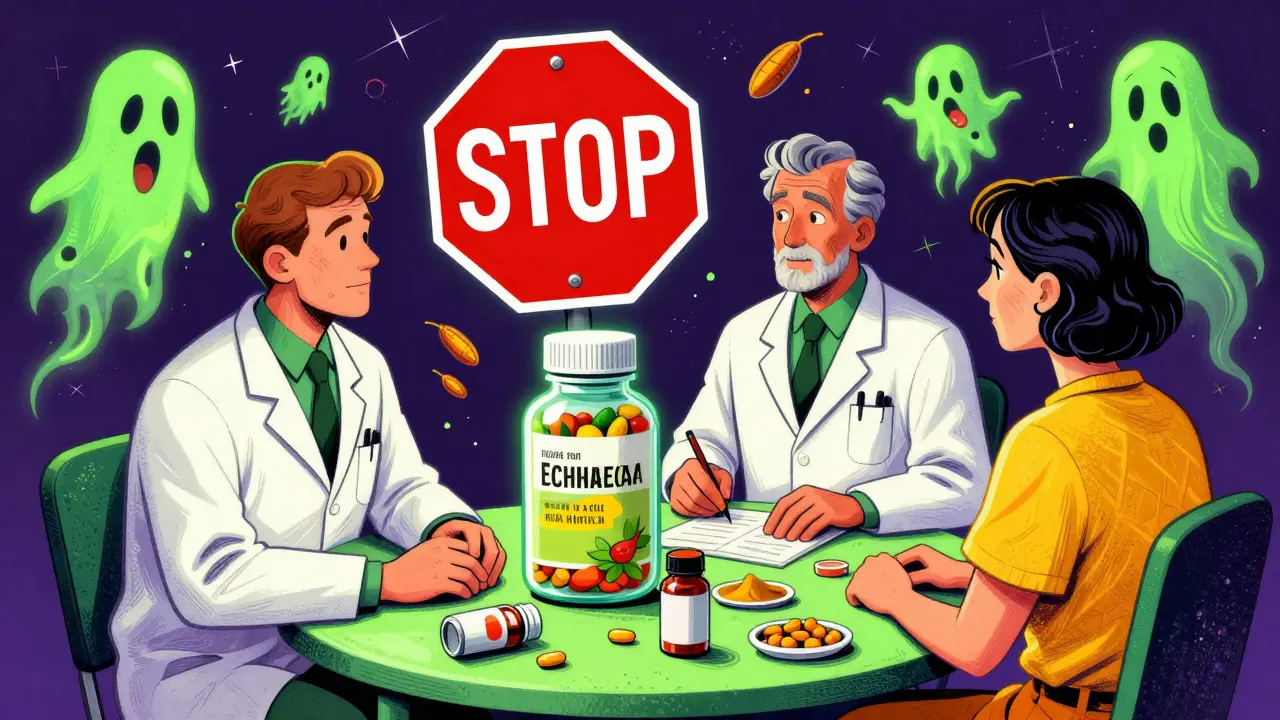
- Stop taking echinacea immediately. Even if you feel fine, the damage might be happening silently.
- Tell your doctor. Don’t wait for your next appointment. Call now. Bring a list of every supplement you take-even “natural” ones.
- Don’t assume “natural” means safe. Many people think herbs are harmless because they come from plants. But foxglove is a plant too-and it’s deadly if misused.
- Ask for alternatives. If you’re taking echinacea for colds, ask your doctor what’s safe. Zinc, vitamin D, and good sleep are proven immune supporters without the risk.
There’s no safe dose of echinacea if you’re on immunosuppressants. Not one. Not even a tea bag.
The Bigger Picture
The echinacea market is worth over $140 million a year. Nearly half of users take it for “immune support.” That’s a lot of people walking into pharmacies, buying a bottle, and thinking they’re doing something good for their health.
But for those on immunosuppressants, that bottle could be a ticking time bomb.
Doctors can’t protect you if they don’t know what you’re taking. And supplement labels? They rarely mention drug interactions. That’s why the burden falls on you.
You don’t need echinacea to stay healthy. You need to protect the medication that’s keeping you alive.
What’s Being Done Now?
The National Institutes of Health is funding a $2.4 million study (NCT04851234) to look at how echinacea affects tacrolimus levels in kidney transplant patients. Results are expected in early 2025.
Until then, the safest choice is clear: don’t take it.
Diana Campos Ortiz
January 13, 2026 AT 07:18I never realized echinacea could mess with my transplant meds. I’ve been taking it for years because my mom swore by it. I’m calling my doctor tomorrow to get off it-better safe than sorry.
Thanks for laying this out so clearly.
James Castner
January 13, 2026 AT 13:45One must consider the metaphysical implications of herbal intervention in the delicate equilibrium of pharmacological immunomodulation. Echinacea, as a phytochemical agent, does not merely ‘boost’ immunity-it disrupts the homeostatic silence that immunosuppressants painstakingly enforce. The body, in its wisdom, does not distinguish between ‘natural’ and ‘synthetic’; it responds to signal, not origin. To conflate botanical provenance with benignancy is to commit a fundamental error of epistemology-akin to believing that arsenic is harmless because it comes from the earth.
The regulatory silence of supplement labels is not negligence; it is commodification masquerading as wellness. We have turned healing into a consumer choice, and in doing so, we have abandoned the sacred responsibility of informed consent.
lucy cooke
January 14, 2026 AT 07:17Oh my god, I just Googled ‘echinacea transplant death’ and there’s a whole Reddit thread from 2018 where someone’s uncle died because he ‘just wanted to beat his cold.’ Like… what were you thinking? You’re on life-saving drugs and you’re sipping herbal tea like it’s kombucha?
Also, why do people think ‘natural’ means ‘no side effects’? That’s like saying ‘I’m not speeding, I’m just driving a Tesla.’
Kimberly Mitchell
January 16, 2026 AT 05:17There’s a documented interaction between echinacea and CYP3A4 substrates, which includes tacrolimus and cyclosporine. The pharmacokinetic data shows increased AUC and decreased clearance when co-administered. This isn’t anecdotal-it’s in the Lexicomp database. If you’re on immunosuppressants and you’re still taking echinacea, you’re not just risky-you’re statistically likely to experience graft rejection or cytopenia within 6–12 weeks.
Angel Molano
January 17, 2026 AT 10:38If you’re taking echinacea while on immunosuppressants, you’re an idiot. Stop. Now.
Vinaypriy Wane
January 18, 2026 AT 20:32I’m from India, and we’ve used herbs for centuries-but we also had gurus who knew when NOT to use them. Echinacea? It’s like mixing fire and gasoline and calling it ‘wellness.’
My cousin had a kidney transplant last year. Her doctor told her: ‘No herbs, no teas, no ‘natural boosts.’’ She listened. She’s fine. Others didn’t. I’m sharing this because I care.
Please, if you’re reading this and you’re on meds-talk to your pharmacist. Not your yoga instructor.
Adam Rivera
January 20, 2026 AT 11:59Just wanted to say thanks for posting this. I’m a transplant recipient and I’ve seen so many people online say ‘I took echinacea and felt great!’-and I just want to scream, ‘You’re lucky!’
My mom’s a nurse. She told me: ‘If it’s not on the FDA’s list of approved drugs, it’s not your friend.’ I used to roll my eyes. Now I get it.
Also-zinc and vitamin D are your new best friends. Sleep. Hydration. No magic tea needed.
mike swinchoski
January 21, 2026 AT 06:38People are so dumb. You take a pill that stops your body from killing your new kidney, then you drink a tea that makes your body go ‘I’m gonna kill it anyway!’ What is wrong with you? You don’t get to be ‘natural’ and then act surprised when you die.
Stop. Just stop.
Anny Kaettano
January 22, 2026 AT 21:57As someone who works in clinical immunology, I see this every day. Patients come in with ‘just a little echinacea’ and then their tacrolimus levels crash. We have to increase doses, run more labs, delay follow-ups. It’s not just dangerous-it’s a burden on the system.
And the worst part? They never tell us. They say, ‘Oh, I didn’t think it mattered.’
It matters. It always matters.
If you’re on immunosuppressants, please, please, please-keep a list of everything you take. Even the ‘harmless’ stuff. Bring it to every appointment. Your life depends on it.
John Tran
January 24, 2026 AT 21:00Okay so here’s the thing-I used echinacea for 3 months after my liver transplant because I thought it would help me ‘recover faster.’ I didn’t tell my doctor because I didn’t want to sound stupid. Then I got a crazy fever, my enzymes spiked, and they thought I was rejecting. Turns out? It was the echinacea. Took 3 weeks to get my levels stable again.
I feel like such an idiot. But I’m sharing this because I don’t want anyone else to go through that. You think you’re being healthy? You’re just playing Russian roulette with your organs.
Also, I miss the tea. But not as much as I miss nearly dying.
Robin Williams
January 25, 2026 AT 06:07Life’s too short to be scared of herbs-but it’s also too short to ignore science. Echinacea isn’t evil. It’s just not for you if you’re on immunosuppressants. Like, imagine trying to win a tug-of-war while your teammate is holding back. That’s your immune system right now.
Be kind to your body. It’s doing its best. Stop giving it mixed signals.
Scottie Baker
January 26, 2026 AT 15:16I just got my transplant last year. I was taking echinacea like it was candy. Then I read this and I threw the whole bottle in the trash. I cried. Not because I’m sad-I’m just so damn mad at myself for being so naive.
Thanks for this. I’m telling everyone I know.