Every pill you take - whether it’s a brand-name drug or a generic - should work the same way. But how do you know it’s real? In 2025, counterfeit drugs still slip through cracks in the supply chain, especially in low-regulation markets. The difference between a safe generic and a dangerous fake isn’t luck. It’s quality control - built into every step of manufacturing, not just tested at the end.
Why Generic Drugs Can’t Be Cut Corners
Generic drugs make up 90% of all prescriptions filled in the U.S. But they account for only 23% of spending. That’s because they’re cheaper - not because they’re lower quality. The law requires them to be identical in active ingredient, strength, dosage form, and how the body absorbs them. But that’s only half the story. The real safeguard is the system that keeps fake drugs from ever being made.Counterfeiters don’t just copy the label. They copy the color, shape, and even the imprint. Some even use the right chemical - but in the wrong crystal form. That’s deadly. A drug might look perfect, but if the molecules aren’t arranged right, it won’t dissolve in your body. You get no effect. Or worse - toxic buildup. That’s why testing the final pill isn’t enough. Quality has to be built in from day one.
The cGMP System: Quality You Can’t Test In
The backbone of all legitimate generic drug production is cGMP - Current Good Manufacturing Practices. This isn’t a suggestion. It’s federal law under 21 CFR Part 211. And the FDA says it plainly: “Quality cannot be tested into a finished product; it must be built into the design and manufacturing process at every single step.”That means every raw material is tested before it touches the production floor. Every machine is cleaned and validated. Every room has air filters keeping particles under 3,520 per cubic meter - the ISO Class 5 standard. Even the humidity and temperature are tracked. If a batch of powder doesn’t meet specs, the whole lot is scrapped. No exceptions.
Why does this matter for counterfeits? Because fake manufacturers can’t afford this level of control. Setting up a clean room, buying certified equipment, training staff, and running daily audits costs millions. Counterfeiters want quick cash. They skip the audits. They reuse containers. They use unapproved fillers. That’s why the FDA found 96% of drugs sold by illegal online pharmacies failed basic quality tests. Legitimate generics? Their adverse event rate is actually lower than brand-name drugs - 0.02% versus 0.03%.
The SQUIPP Framework: What Gets Tested
Legitimate manufacturers don’t just test for “is it the right drug?” They test for five things - SQUIPP: Safety, Quality, Identity, Potency, Purity.- Identity: Is this the exact chemical compound? Infrared spectroscopy and high-performance liquid chromatography (HPLC) can spot fake ingredients with 99.9% accuracy.
- Potency: Does it have the right amount of active ingredient? Too little? It won’t work. Too much? It could poison you.
- Purity: Are there harmful impurities? The 2018 valsartan recall happened because a byproduct formed during manufacturing wasn’t caught by old testing methods. Now, labs use mass spectrometry to catch even trace contaminants.
- Quality: Does it dissolve properly? Dissolution testing checks if the pill releases 80% of its drug within 30-45 minutes - the same as the brand version.
- Safety: Are there foreign particles? Microbial contamination? Even a speck of mold can kill someone with a weak immune system.
These aren’t optional checks. They’re required for every batch. And the data? It’s stored electronically. No paper logs. No lost records. That’s where eQMS - Electronic Quality Management Systems - come in. By 2023, 78% of major generic makers used cloud-based systems to track over 15,000 quality parameters per batch. If a temperature spike happens during mixing, the system flags it instantly. The batch is quarantined. No one gets it.
Serialization: The Digital Fingerprint
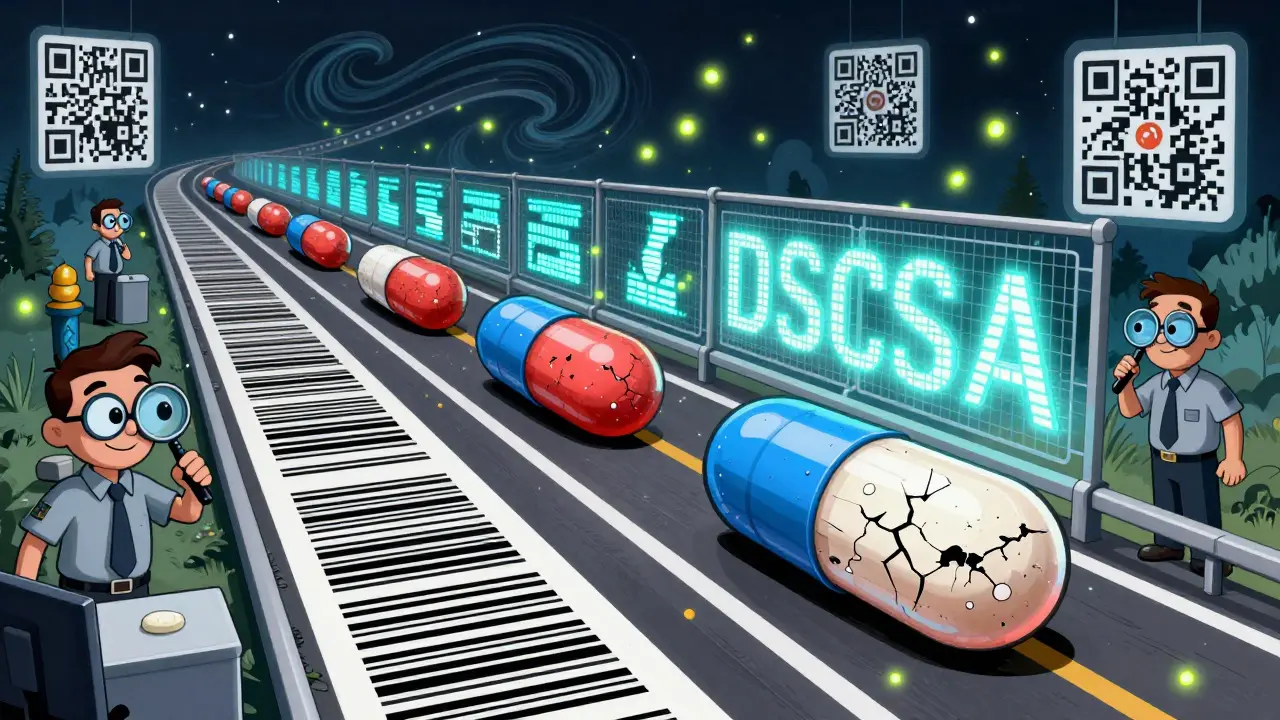
Even if a fake pill passes lab tests, it still can’t fool the supply chain. That’s thanks to the Drug Supply Chain Security Act (DSCSA). Every package - from blister packs to bottles - now has a unique serial number. It’s like a digital ID card for your medicine.When a pharmacy receives a shipment, they scan each package. The system checks: Is this number real? Was it made by an approved facility? Was it shipped legally? If the number doesn’t match the database, the package is blocked. This system has 99.99% accuracy. In 2023, 92% of the top 50 generic manufacturers had full serialization in place. Smaller companies lag, but the clock is ticking.
Some countries are going further. The EU requires safety features on all prescription packages - including tamper-evident seals and QR codes linked to a national database. Africa is testing blockchain for antimalarial generics. If you scan the code, you see the factory, batch number, and shipping route. No middlemen. No fakes.
Where the System Still Fails
No system is perfect. The biggest blind spot? Polymorphs. That’s when the same chemical molecule arranges itself in a different crystal structure. One form works. Another doesn’t. Standard tests can’t always tell them apart. The valsartan recall proved that. Manufacturers didn’t know their process was making the wrong form - until patients got sick.Another problem? Global inconsistency. In the U.S., FDA inspections show 94% of generic facilities are compliant. In India? 78%. In China? 65%. That’s why the WHO estimates counterfeit drugs make up 1% of the supply in rich countries - but up to 30% in poor ones. Regulatory agencies in those regions often lack funding, training, or power to enforce standards.
Even within the U.S., small manufacturers struggle. A single mass spectrometer costs $500,000 to $1 million. Many can’t afford it. Some still rely on older, less accurate methods. That’s why the FDA is pushing for continuous manufacturing - where sensors monitor quality every 5 seconds during production. It’s expensive, but it catches problems before they become batches.
What’s Next: AI and Molecular Taggants
The future of counterfeit prevention isn’t just better testing - it’s smarter detection. AI is already being used to spot anomalies in production data. IBM and Siemens have poured $1.2 billion into AI tools that predict when a machine is about to fail or when a batch is off-spec - before a single pill is made.Even more promising? Molecular taggants. These are invisible markers added to the drug at the molecular level. Think of them as DNA for pills. Only specialized scanners can read them. Even if a counterfeiter copies the chemical formula, they can’t replicate the taggant. The EU is already testing them. By 2026, they could be mandatory.
And then there’s quantum-resistant encryption. Serialization codes today could be hacked in the future. New encryption methods are being developed to survive quantum computing attacks - because if fake drug codes can be cloned digitally, the whole system collapses.
What You Can Do
As a patient, you don’t need to understand chromatography or polymorphs. But you can protect yourself:- Only buy from licensed pharmacies. Avoid websites that don’t require a prescription.
- Check your pills. If the color, shape, or imprint changes suddenly, ask your pharmacist. It could be a different generic - or a fake.
- Use the FDA’s Drug Shortage Database or the WHO’s list of approved generics to verify your medication.
- Report suspicious drugs. The FDA has a reporting portal. One tip can stop a whole shipment.
Generic drugs saved the U.S. healthcare system over $300 billion in 2023 alone. They’re safe, effective, and essential. But that safety isn’t automatic. It’s the result of thousands of inspections, millions of dollars in tech, and a system that refuses to cut corners. When you take a generic pill, you’re trusting that system. And it’s working - as long as we keep demanding it.
Are generic drugs as safe as brand-name drugs?
Yes - when they’re made under proper quality control. The FDA requires generic drugs to have the same active ingredient, strength, dosage form, and bioequivalence as the brand version. In fact, studies show generic drugs have a slightly lower adverse event rate (0.02%) compared to brand-name drugs (0.03%), because they’re held to the same strict cGMP standards. The difference isn’t in the drug - it’s in the manufacturing.
How do I know if my generic drug is fake?
Look for changes in appearance - color, shape, size, or imprint code. If it looks different from your last refill, ask your pharmacist. Check if the pharmacy is licensed (use the NABP’s Vetted Pharmacy list). Never buy from websites that sell pills without a prescription. If you suspect a fake, report it to the FDA’s MedWatch program. Most counterfeit drugs come from illegal online sources - not legitimate pharmacies.
Why are some generic drugs cheaper than others?
Price differences usually reflect manufacturing costs, not quality. A cheaper generic might be made in a facility with lower overhead, or by a company with fewer marketing expenses. But if it’s sold through a licensed pharmacy and approved by the FDA, it meets the same safety and efficacy standards. Don’t assume the cheapest is the worst - or the most expensive is the best. Always check for FDA approval and verify the manufacturer.
Can counterfeit drugs pass lab tests?
Some advanced counterfeits can mimic the chemical composition and pass basic identity tests. But they often fail in other areas - like dissolution rate, impurity profile, or polymorph structure. Standard tests don’t always catch these subtle differences. That’s why modern systems combine chemical testing with digital track-and-trace and serialization. A fake pill might pass a lab test but still get flagged by its serial number or packaging mismatch.
Do all countries have the same quality standards for generics?
No. The U.S., EU, Canada, and Japan have strict cGMP enforcement. But in many low- and middle-income countries, regulatory systems are underfunded or weak. The WHO estimates 10-30% of medicines in these regions are counterfeit. That’s why buying from international online pharmacies is risky - even if the drug looks real. Always use local, licensed pharmacies or verified international sources.
josue robert figueroa salazar
December 26, 2025 AT 11:47So basically if your pill looks right and you didn’t buy it off some shady website you’re good?
Joanne Smith
December 27, 2025 AT 09:53Let’s be real - most people don’t know what cGMP stands for, but they trust their pharmacist. And that’s the real safety net. The tech is cool, but the system works because someone at the counter still cares enough to double-check.
Also, I’ve had generics from three different makers for the same med - all worked fine. The color changed? Cool. The shape? Whatever. As long as it doesn’t make me hallucinate, I’m not complaining.
carissa projo
December 28, 2025 AT 07:43There’s something quietly beautiful about how much invisible labor goes into making sure a tiny pill doesn’t kill you.
It’s not glamorous. No one cheers when a machine validates a clean room. No TED Talk about humidity controls. But that’s where the real heroism lives - in the quiet, repetitive, exacting work that refuses to cut corners even when no one’s watching.
We treat medicine like a commodity, but it’s not. It’s a covenant. And every batch that gets scrapped? That’s someone saying: ‘I’d rather lose money than lose a life.’
Next time you swallow a generic, don’t think ‘cheap.’ Think ‘trust.’
Alex Ragen
December 29, 2025 AT 02:35Oh, so we’re now romanticizing regulatory compliance as if it were a Whitman poem? How quaint. The real tragedy isn’t counterfeit pills - it’s that we’ve outsourced our health literacy to a bureaucracy that operates on spreadsheets and not ethics.
And let’s not pretend AI and taggants are solutions - they’re just expensive band-aids on a system that’s been bleeding since the 1980s. The FDA doesn’t prevent fakes - it reacts to them. And that’s not safety. That’s damage control with a logo.
Ryan Cheng
December 30, 2025 AT 00:27My cousin works at a small generic manufacturer in Ohio. They got audited last year. They spent $300k upgrading their dissolution testing rig because the old one couldn’t catch polymorph shifts.
They didn’t have to. The FDA didn’t require it. But they did it anyway - because their founder’s mom died from a bad batch in the 90s.
That’s the real story. Not the tech. Not the regulations. The people who refuse to let history repeat itself.
Most of us don’t know their names. But they’re the ones keeping us alive.
Jeanette Jeffrey
December 30, 2025 AT 20:53Wow. So the solution to global health inequality is… more expensive machines? And QR codes? Cute. You think a village in rural Bihar gives a damn about serialization? They need medicine that doesn’t cost their entire month’s wage.
This whole post reads like a pharma marketing brochure written by someone who’s never seen a pharmacy without air conditioning.
Stop fetishizing compliance. Fix the supply chain. Or shut up.
wendy parrales fong
December 31, 2025 AT 00:40Just think about it - someone out there spent hours making sure your pill dissolves right so you don’t get sick.
That’s kind of amazing when you think about it.
And we just swallow it without a second thought.
Maybe we should be a little more grateful.
Also, my blood pressure med changed shape last month. Asked my pharmacist. She said it’s the same stuff, just a different maker. I believed her. And I’m still alive. So yeah.
Trust the system. It’s working.
jesse chen
January 1, 2026 AT 22:57Can I just say how much I appreciate the SQUIPP framework? It’s so rare to see a technical subject broken down into something so clear and memorable - and honestly, it’s the kind of thing that should be taught in high school health class.
Identity, potency, purity - these aren’t buzzwords. They’re lifelines.
And the fact that 78% of manufacturers now use cloud-based eQMS? That’s huge. It means errors are caught before they leave the plant - not months later when someone’s liver fails.
Also, the part about polymorphs? Terrifying. But also fascinating. One tiny rearrangement of atoms, and your medicine becomes useless - or dangerous. It’s like molecular magic. And we’re lucky that someone’s watching the spell.
Lori Anne Franklin
January 3, 2026 AT 11:18i just took my generic blood thinner and i was like… wait, did this pill use to be blue? now it’s white??
so i called my pharma and they were like ‘yep same thing diff maker’ and i was like ‘ok cool’ and then i went back to scrolling tiktok
but honestly? if i’m alive and not bleeding out, i’m not gonna stress about it
also i hate when people say ‘buy from licensed pharmacies’ like that’s easy when you’re on food stamps and your town has one pharmacy and it’s 40 miles away
so yeah. system’s good. but not everyone can play by the rules.
Prasanthi Kontemukkala
January 5, 2026 AT 04:27I come from a country where counterfeit medicines are common - and I’ve seen what happens when people take them.
It’s not just about money. It’s about dignity. No one should have to gamble with their life because they can’t afford the brand.
That’s why I’m so glad to see systems like serialization and cGMP being pushed globally. It’s not perfect, but it’s progress.
And yes - small manufacturers in India and Africa need support, not judgment. We need more funding, more training, more collaboration - not just audits.
Quality isn’t a luxury. It’s a right.
And we’re getting closer.
Bryan Woods
January 6, 2026 AT 07:55Interesting read. The technical depth is impressive, and the emphasis on process over end-product testing is a critical point often overlooked.
That said, the assumption that serialization and AI will solve the problem may be overly optimistic. Cybersecurity risks, supply chain complexity, and geopolitical instability all introduce new vectors for failure.
Still, the core message stands: quality is engineered, not inspected. That principle applies far beyond pharmaceuticals.
Well-structured argument.
david jackson
January 7, 2026 AT 16:23Let me tell you - I used to work in a lab that tested generics for a Fortune 500 company. I’ve seen the machines. I’ve seen the logs. I’ve seen the batches that got tossed because a single molecule was out of place.
And let me tell you something: the system works - not because it’s perfect, but because it’s obsessive.
Every single day, someone checks the humidity in Room 7B. Someone recalibrates the HPLC. Someone stares at a chromatogram for an hour because the peak is 0.3% off.
And yes - it costs millions. And yes - it’s slow. And yes - it’s boring.
But when you’re the person whose kid is on that drug? When you’re the one who remembers the last time a batch killed someone because someone cut a corner?
You don’t want ‘good enough.’
You want ‘perfect.’
And that’s what they’re giving you.
So next time you pick up a $3 generic? Don’t think ‘cheap.’
Think: ‘Someone sacrificed their lunch break so you wouldn’t die.’
Ryan Cheng
January 7, 2026 AT 22:49Also - if you’re still buying pills from websites that don’t ask for a prescription? You’re not just risking your health.
You’re funding organized crime.
Those ‘discount’ pills? The profits go to cartels, hackers, and human traffickers.
So no - it’s not ‘your choice.’ It’s a public safety issue.
And if you think your grandma’s ‘online pharmacy’ is harmless? Ask her if she knows where the pills came from.
She probably doesn’t.
And that’s the real crisis.