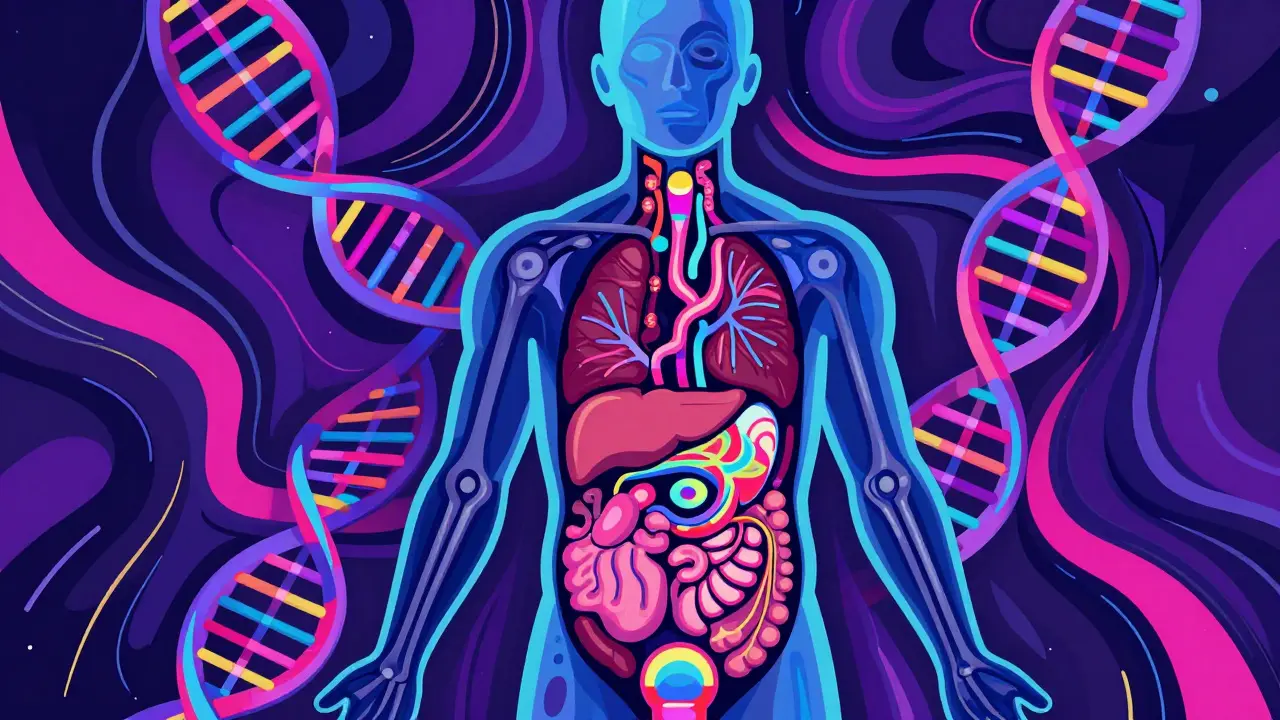
Pharmacogenomics Risk Explorer
Select a known genetic variant below to see how it alters drug processing and the potential clinical risks associated with it.
Analysis Result
Ever wonder why your friend can take a certain medication with zero issues, but you experience a total meltdown from the same dose? It isn't just bad luck. Your DNA acts like a biological instruction manual for your body, and for some of us, those instructions change how we process medicine. This field, known as pharmacogenomics is the study of how genes affect a person's response to drugs, reveals that your genetic makeup can make you far more susceptible to genetic factors and drug side effects than the average person.
The Biological Engine: How Your Genes Process Drugs
Most of the time, when you swallow a pill, your body treats it as a foreign substance that needs to be broken down and removed. This process relies heavily on a family of proteins called Cytochrome P450 a group of enzymes primarily found in the liver that metabolize the majority of clinically used drugs. Think of these enzymes as a processing plant. If your plant is running at full speed, the drug leaves your system quickly. If it's sluggish, the drug lingers.
The problem is that these enzymes aren't the same for everyone. Small variations in your DNA, known as polymorphisms, can categorize you into different "metabolizer" types. For example, if you are a "poor metabolizer" of the CYP2C19 enzyme, drugs like pantoprazole (a common heartburn medication) can stay in your blood at concentrations 5 to 10 times higher than normal. This essentially turns a standard dose into an overdose, leading to exaggerated side effects.
On the flip side, "ultrarapid metabolizers" process drugs too quickly. A dangerous example occurs with codeine. Your body must convert codeine into morphine using the CYP2D6 enzyme to get pain relief. If you're an ultrarapid metabolizer, you produce morphine at a rate up to 50 times higher than normal. For a breastfeeding mother with this trait, this can lead to fatal respiratory depression in her nursing infant because the baby is exposed to massive amounts of morphine.
Predicting the Unpredictable: Which Side Effects are Genetic?
Not all side effects are created equal. Some are predictable based on your DNA, while others are random. Recent data shows that cardiovascular side effects are the most predictable, with a positive predictive value of nearly 30%. This means if you have the genetic marker for a heart-related reaction, there's a decent chance you'll actually experience it. On the other hand, stomach issues (gastrointestinal side effects) are much harder to predict, often falling below a 10% predictive value.
One of the most severe genetic reactions involves the HLA-B*15:02 a specific genetic allele associated with severe hypersensitivity reactions to certain anticonvulsants allele. People carrying this marker face a staggering 100 to 150-fold increase in the risk of developing Stevens-Johnson Syndrome (SJS), a life-threatening condition where the skin blisters and peels off. For drugs like carbamazepine, a simple genetic test can tell a doctor whether the medication is a lifesaver or a deadly risk.
| Gene/Variant | Associated Drug | Effect of Variant | Clinical Risk |
|---|---|---|---|
| CYP2D6 | Codeine | Ultrarapid metabolism | Morphine toxicity/Respiratory depression |
| HLA-B*15:02 | Carbamazepine | Immune hypersensitivity | SJS/TEN (Severe skin peeling) |
| VKORC1 / CYP2C9 | Warfarin | Reduced sensitivity/metabolism | Internal bleeding or blood clots |
| CYP2C19 | Proton Pump Inhibitors | Poor metabolism | Excessive plasma drug concentration |

The Danger Zone: Drug Targets and Cardiac Risks
It's not just about how you break drugs down (pharmacokinetics); it's also about where the drug goes and what it hits (pharmacodynamics). Some people have genetic mutations in the actual targets the drug is designed to hit. This is especially true for heart safety. About 5% of people who experience drug-induced "torsades de pointes" (a dangerous heart rhythm) actually have hidden, subclinical mutations in genes like KCNQ1 or SCN5A.
Essentially, these people have a "pre-existing condition" written into their DNA-Long QT Syndrome-that they don't even know they have. When they take a drug that affects the heart's electrical system, it triggers a catastrophic failure. In these cases, the drug isn't the sole cause; it's the key that unlocks a genetic time bomb.

Bridging the Gap: From Lab to Pharmacy
If we know these risks, why isn't everyone getting tested? The reality is that clinical implementation is slow. While the FDA maintains a table of over 128 gene-drug interactions, only about 10-15% of these actionable variants are actually used in routine care. Many doctors simply aren't trained to read the results. A survey of over 1,200 physicians found that nearly 69% felt they didn't have enough training to interpret pharmacogenetic reports.
There are also logistical nightmares. Integrating this data into electronic health records can cost a hospital millions of dollars and take over a year of technical work. However, the benefits are real. Programs like the RIGHT Protocol at the Mayo Clinic have seen a 23% drop in hospitalizations related to adverse drug reactions by testing for 10 key genes before prescribing.

The Cost and Reality of Testing
If you're considering a test, be prepared for a mixed bag of insurance coverage. Comprehensive pharmacogenetic tests typically cost between $249 and $499. While some high-end plans cover them, many standard insurance providers still view preemptive testing as "experimental."
It's also important to understand that genetics is not destiny. Having a "high-risk" gene doesn't guarantee you'll have a side effect. For example, only 5-10% of people with the HLA-B*57:01 marker actually develop a hypersensitivity reaction to the drug abacavir. The test is great for telling you who won't react, but it's less certain about who will.
Can a genetic test tell me exactly which drugs to avoid?
Not exactly. While tests can identify specific high-risk markers (like HLA-B*15:02), most drug reactions are "polygenic," meaning they involve many different genes interacting. A test can provide a risk profile, but your doctor still needs to monitor you clinically.
Are these tests available for home use?
Yes, companies like 23andMe and Color Genomics offer pharmacogenetic insights. However, the FDA has issued warnings to some companies for overstating how useful these results are. It's always best to have a healthcare provider interpret the results in the context of your medical history.
What is the most common gene involved in drug side effects?
The Cytochrome P450 (CYP) family is the most influential. Specifically, CYP2D6, CYP2C19, and CYP2C9 are frequently involved in everything from antidepressants and painkillers to blood thinners.
Does ethnicity play a role in genetic drug susceptibility?
Yes, significantly. For example, the HLA-B*15:02 variant is much more common in certain Asian populations. Unfortunately, many studies have lacked diversity, meaning some genetic risks for people of African ancestry are still being uncovered.
If I have a "poor metabolizer" gene, should I always take a lower dose?
Often, yes, but not always. For some drugs, a lower dose prevents toxicity. For others, like certain prodrugs (which need to be activated by the enzyme to work), a poor metabolizer might need a different drug entirely because the original one will never actually activate in their body.
Next Steps: Navigating Your Medication
If you have a family history of severe drug reactions, don't wait for a crisis. Start by documenting every side effect you've ever had, even the ones that seemed minor. Mention these to your doctor and ask specifically if any of your medications have known pharmacogenetic associations.
For those in specialized care, such as oncology or cardiology, you're more likely to encounter these tests routinely. If you're in primary care, you may need to be a more active advocate for your own genetic screening. Remember, the goal isn't to find a "perfect" drug, but to avoid the ones your DNA is wired to reject.



Ajinkya Joshi
April 23, 2026 AT 20:13Oh sure, let's just trust the 'science' that says 69% of doctors can't even read the reports they're supposed to use. Absolute geniuses in charge of our health, truly. 🙄
Rick Brewster
April 25, 2026 AT 19:06one must ponder if the very notion of a biological manual is merely a reductionist facade for the chaos of existence where we mistake a correlation for a cosmic destiny and fail to see that the drug is not the catalyst but the mirror reflecting our own inherent fragility in a world obsessed with quantification despite the obvious lack of holistic synthesis in modern medicine regardless of the p-value
Ally Warren
April 26, 2026 AT 09:41The idea that our DNA is a 'time bomb' is a fascinating metaphor for the human condition. We carry the seeds of our own undoing, waiting for a specific external trigger to activate a dormant destiny. It makes you wonder how many of our daily interactions are just chemical keys turning locks we didn't know we had.
Sarah Watters
April 27, 2026 AT 08:23Typical. They want us to pay $500 for a test just so they can put our genetic markers in a database. Probably just a way for the big pharma conglomerates to tailor their poisons more effectively while they hide the real cures from the public. Don't fall for the trap.
Divyanshu Giri
April 28, 2026 AT 19:42totally awesome info man! keep crushing it with the knowledge drops! its like a secret map for the body! stay gold!
Anantha Lakshmi
April 30, 2026 AT 00:38I really appreciate how this highlights the lack of diversity in these studies. It's so important that we push for more inclusive research so everyone, regardless of ancestry, can get safe treatment! 🌈💪 Let's keep pushing for equity in medicine!
Dan Wizard
May 1, 2026 AT 14:27I find it quite intriguing that the predictive value for cardiovascular issues is significantly higher than for gastrointestinal ones, and it makes me wonder if the structural simplicity of heart rhythms compared to the complex microbiome of the gut is why the genetic markers are easier to isolate and predict in a clinical setting.
Chidi Prosper
May 2, 2026 AT 14:32The point about the breastfeeding mother and codeine is a massive wake-up call. We cannot afford to ignore these genetic markers when lives are literally on the line. The medical system needs to stop lagging and implement this testing as a mandatory standard of care immediately.
Olayinka Ibukunoluwa Mercy
May 2, 2026 AT 16:20It is so vital for us to be our own advocates in the healthcare system!!! 💖 Please, everyone, start a folder of your reactions today... it could literally save your life someday!!! 📑✨🙏
Nicole Antunes
May 3, 2026 AT 14:06It is quite reasonable to suggest that the cost of implementation is a significant barrier, yet the reduction in hospitalizations at the Mayo Clinic provides a compelling argument for the long-term economic benefit. One hopes that insurance providers will shift their perspective from 'experimental' to 'preventative' soon. :-)