
Every year, millions of people in the U.S. switch from brand-name drugs to generics - and most never notice a difference. But millions more refuse the switch, even when their doctor says it’s safe, and their pharmacist confirms it’s cheaper. Why? It’s not about science. It’s about psychology.
Generics Work Just as Well - The Science Is Clear
The FDA requires generic drugs to meet the same strict standards as brand-name drugs. Same active ingredient. Same strength. Same dosage form. Same way the body absorbs it. To prove it, manufacturers must show bioequivalence: the generic delivers the same amount of medicine into your bloodstream as the brand, within a 90% confidence interval of 80-125%. That’s not a guess. That’s lab-tested, regulated, and monitored.
More than 90% of all prescriptions filled in the U.S. are for generics. Yet they make up only about 23% of total drug spending. That’s because generics cost 80-85% less. A pill that costs $350 as a brand-name drug? The generic version? Four dollars at Walmart. The Congressional Budget Office estimates that if doctors prescribed generics for every new prescription - not just when they’re filled - Medicare Part D could save $17.3 billion a year.
The American College of Physicians made it official in 2016: “Clinicians should prescribe generic medications, if possible.” Why? Because adherence goes up. Patients on generics are 6% more likely to keep taking their meds. That’s not a small number. It means fewer hospital visits, fewer complications, fewer deaths from uncontrolled high blood pressure, diabetes, or cholesterol.
Doctors Know It’s Safe - So Why Don’t They Prescribe More?
You’d think if the evidence is this strong, doctors would write generics by default. But they don’t. In Saudi Arabia, primary care doctors prescribed generics 47% of the time. Hospital doctors? 31%. Private practice? Just 22%. In Greece, half of doctors said generics were “high or very high” quality - but only 25% actually prescribed them.
Why the gap? It’s not ignorance. A 2016 study found 96% of Saudi physicians believed they had “adequate knowledge” of generics. Yet only 16% said they’d use them in “all” situations. Something else is going on.
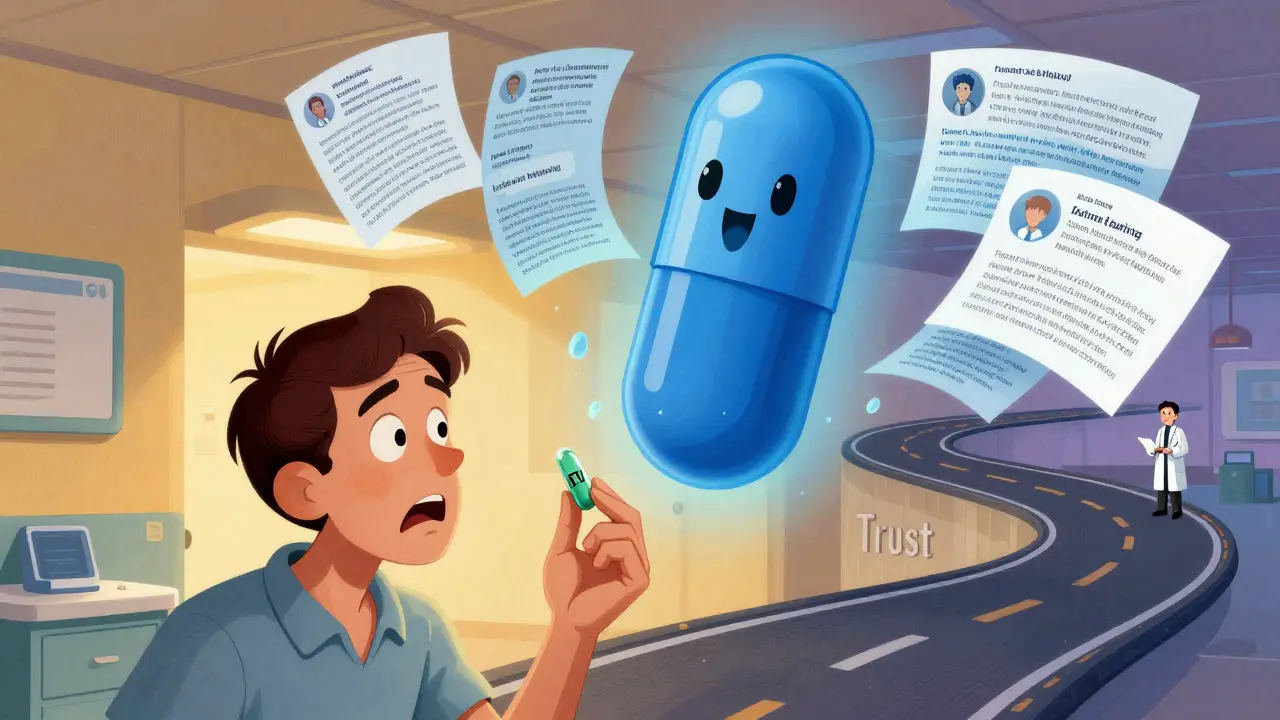
Some doctors worry about patient pushback. Others fear a rare adverse reaction - even though the data shows no increased risk. One internist on Reddit said patients refuse generic lisinopril because “it looks different.” They’ve been told for years that the blue pill is the real one. The white one? Must be fake.
And then there’s the habit. If a doctor learned to prescribe Lipitor in medical school, they keep prescribing Lipitor - even when atorvastatin is available for pennies. It’s not laziness. It’s cognitive inertia. The brand name is familiar. The generic isn’t.

Patients Trust the Brand - Even When It’s Not Better
Here’s the real kicker: patients believe the brand-name version works better. Even when it doesn’t.
The FDA did a qualitative study in 2015. Patients said they trusted generics because they were cheaper and covered by insurance - but they weren’t sure if they worked the same. One woman said, “I’ve been on this brand for 10 years. Why change it?” Another worried the generic might “not be as pure.”
That’s not irrational. It’s human. We associate color, shape, and packaging with effectiveness. If your heart pill used to be a large white capsule with “Lipitor” printed on it, and now it’s a small green tablet with “ATV” on it - your brain says, “This isn’t the same.”
Even worse, when patients switch and feel a slight change - maybe they’re a little more tired, or their headache is a bit worse - they blame the generic. But they don’t blame the brand when they feel worse on it. That’s confirmation bias. The brain looks for proof that confirms what it already believes.
And it’s not just patients. Pharmacists report that 41% of physicians say they’re sometimes pressured by patients to prescribe brand-name drugs. Forty percent say they’re pressured to prescribe generics. That’s a system caught in the middle.
When Generics Really Do Need Extra Care
There are exceptions. The FDA keeps a list of 15 drugs with a narrow therapeutic index - meaning tiny changes in blood levels can cause big problems. Think warfarin, levothyroxine, phenytoin. For these, switching from brand to generic requires careful monitoring. Blood tests. Dose adjustments.
But even here, the science says: if the generic is FDA-approved, it’s safe. The issue isn’t quality. It’s consistency. Some patients who’ve been stable on a brand for years do better staying on it. But that’s not because the generic is inferior. It’s because changing anything - even a pill - can disrupt a person’s routine.
And then there are complex drugs: inhalers, topical creams, injectables. A 2015 FDA study found patients with asthma or COPD were unsure if generic inhalers delivered the same dose. Why? Because the device felt different. The click sounded different. The puff felt weaker. The active ingredient? Identical. The delivery mechanism? Not always. That’s a design flaw - not a drug flaw.
How Doctors Can Help Patients Accept Generics
It’s not enough to say, “This is the same.” You have to say it in a way that changes perception.
Here’s what works:
- Explain why the switch is happening. “Your insurance requires a generic, and it’s been proven to work just as well.”
- Use the same language as the brand. Don’t say “atorvastatin.” Say “the generic version of Lipitor.”
- Normalize it. “Most people I treat switch to the generic. They save money and feel the same.”
- Address appearance changes. “The pill looks different because it’s made by a different company - but the medicine inside is exactly the same.”
- Follow up. Check in after a week. “How’s it going? Any new side effects?”
The FDA’s “Look Alike Sound Alike” program has cut patient confusion by 37% since 2018. But that’s not enough. It’s still happening. Every day.
The Bigger Picture: Generics Are the Future
The global generic drug market is projected to hit nearly $600 billion by 2028. Biosimilars - generic versions of complex biologic drugs - are starting to enter the market. By 2027, they could make up 15% of biologic prescriptions.
Residency programs are catching up. In 2015, only 29% of internal medicine programs taught generic prescribing. Now, it’s 68%. That’s progress.
But real change won’t come from regulations or cost savings alone. It’ll come from trust. From doctors who take the time to explain. From patients who learn to question their assumptions. From a system that stops treating generics as “second best” and starts treating them as what they are: safe, effective, and essential.
Medicine isn’t about pills. It’s about people. And people don’t respond to data. They respond to stories. To trust. To reassurance.
So next time your doctor offers a generic - ask why. Then listen. Because the answer might surprise you.
Are generic drugs really as effective as brand-name drugs?
Yes. The FDA requires generic drugs to have the same active ingredient, strength, dosage form, and bioequivalence as the brand-name version. That means they work the same way in your body. Studies show no difference in effectiveness for over 95% of medications. The only exceptions are a small list of drugs with a narrow therapeutic index, where dosing needs to be closely monitored.
Why do some patients feel worse after switching to a generic?
Most often, it’s not the drug - it’s the change. When a pill looks, feels, or tastes different, patients expect something to change. This is called the nocebo effect. Some patients also report issues with inactive ingredients - like dyes or fillers - which are rare but possible. If a patient has a reaction, it’s not because the generic is inferior. It’s because their body reacted to something new. Doctors should always follow up after a switch.
Do pharmacists automatically substitute generics?
In 49 U.S. states, pharmacists can substitute a generic unless the doctor writes “Dispense as Written” or “Do Not Substitute.” Even then, the pharmacist must inform the patient. It’s not a secret swap. It’s a legal, regulated process designed to save money and improve access.
Why do doctors still prescribe brand-name drugs?
Some do it out of habit. Others fear patient complaints. Some have been influenced by pharmaceutical marketing. And a few worry about rare cases where switching might cause issues - even though the data doesn’t support it. The real barrier isn’t science. It’s perception - both from doctors and patients.
Can I ask my doctor to prescribe a generic even if they don’t suggest it?
Absolutely. You have the right to ask. Say something like, “I noticed this medication is expensive. Is there a generic version available that’s just as effective?” Most doctors will agree - especially if you mention cost as a barrier to taking the medication. Studies show that when patients bring up cost, doctors are more likely to prescribe generics.

Jasneet Minhas
January 29, 2026 AT 10:50Generics are the unsung heroes of modern medicine 💊😎 Honestly, if I can save $346 on a pill that does the exact same thing, I’m not gonna question it. My grandma takes generic metformin and still outwalks me at family reunions. Science wins. Wallet wins. Everyone wins.
Eli In
January 31, 2026 AT 10:06I grew up in a household where brand-name meant ‘trust.’ But after my dad switched to generic levothyroxine and his TSH stayed perfect? I changed my mind. 🌍 It’s not just about money-it’s about access. People in rural areas, low-income families, even middle-class folks drowning in co-pays-they need this. Generics aren’t ‘lesser.’ They’re liberation.
Megan Brooks
February 1, 2026 AT 09:45The psychological barrier to generics is fascinating-and deeply human. We don’t just consume medication; we ritualize it. The shape, the color, the branding become part of the healing narrative. To disrupt that is to disrupt identity. Doctors who say ‘it’s the same’ aren’t wrong-but they’re incomplete. What’s needed isn’t just data, but narrative repair. The pill isn’t the medicine. The trust is.
Ryan Pagan
February 1, 2026 AT 11:12Let’s cut the crap-pharma companies spent decades brainwashing us into thinking blue pills = better pills. It’s marketing, not medicine. I’m a nurse. I’ve seen patients cry because their ‘Lipitor’ was swapped for ‘atorvastatin.’ I show them the FDA’s bioequivalence charts. I say: ‘If this was a Tesla, you’d be thrilled you got the same engine for $5000 less.’ They laugh. Then they take it. That’s the trick: reframe it as a win, not a compromise.
Paul Adler
February 3, 2026 AT 06:02I’ve been on generic lisinopril for five years. No issues. My BP is better than it was on the brand. But I get why people hesitate. I used to be one of them. It’s not ignorance-it’s fear. Fear of the unknown. Fear of being ‘cheap.’ Fear that if it looks different, it must be broken. We need more stories like this post. Not just stats. Real talk.
Robin Keith
February 4, 2026 AT 10:15Think about it… the FDA approves generics… but who approves the FDA? Who’s auditing the labs? Who’s checking if the ‘bioequivalence’ is just a statistical mirage? I’ve seen people go from 100% stable on brand to crashing after switching… and the system just says ‘coincidence.’ Coincidence? Or a quiet, systemic erasure of patient autonomy? The pharmaceutical-industrial complex doesn’t want you to know how much they profit from your confusion. Generics aren’t the solution-they’re the distraction.
Sheryl Dhlamini
February 4, 2026 AT 19:46My mom switched to generic Xanax after her insurance dropped the brand. She said she felt ‘off’ for two weeks. We thought it was the meds. Turns out? She was grieving the blue oval pill. It was her ‘calm.’ The new one? It looked like a baby aspirin. She cried. Not because it didn’t work-because it didn’t *feel* right. We went back to brand for a few months. Then tried again. This time, I held her hand while she took it. She’s been on generic for three years now. The pill didn’t change. Her relationship with it did.
Doug Gray
February 4, 2026 AT 23:06generic = low quality. always. it's a fact. the fda is compromised. big pharma owns them. you think they'd let a $4 pill replace $350? nah. it's a scam. people die from generics. quietly. no one talks about it. #conspiracy #trusttheprocess
Kristie Horst
February 6, 2026 AT 21:00As someone who works in public health, I’ve seen the impact of generics on adherence rates. The 6% increase isn’t just a number-it’s lives. It’s mothers who don’t miss work. It’s elders who avoid ER visits. It’s teenagers with asthma who can finally play soccer. But here’s the thing: no one ever tells patients, ‘This generic is FDA-approved and clinically equivalent.’ They just hand it over. We need to stop assuming patients know. We need to speak. Clearly. Kindly. Repeatedly.
Laura Arnal
February 8, 2026 AT 19:22My pharmacist once told me, ‘If your pill looks weird, don’t panic-just call your doctor.’ I did. Turns out, my generic metoprolol switched manufacturers. New color, new shape. Same pill. I felt silly. But I’m glad I asked. Now I ask every time. It’s not being paranoid-it’s being empowered. 💪❤️
ryan Sifontes
February 10, 2026 AT 14:29generics are a government scam to make us sicker. the fillers are toxic. the fda is bought. dont switch. stay on brand. your life depends on it. 🚨