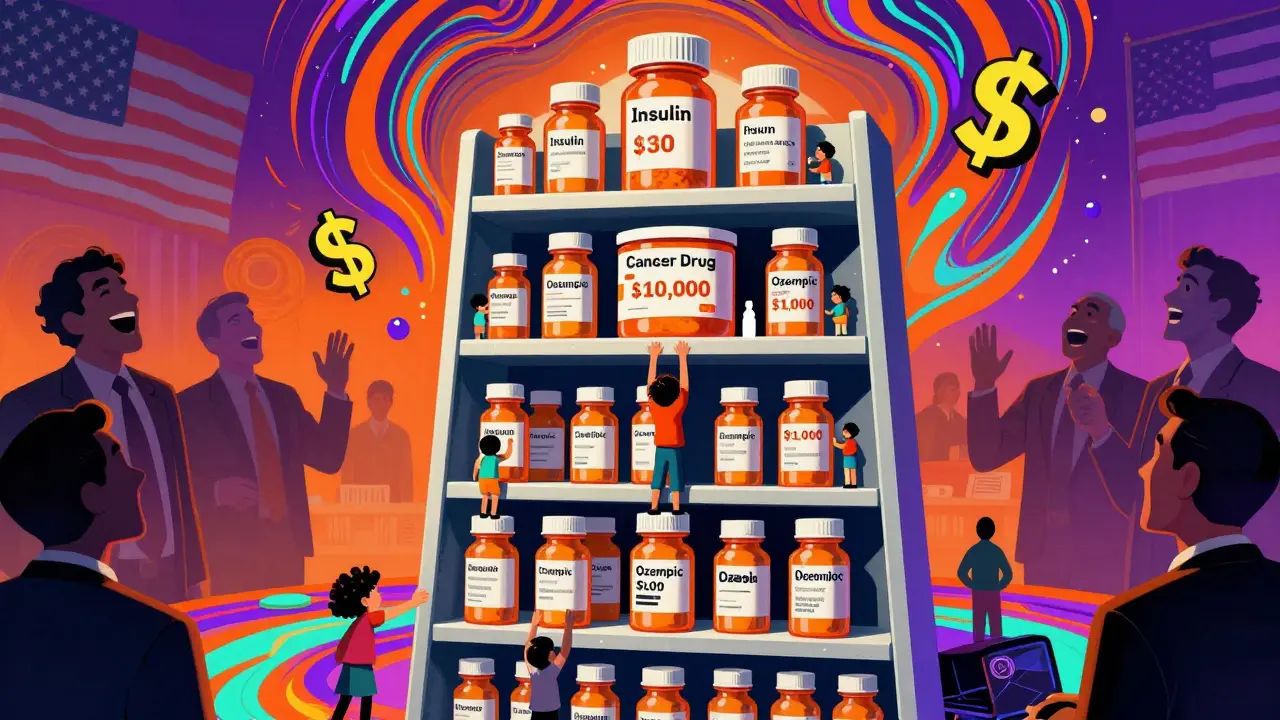
For millions of Americans, filling a prescription isn’t just a routine trip to the pharmacy-it’s a financial gamble. A month’s supply of insulin can cost $300. A cancer drug might run $10,000. And for some rare disease treatments, the annual price tag hits six figures. Meanwhile, people in Canada, Germany, or the UK pay a fraction of that for the exact same pill, made in the same factory. Why does this happen? And why is the U.S. the only developed country where drug prices keep climbing while everyone else keeps them in check?
The System Was Built to Protect Profits, Not Patients
The U.S. doesn’t have a broken drug pricing system-it has a system that was designed this way. In 2003, Congress passed the Medicare Modernization Act, which created Medicare Part D. It sounded like a win: seniors finally got prescription drug coverage. But there was a hidden clause: Medicare was banned from negotiating drug prices directly with manufacturers. That meant the government, which buys drugs for over 60 million people, couldn’t use its massive buying power to get lower prices. Other countries do this all the time. Canada negotiates. The UK sets price caps. Germany compares prices across Europe and picks the lowest. The U.S.? It lets drug companies set their own prices with almost no oversight. This isn’t an accident. It was a deliberate choice made under heavy lobbying from pharmaceutical companies. The result? Americans pay more than three times what other wealthy nations pay for the same brand-name drugs, according to the White House. And it’s not just older adults. People on private insurance, the uninsured, and even those with good coverage are feeling the squeeze.Who’s Really in Charge? The Hidden Players Between You and Your Medicine
You might think the price on your prescription label is what the drug company charges. It’s not. There’s a whole hidden chain between the factory and your pharmacy. At the center of this mess are Pharmacy Benefit Managers, or PBMs. Originally, they were supposed to be middlemen who negotiated discounts for insurers. Now, they’re giant corporations that own pharmacies, manage insurance plans, and hold contracts with drugmakers. Their business model? They get paid based on the list price of drugs, not the final cost to you. So if a drug’s list price goes up, the PBM’s rebate goes up-even if you pay more out of pocket. Take Galzin, a drug used to treat Wilson’s disease. In the U.S., it costs $88,800 a year. In the UK, it’s $1,400. In Germany, $2,800. The same drug. Same manufacturer. Same active ingredient. The difference? PBMs in the U.S. have no incentive to push for lower prices. In fact, they benefit when prices rise. And because their deals are secret, patients and even doctors have no idea what’s really going on.Specialty Drugs Are Breaking the Bank
Not all drugs are created equal. The most expensive ones today aren’t antibiotics or blood pressure pills-they’re specialty drugs. These are treatments for cancer, rare diseases, diabetes, and obesity. They’re often biologics, meaning they’re made from living cells, not chemicals. That makes them harder and more expensive to produce. But here’s the kicker: their prices don’t reflect production costs. They reflect what the market will bear. In 2024, net drug prices in the U.S. jumped 11.4%, up from 4.9% the year before. The biggest drivers? New obesity drugs like Ozempic and Wegovy, and diabetes treatments. These drugs are being pushed to millions of patients-even those who don’t need them yet. Drugmakers spend billions on marketing, and PBMs push them because they earn bigger rebates on higher-priced drugs. The result? A single monthly dose of Ozempic used to cost $1,000. Now, after a deal announced in late 2025, it’s $350. That’s a win for some. But for millions who don’t qualify for that deal, it’s still unaffordable.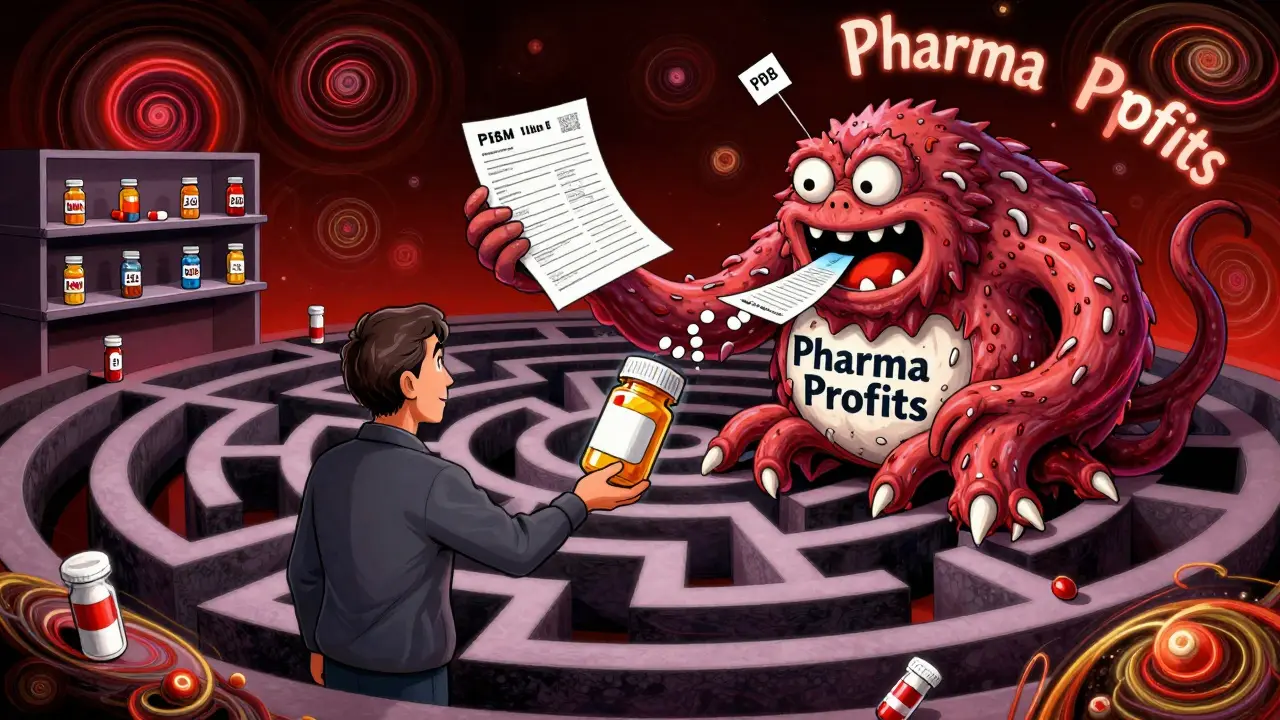
Government Efforts Are Too Small, Too Late
The Inflation Reduction Act of 2022 was supposed to fix this. It gave Medicare the power to negotiate prices for a small number of drugs-starting with 10 in 2026. That’s a start. But here’s the problem: it’s a drop in the ocean. Out of 10,000+ prescription drugs on the market, only 10 are eligible. And even those negotiations are limited. The law doesn’t let Medicare set prices based on what other countries pay. It doesn’t stop drugmakers from raising prices next year. And in 2025, Congress weakened the law further, reducing its projected savings by billions. The White House has also tried executive actions. In May 2025, President Biden ordered agencies to align U.S. drug prices with those in other developed nations. That sounds simple. But it’s hard to enforce. Drugmakers just delay, litigate, or find loopholes. In fact, since 2020, over 688 drugs have increased in price-even as politicians promised to lower them. One report found that after President Trump sent letters to drug companies asking them to cut prices, 87 drugs still went up by an average of 8%.What Happens When You Can’t Afford Your Medicine?
The human cost isn’t just a statistic. It’s real. One in four Americans says they’ve skipped doses, cut pills in half, or gone without a prescription because they couldn’t pay. For seniors on Medicare, the $2,000 annual out-of-pocket cap introduced in 2025 is a lifeline. Before that, some paid over $10,000 a year just for their meds. Now, they’re breathing easier. But that cap only applies to Medicare Part D. It doesn’t help people on private insurance or those without coverage. And the threat isn’t gone. A proposed plan called Project 2025 could roll back these protections. According to the Center for American Progress, it could increase out-of-pocket costs for as many as 18.5 million seniors and people with disabilities. That’s not hypothetical. That’s policy in motion.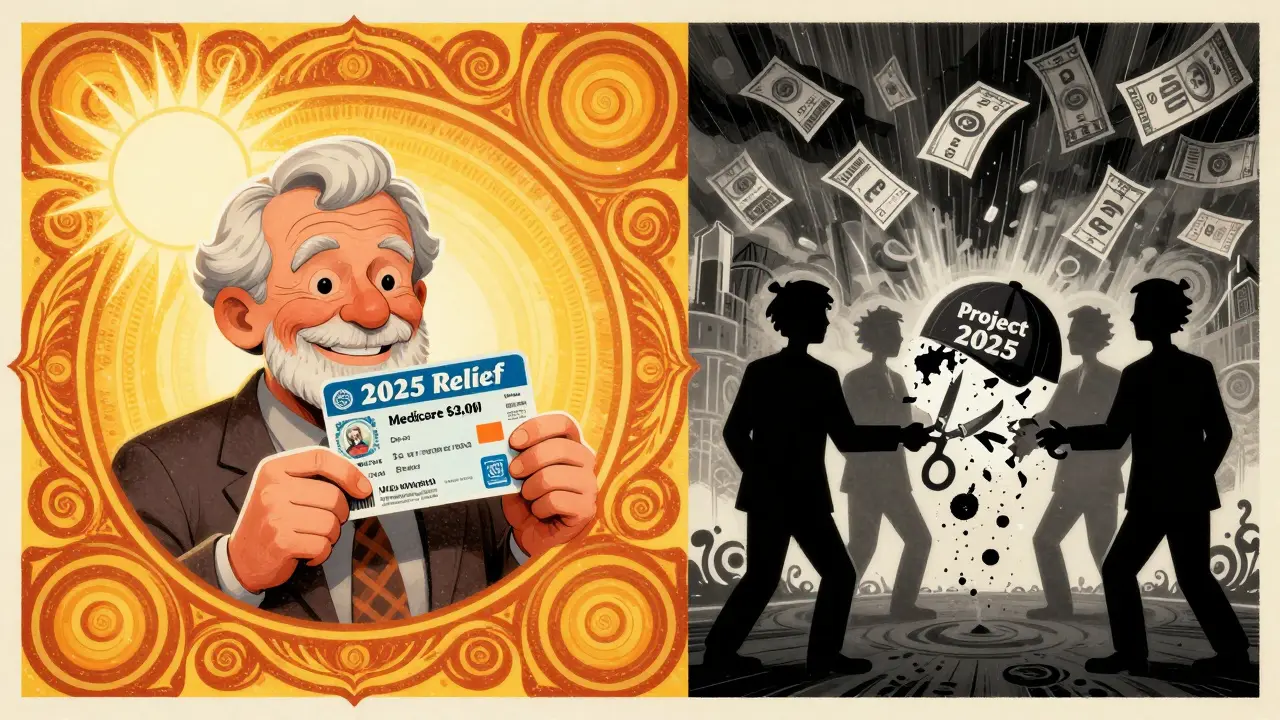
Why Other Countries Don’t Have This Problem
Look at Germany. They use reference pricing. If a new drug comes out, they compare it to similar ones already on the market and set a fair price. If the company doesn’t agree, the drug doesn’t get covered by public insurance. Canada negotiates prices nationally. The UK’s NHS sets a price based on health outcomes-how much life it saves, how much pain it reduces. If the drug doesn’t deliver enough value, it doesn’t get approved. The U.S. doesn’t have any of that. We don’t ask: “Is this drug worth it?” We just ask: “How much will they pay?” And here’s the irony: the U.S. pays the most, yet other countries get the same drugs. American drugmakers sell the exact same pills abroad at lower prices. That means U.S. patients are effectively subsidizing healthcare in other countries. The White House estimates the U.S. generates 75% of global pharmaceutical profits. That’s not innovation. That’s extraction.Is There a Way Out?
There are solutions. One is to let Medicare negotiate prices-not just for 10 drugs, but for all. Another is to cap out-of-pocket costs for everyone, not just seniors. A third is to ban secret rebates and require PBMs to pass savings directly to patients. Some states have already tried this. Colorado passed a law in 2024 requiring PBMs to disclose their pricing and rebate structures. The results? Lower costs for state employees. The biggest hurdle isn’t technical. It’s political. Drugmakers spent over $300 million lobbying Congress in 2024 alone. They fund think tanks, campaign donations, and PR campaigns that paint price controls as “government overreach.” But the truth is simple: no other country has this problem. No other country lets companies charge whatever they want. And no other country has patients rationing insulin or skipping cancer treatments because they can’t afford them. The U.S. doesn’t need to reinvent the wheel. It just needs to copy what works elsewhere. The technology, the science, the manufacturing-all of it is the same. Only the price tag changes. And that’s not a market failure. It’s a policy failure.Why do U.S. drug prices cost so much more than in other countries?
The U.S. is the only developed country that bans the government from negotiating drug prices directly with manufacturers. Other countries use reference pricing, cost-effectiveness reviews, or direct negotiations to keep prices low. In the U.S., drugmakers set prices freely, and middlemen like PBMs profit from higher list prices, not lower costs for patients.
What role do Pharmacy Benefit Managers (PBMs) play in high drug prices?
PBMs were meant to negotiate discounts, but now they’re vertically integrated companies that earn rebates based on a drug’s list price. The higher the list price, the bigger their cut-even if patients pay more. This creates a perverse incentive: PBMs push expensive drugs over cheaper ones, and they keep their deals secret, so patients and doctors can’t compare real costs.
Does the Inflation Reduction Act actually lower drug prices?
It helps, but only for a tiny fraction of drugs. Starting in 2026, Medicare can negotiate prices for 10 high-cost drugs, with savings projected at $1.5 billion annually. But there are over 10,000 prescription drugs in the U.S. The law also requires drugmakers to pay rebates if they raise prices faster than inflation, which has already saved money on 64 drugs. However, a 2025 budget bill weakened its scope, reducing its long-term impact.
Why do drug companies raise prices so often?
Drugmakers raise prices to maximize profits, especially on drugs with little competition. For specialty drugs like those for diabetes or cancer, there’s often no generic alternative. Companies also time price hikes to avoid public backlash-often just after New Year’s or before insurance deductibles reset. Since 2020, over 688 drugs have increased in price despite political promises to lower them.
Can I get the same drug cheaper by buying it from another country?
Technically, yes. Many Americans buy insulin, heart meds, or diabetes drugs from Canada or Mexico at a fraction of the U.S. price. But it’s still technically illegal to import prescription drugs from abroad without FDA approval. While enforcement is rare for personal use, the risk and inconsistency make it unreliable. The real solution is lowering U.S. prices, not turning to black-market pharmacies.
What’s Project 2025, and how would it affect drug costs?
Project 2025 is a conservative policy plan that proposes rolling back Medicare drug price controls, eliminating the $2,000 out-of-pocket cap, and reducing government oversight of PBMs. According to the Center for American Progress, it could increase prescription drug costs for up to 18.5 million Medicare beneficiaries, forcing many to choose between medicine and rent.
Nikki Brown
December 26, 2025 AT 03:13Let’s be clear: people who can’t afford insulin are not ‘lazy’-they’re victims of a system designed to extract wealth from the sick. If you’re okay with this, you’re not just indifferent-you’re complicit. And yes, I’m calling you out. 😔
roger dalomba
December 26, 2025 AT 03:54Wow. A 10,000-word essay on something that’s literally just capitalism with a stethoscope.
Becky Baker
December 26, 2025 AT 22:02Why don’t these people just move to Canada? We pay for their healthcare anyway. 🇺🇸💪
sakshi nagpal
December 27, 2025 AT 12:10As someone from India, I’ve seen how even our public healthcare system struggles with access-but at least we don’t have PBMs profiting off people’s suffering. The U.S. system feels like a corporate labyrinth with no exit.
Steven Destiny
December 28, 2025 AT 16:07This isn’t about politics-it’s about morality. We can fix this tomorrow if we choose to. The technology exists. The will just needs to be activated. Let’s not wait for another funeral to act.
Sandeep Jain
December 29, 2025 AT 07:15i mean… i get it. but like… why do the pharma co’s even get to set prices? it’s wild. my uncle died becuz he skipped his meds. not fair.
Fabio Raphael
December 31, 2025 AT 06:31I’ve read a lot on this, and the PBM model is the real monster here. They’re not middlemen-they’re parasites. If they got paid based on what patients actually pay, not list price, everything would shift. But no one talks about that enough.
Sophia Daniels
January 1, 2026 AT 07:00Let’s not sugarcoat this: Big Pharma is running a Ponzi scheme on human suffering. They’ve turned medicine into a luxury good, and we’re all forced to play along. The fact that Ozempic is now $350? That’s not a win-it’s a PR stunt. The real price is still $1,000 for everyone who doesn’t get the ‘deal.’ And don’t even get me started on the lobbying. $300 million? That’s more than some countries spend on their entire health systems. 🤢
Peter sullen
January 1, 2026 AT 08:48It is imperative to recognize that the structural inefficiencies inherent in the U.S. pharmaceutical supply chain-particularly the absence of centralized price negotiation mechanisms, coupled with the perverse incentive structures embedded within Pharmacy Benefit Manager (PBM) contractual frameworks-constitute a systemic failure of regulatory governance. The market-based paradigm, untempered by evidence-based cost-effectiveness thresholds or international reference pricing, has engendered a rent-seeking environment wherein profit maximization supersedes public health imperatives. The Inflation Reduction Act’s limited scope, while symbolically significant, remains statistically negligible in the context of over 10,000 prescription agents; thus, comprehensive legislative reform-encompassing mandatory transparency, rebate pass-through mandates, and Medicare negotiation for all high-cost therapeutics-is not merely advisable, but ethically obligatory.
Sumler Luu
January 2, 2026 AT 19:48I appreciate the depth of this post. But I also think we need to stop blaming individuals who work in the system-pharmacists, reps, even PBMs-are often just doing their jobs under broken rules. The fix has to be systemic, not personal.
Brittany Fuhs
January 3, 2026 AT 08:11Why do we keep pretending this is about ‘fairness’? America wins because we pay more. That’s how innovation happens. If you want cheap drugs, go live in a country where they don’t value life. 🇺🇸
Erwin Asilom
January 4, 2026 AT 11:21There’s real hope here. Colorado’s PBM transparency law is proof that state-level action works. If more states follow, the pressure on federal policy will grow. We don’t need to wait for Congress to get brave-we can build the movement from the ground up.