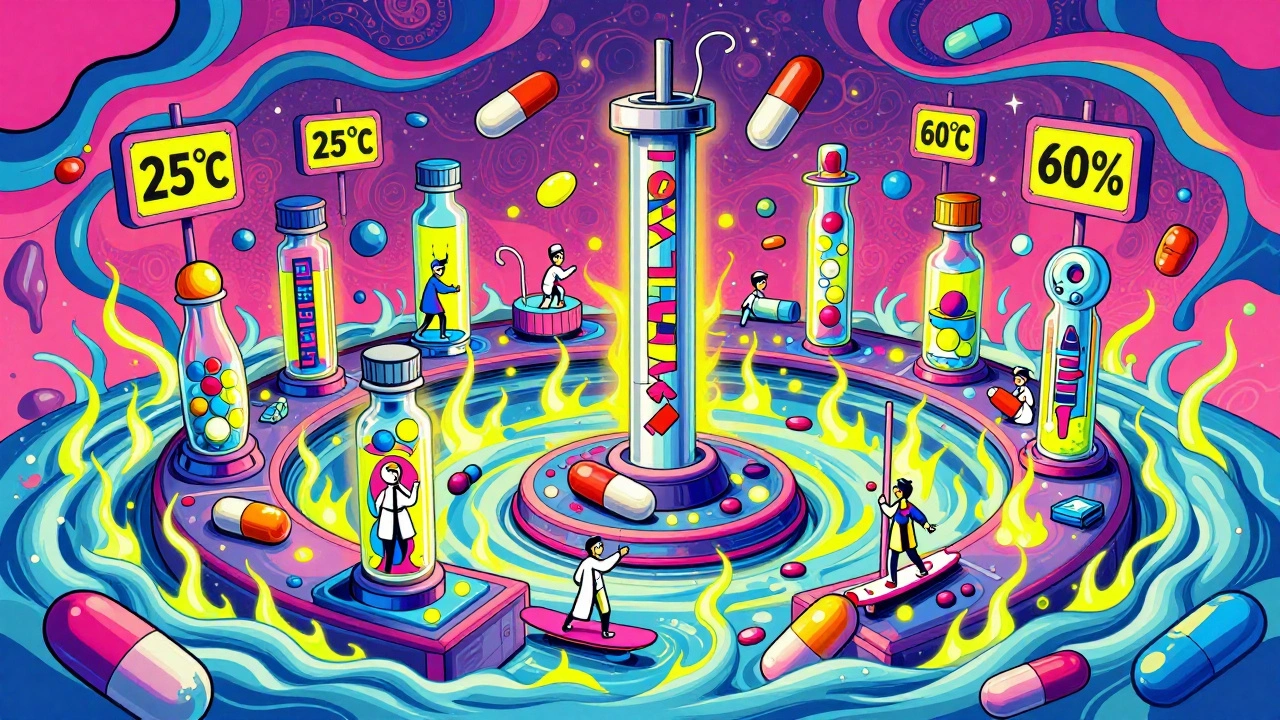
When a pill leaves the factory, it doesn’t stop being monitored. In fact, the real test of its quality begins after manufacture. Stability testing is the quiet, relentless process that ensures every tablet, injection, or inhaler remains safe and effective until the day it expires. This isn’t just paperwork or a regulatory checkbox-it’s what keeps patients from taking a drug that’s lost its power or turned toxic.
Why Stability Testing Exists
Pharmaceuticals aren’t like canned soup. They’re complex chemical systems. Even under ideal conditions, active ingredients slowly break down. Moisture, heat, light, and even the container can trigger reactions that reduce potency or create harmful byproducts. A cancer drug that drops below 90% potency? It won’t work. A blood thinner that degrades into a toxic compound? It could kill. That’s why regulators like the FDA and the European Medicines Agency require manufacturers to prove their products won’t fall apart over time. The International Council for Harmonisation (ICH) set the global standard in 2003 with ICH Q1A(R2). These aren’t suggestions-they’re legal requirements for approval. Every new drug must come with at least two years of real-time stability data. For many, it’s three years or more.How It Works: The Science Behind the Chambers
Stability testing happens in controlled rooms called stability chambers. These aren’t regular fridges or closets. They’re precision instruments, locked down to exact temperature and humidity levels. For most drugs meant for temperate climates, the test condition is 25°C ± 2°C and 60% relative humidity. For hotter regions, it’s 30°C ± 2°C and 65% humidity. These aren’t arbitrary numbers-they mirror real-world storage conditions in homes, pharmacies, and warehouses. Samples are pulled at specific intervals: 0, 3, 6, 9, 12, 18, 24, and 36 months. At each point, scientists run tests:- Is the tablet still the right color and shape?
- Does the liquid still dissolve properly?
- How much of the active ingredient remains?
- Are there new chemicals formed from degradation?
- Is the product still sterile-or free from mold and bacteria?
Accelerated Testing: The Shortcut That Isn’t a Shortcut
To save time, companies run accelerated tests at 40°C and 75% humidity for six months. This speeds up degradation so they can spot problems early. But here’s the catch: accelerated data can’t predict shelf life on its own. It’s a warning system, not a final answer. A 2021 study in the Journal of Pharmaceutical Sciences showed that while accelerated testing catches 80% of major issues, it misses subtle changes that only show up after real-time exposure. That’s why the FDA still demands real-time data. You can’t fake time.
The Cost of Getting It Wrong
Stability testing isn’t cheap. A single product study can cost $50,000 to $150,000. Large companies spend millions a year on chambers, staff, and lab equipment. But the cost of failure is far higher. In 2021, 17.3% of drug recalls in the U.S. were due to stability failures-potency loss, contamination, or unexpected degradation products. One 2021 FDA warning letter cited a cancer drug manufacturer that ignored out-of-spec results for months. The approval was delayed by 14 months. The company lost tens of millions. Conversely, stability testing has prevented disasters. In 2022, SGS identified a chemical reaction between a new biologic drug and its glass vial. Without that discovery, the product would’ve been launched, risking patient safety and a potential $500 million recall.Who Does It and How
Big pharma companies like Pfizer and Novartis run in-house stability labs. They have entire teams dedicated to monitoring chambers, analyzing data, and writing reports. But smaller biotechs and generics manufacturers often outsource to contract labs like SGS, Eurofins, or Charles River Laboratories. Outsourcing saves money but adds complexity. The manufacturer still owns the data and the responsibility. If the CRO messes up, the FDA comes knocking at the brand’s door. The biggest headaches? Chamber failures. A humidity spike, a power outage, a calibration drift-any of these can wipe out months of data. One company on Reddit reported a 3-month data gap that delayed their drug approval by eight months and cost $2.3 million in lost revenue.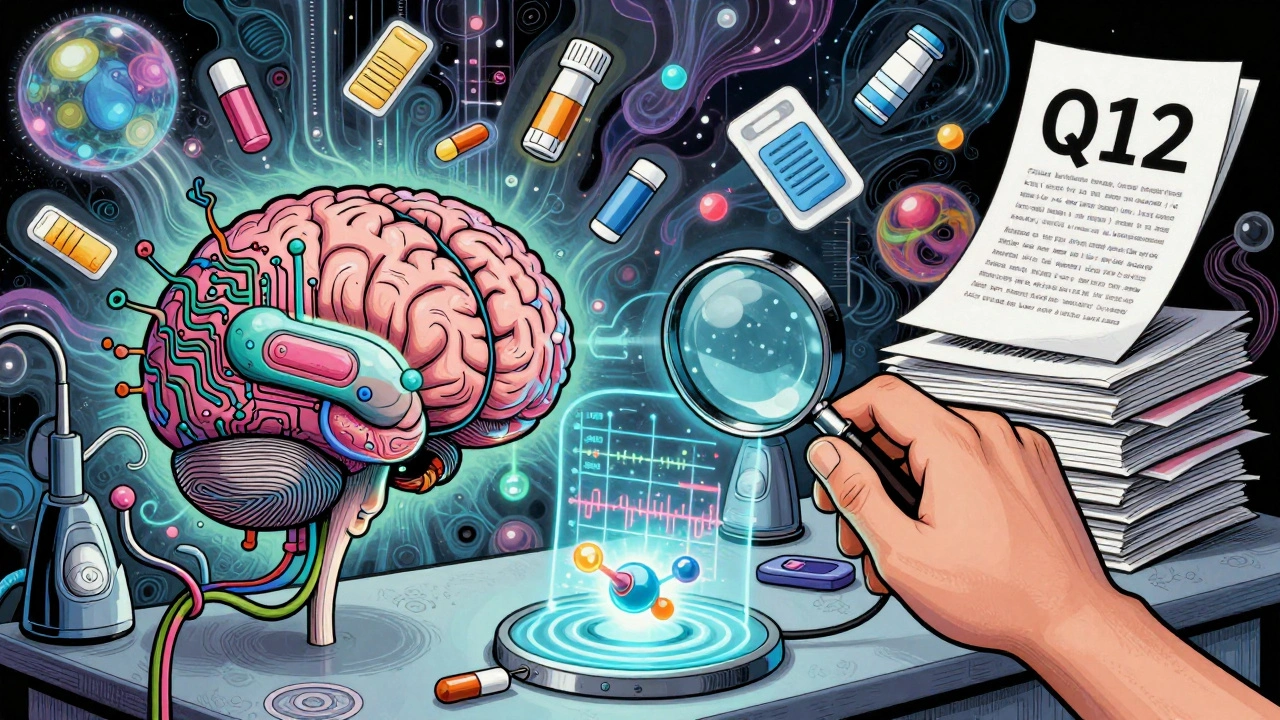
New Rules, New Tech
The field is changing. In February 2023, ICH finalized Q13, a new guideline for stability testing in continuous manufacturing-a shift away from batch-based production. This means testing must now track stability as the drug is made, not just after. Also gaining ground is ICH Q12, which lets companies make minor changes to their product (like switching suppliers) without restarting full stability studies. Companies using Q12 have cut their testing samples by 40%, saving up to $120,000 per product annually. AI is starting to play a role. Machine learning models can now predict degradation patterns based on molecular structure and environmental exposure. PhRMA estimates AI could cut stability testing timelines by 30-40% by 2027. But regulators aren’t ready to accept predictions alone. Real data still rules.What’s Next?
The future of stability testing is smarter, not just faster. Risk-based approaches are replacing one-size-fits-all testing. For well-understood, stable small molecules, fewer tests may be needed. For complex biologics or personalized medicines, more tests will be required. The WHO and FDA are pushing for global alignment. Emerging markets are catching up, demanding the same level of data as the U.S. and EU. That means even small manufacturers must now meet global standards. Stability testing isn’t glamorous. No one cheers when a drug reaches its expiration date without issue. But that’s exactly the point. It’s the invisible guardrail keeping patients safe. The pill you take today should work the same way next year. Stability testing makes sure it does.Is stability testing required for all drugs?
Yes. Every new drug approved by the FDA, EMA, or other major regulators must include comprehensive stability data. This includes generics, biologics, and even over-the-counter products. There are no exceptions. Even if a drug seems stable, regulators require proof.
How long does stability testing take?
Real-time testing typically takes 24 to 36 months to complete, depending on the product’s intended shelf life. Accelerated testing takes six months but can’t replace real-time data. Some products, like biologics, require testing beyond 36 months because their degradation is slow and complex.
Can stability data be reused for similar products?
Under ICH Q12, yes-but only for minor changes. If you change the packaging material or slightly adjust the manufacturing process, you may be able to use existing stability data with supporting justification. But if you change the active ingredient, formulation, or strength, you need new testing. It’s not a loophole-it’s a science-based exception.
What happens if a stability test fails?
An out-of-specification (OOS) result triggers a formal investigation. The manufacturer must determine if the failure was due to a lab error, equipment malfunction, or a real product problem. If it’s a real issue, they must recall batches, halt shipments, and often redesign the formulation or packaging. Failure to investigate properly can lead to FDA warning letters, delayed approvals, or even criminal charges.
Do storage conditions on the label come from stability testing?
Absolutely. The label instructions-"Store at 2-8°C," "Keep in original container," "Protect from light"-are based directly on stability data. If the drug degrades in high humidity, the label says "Keep dry." If light causes breakdown, it says "Protect from light." Every word on the label is backed by test results.
Is stability testing only for pills and injections?
No. It applies to all drug forms: creams, inhalers, eye drops, patches, suppositories, and even IV bags. Even transdermal patches must be tested for adhesion loss, drug leakage, and chemical stability over time. Any product that degrades or changes over time requires stability data.
How do companies prove their stability data is reliable?
They validate their analytical methods under ICH Q2(R1), maintain strict cGMP controls, and document every step. Chambers are calibrated quarterly. Data is stored electronically with audit trails. All results are reviewed by Quality Assurance. Regulatory agencies audit this process during inspections. If the data can’t be traced, replicated, or explained, it’s rejected.



Rudy Van den Boogaert
December 4, 2025 AT 17:47Man, I never realized how much goes into making sure a pill doesn’t turn into a time bomb. I just pop them like candy and assume it’s all good. This stuff is wild - like, someone’s sitting in a climate-controlled room for three years watching a tablet age. Respect.
Also, the part about the biologic reacting with the glass vial? That’s next-level vigilance. I’d lose sleep over that kind of responsibility.
Jordan Wall
December 6, 2025 AT 14:40Let’s be honest - this whole stability regime is less ‘science’ and more ‘regulatory theatre’. ICH Q1A(R2)? More like ICH Q1A(R2)™ - patented bureaucracy. Accelerated testing is a band-aid on a bullet wound, and AI? Please. You can’t algorithmically predict molecular decay like it’s a Netflix recommendation engine. We’re still flying blind in 20% of cases, and the FDA knows it. But hey, at least we have audit trails - and by that I mean, paper trails that no one reads.
Also, ‘protect from light’? That’s not science - that’s a cry for help from a chemist who spilled coffee on a vial.
Pavan Kankala
December 7, 2025 AT 06:09They say it’s for safety. But who really benefits? Big Pharma. They charge $100k for a pill that costs $2 to make. Stability testing? Just a way to delay generics and keep prices high. You think they care if a cancer drug loses 8% potency? Nah. They just tweak the label and keep selling.
And don’t get me started on ‘accelerated testing’ - it’s a lie wrapped in a lab coat. If the drug breaks down in 30°C humidity, why are we selling it in Arizona? Why are we shipping it to India without climate-controlled logistics? This isn’t science - it’s a money laundering scheme disguised as public health.
They’re not protecting you. They’re protecting their stock price.
And yes, I’ve read the FDA warning letters. They’re all the same. ‘We’re sorry we didn’t catch it sooner.’ Like we didn’t see this coming.
Martyn Stuart
December 7, 2025 AT 09:09Just to clarify - the ICH Q12 framework isn’t a loophole; it’s a risk-based, scientifically validated approach to post-approval changes. It reduces redundant testing, not safety. The key is that the change must be minor, well-characterized, and supported by prior data - and yes, the manufacturer still bears full responsibility.
Also, the use of HPLC and GC-MS isn’t optional - these are the gold standards for detecting sub-ppm degradation products. If your lab can’t detect a 0.1% impurity, you shouldn’t be in pharma. Period.
And for those who think this is overkill - ask yourself: Would you take a heart medication that’s 85% potent? No. Then don’t dismiss the process.
Jessica Baydowicz
December 9, 2025 AT 08:15OMG I JUST LEARNED SO MUCH!!! Like, I thought expiration dates were just marketing, but NOPE - it’s like the pill has a whole life story, and someone’s been checking in on it every 3 months like a concerned aunt. 🥹
Also, the glass vial thing? That’s wild. It’s like the drug was trying to escape its own container. I’m so glad someone’s watching out for us. 🙏
PS: I’m gonna start reading my pill labels like poetry now. ‘Protect from light’ - sounds like a line from a love song. 💙
Shofner Lehto
December 10, 2025 AT 08:55This is one of those topics that doesn’t get enough attention, and that’s dangerous. People think if a drug looks the same, it works the same. But chemistry doesn’t care what you think.
The fact that stability testing prevents recalls, injuries, and deaths should make this non-negotiable. The cost isn’t just financial - it’s human.
Also, the part about chamber failures delaying approvals by months? That’s a systemic risk. We need better redundancy, better sensors, better real-time monitoring. This isn’t 1995 anymore.
Let’s not romanticize the process - let’s improve it.
Rachel Bonaparte
December 12, 2025 AT 05:06Let’s be real - the entire pharmaceutical industry is a controlled fraud. Stability testing? Just a smokescreen. They know exactly how fast drugs degrade. They just don’t tell you. Why? Because if you knew that your antidepressant lost 15% potency after 6 months in your bathroom cabinet, you’d stop taking it. And then they’d lose billions.
Ever wonder why expiration dates are so short? It’s not because the drug breaks down - it’s because they want you to buy more. The ‘36-month’ data? It’s just what they need to get approval. The real shelf life? Probably longer. But they don’t want you to know that.
And don’t even get me started on outsourcing to CROs. Half of them are in countries with zero oversight. Your ‘safe’ pill? Maybe it was tested in a garage with a broken thermostat.
They’re not protecting you. They’re protecting profits.
And AI? Please. They’re using it to cut corners, not improve safety. You think the FDA will ever accept a prediction over real data? Only after 100 people die.
Michael Feldstein
December 12, 2025 AT 23:19Interesting breakdown. I’ve always wondered how they decide on those exact temps and humidity levels - 25°C/60% RH? Why not 24 or 26? Turns out, it’s based on global average home environments. That’s actually kind of beautiful - they’re designing for real human lives, not just lab conditions.
Also, the fact that ‘protect from light’ on the label is backed by actual data? That’s science serving people, not the other way around.
Biggest takeaway: This isn’t about bureaucracy. It’s about trust. And trust is earned one tested tablet at a time.
Libby Rees
December 12, 2025 AT 23:53Stability testing is essential. The process is rigorous, well-documented, and necessary. Labels are not arbitrary. Every instruction is evidence-based. This system works because it is grounded in science, not speculation. Thank you for sharing this clear explanation.
Gillian Watson
December 14, 2025 AT 20:41Didn’t know this was a thing. But now I’m weirdly impressed. Like, imagine being the person who checks a pill every 3 months for 3 years. That’s a job. Respect.
Also, ‘protect from light’ - I always thought that was just for drama. Turns out it’s real. Mind blown.
Gareth Storer
December 14, 2025 AT 21:45So let me get this straight - we spend millions to make sure a pill doesn’t turn into poison… but we still let people store it in a hot bathroom with a humidifier? Brilliant. Just brilliant.
Next up: FDA mandates that every patient must install a climate-controlled cabinet above their toilet. I’ll start the petition.
Yasmine Hajar
December 15, 2025 AT 06:44Reading this made me cry. Not because it’s sad - because it’s so deeply human. Someone, somewhere, is watching a pill age. Not because they have to - but because someone’s life depends on it.
My grandma took her blood thinner every day. I never knew what went into making sure that tiny thing didn’t kill her. Now I do.
Thank you to every scientist, tech, and lab assistant who does this quiet, invisible work. You’re the real heroes.
Also - if you’ve ever taken a pill and thought ‘eh, it’s probably fine’ - stop. Just stop. Someone cared enough to make sure it was safe. Honor that.
Karl Barrett
December 16, 2025 AT 12:26There’s a philosophical layer here that’s rarely discussed: Stability testing is a ritual of continuity. It’s the pharmaceutical equivalent of a funeral for a drug that hasn’t died yet - a vigil for its future self.
We don’t just test for degradation; we test for trust. The pill isn’t just a chemical compound - it’s a promise. A promise that when you take it, the world still works the way it should.
That’s why we can’t cut corners. Not because of regulations. But because of responsibility.
And yet - we still treat these pills like disposable objects. We toss them in drawers, forget them in cars, ignore the labels. Maybe the real failure isn’t in the lab - it’s in our indifference.
val kendra
December 16, 2025 AT 21:54Just wanted to say - if you’re in pharma and reading this, THANK YOU. You don’t get applause. You don’t get headlines. But you’re the reason I didn’t die last year. I know it’s just a pill. But it’s not. It’s a thousand hours of data. A thousand checks. A thousand people who showed up. You’re doing sacred work. Keep going.