
When you pick up a prescription at the pharmacy and see a different name on the bottle than what your doctor wrote, it’s natural to wonder: Is this generic drug really the same? You’re not alone. Millions of people in the U.S. and around the world take generic medications every day, but myths still linger - that generics work slower, aren’t as strong, or are cut-rate versions of the real thing. The truth? Bioequivalence testing is the science that makes generics safe, effective, and identical in performance to their brand-name counterparts. And it’s not just a formality - it’s one of the most tightly regulated processes in modern medicine.
What Bioequivalence Testing Actually Measures
Bioequivalence testing doesn’t look at whether a drug cures a disease. That’s already been proven by the brand-name drug years earlier. Instead, it asks one simple question: Does the generic version get into your bloodstream the same way, at the same speed, and in the same amount? The answer comes down to two numbers: AUC (area under the curve) and Cmax (maximum concentration).
AUC tells you how much of the drug your body absorbs over time - the total exposure. Cmax tells you how fast it gets there. For a generic drug to be approved, both of these values must fall within 80% to 125% of the brand-name drug’s numbers. That’s not a wide margin. It means the generic can’t be too weak or too strong. If a generic drug hits 126% of the brand’s Cmax, it’s rejected. Same if it’s at 79%. This isn’t guesswork - it’s based on decades of clinical data and statistical modeling.
These tests are done in controlled studies with 24 to 36 healthy volunteers. Each person takes both the brand and the generic, usually in a crossover design - meaning half take the brand first, then the generic, and the other half do the reverse. Blood is drawn repeatedly over 24 to 72 hours to map exactly how the drug moves through the body. The data is then analyzed to ensure the confidence interval for the ratio of the two drugs stays within that 80-125% range for both AUC and Cmax.
Why This Matters More Than You Think
Some people think, “If it has the same active ingredient, why test it?” But pills aren’t just chemicals. They’re engineered products. The way the drug is bound to fillers, how fast it dissolves in your stomach, even the coating on the tablet - all of it affects absorption. A generic drug with the same active ingredient can still behave differently if its formulation is off.
Take a common example: levothyroxine, used for thyroid conditions. Even tiny changes in how it’s absorbed can throw off hormone levels, leading to fatigue, weight gain, or heart issues. That’s why the FDA requires stricter bioequivalence standards for drugs with a narrow therapeutic index - where the difference between a helpful dose and a dangerous one is small. For these, the acceptable range can be tightened to 90-111%.
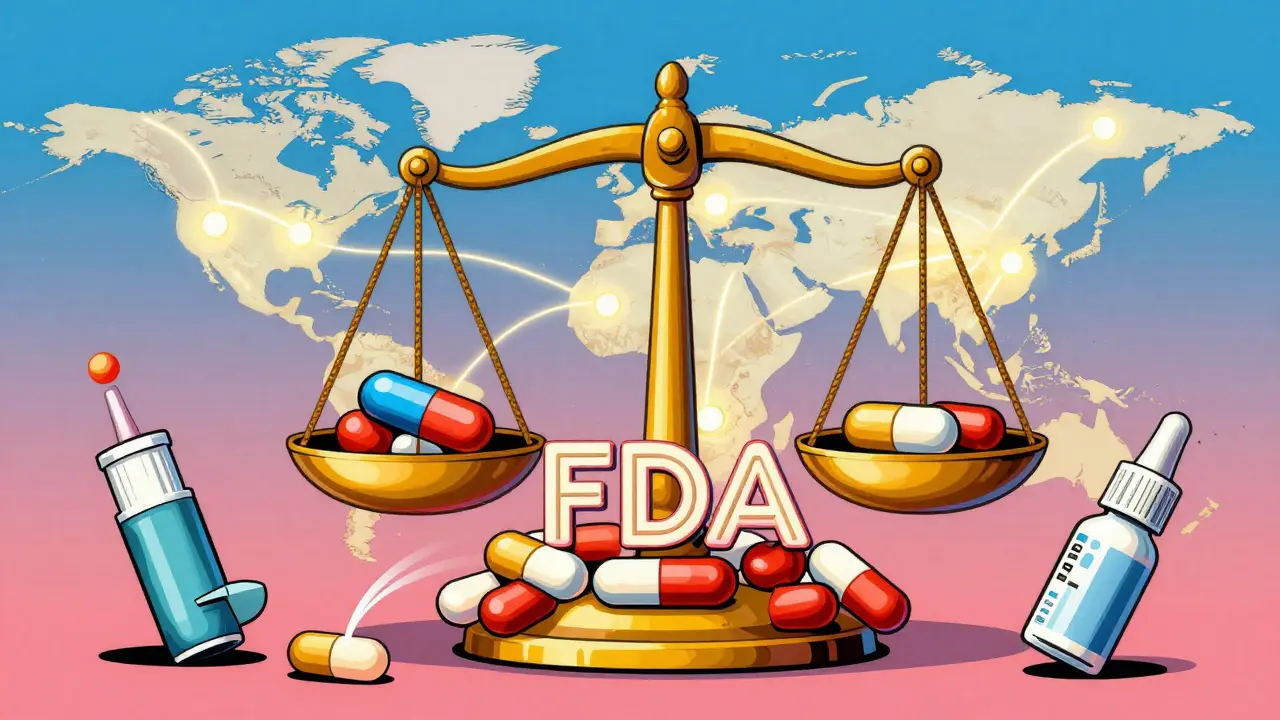
And it’s not just pills. Inhalers, eye drops, and topical creams need special testing because the drug doesn’t enter the bloodstream the same way. For inhalers, you can’t just measure blood levels - you have to prove the drug reaches the lungs the same way. That’s why some complex generics require clinical endpoint studies or pharmacodynamic testing instead of standard pharmacokinetic tests.
How Generic Drugs Are Held to the Same Standards
Many assume brand-name drugs go through more scrutiny. That’s true for initial approval - brand drugs need large, multi-year clinical trials with thousands of patients. But generics? They don’t repeat those trials. Instead, they rely on the FDA’s “Abbreviated New Drug Application” (ANDA) pathway. That doesn’t mean less oversight. It means smarter oversight.
Before a generic is even tested in people, it must pass in vitro tests. The dissolution profile - how quickly the tablet breaks down in simulated stomach fluid - must match the brand within tight limits. Then, the manufacturing facility gets inspected. The FDA inspects over 1,200 generic drug plants every year, both in the U.S. and overseas. And every batch must meet strict quality standards for purity, strength, and stability.
The result? The FDA’s Orange Book lists over 20,000 generic drug products approved as therapeutically equivalent to their brand-name versions. That’s not a small number - it’s the backbone of modern healthcare.

What Bioequivalence Testing Doesn’t Prove
It’s important to know what bioequivalence testing doesn’t cover. It doesn’t prove the generic works better for certain people. It doesn’t test long-term side effects - those are assumed to be the same because the active ingredient is identical. And it doesn’t guarantee identical side effects from inactive ingredients. That’s why some people report stomach upset, rash, or changes in taste with a generic - not because the drug doesn’t work, but because the fillers, dyes, or preservatives are different.
For example, a generic version of a seizure medication might use a different binder that causes mild nausea in some patients. That’s not a failure of bioequivalence - it’s a difference in formulation. The drug still gets into the bloodstream the same way. The side effect is minor and unrelated to the drug’s effectiveness.
And while bioequivalence ensures the drug works the same in healthy adults, it doesn’t guarantee identical results in children, the elderly, or people with liver or kidney disease. But that’s true for brand-name drugs too. The testing is done on healthy volunteers because they’re the most consistent group for measuring absorption.
Real-World Evidence: Do Generics Work?
Science says yes. But what do real people say? A 2022 Consumer Reports survey of 1,200 users found that 87% noticed no difference between their generic and brand-name drugs. Nine percent even said the generic worked better. Only 4% felt the generic was less effective.
On Reddit’s pharmacy forums, a thread with over 1,400 comments showed 78% of users reported no difference in effectiveness. Most complaints were about pill size, color, or minor stomach upset - not lack of results.
Still, 32% of patients in a 2021 study believed generics were less effective. That’s not because the science is flawed - it’s because of perception. The color change, the unfamiliar name, the lower price - all trigger doubt. But the data doesn’t lie. If bioequivalence testing passed, the drug works.
How the System Keeps Improving
The FDA isn’t resting. In 2023, it launched a new initiative to update bioequivalence standards for complex products like topical creams, inhalers, and ophthalmic solutions. These are harder to test because the drug doesn’t enter the bloodstream - it acts locally. Traditional blood tests won’t cut it.
That’s why experts are turning to new tools: computer modeling and physiologically based pharmacokinetic (PBPK) simulations. These models predict how a drug behaves in different people based on age, weight, organ function, and more. The FDA’s 2022 draft guidance on “Model-Informed Drug Development” signals a shift toward using these tools to reduce the number of human studies needed - without lowering standards.
The European Medicines Agency is doing the same. And global harmonization through the ICH means the same bioequivalence rules now apply across the U.S., EU, Japan, and other major markets. That’s why a generic made in India or Germany can be trusted in the U.S. - the science is consistent.
The Bottom Line: You Can Trust Generics
Generic drugs save the U.S. healthcare system over $300 billion a year. They’re used in 90% of prescriptions. And they’re not second-rate. They’re scientifically proven to be the same.
If your doctor prescribes a brand, you can ask for the generic. If your pharmacy gives you a different version, it’s not because they’re cutting corners - it’s because they’re following the law. Every generic on the shelf has passed the same rigorous bioequivalence test.
Don’t let myths stop you from saving money. If your generic works, it’s because the science says it should. And that science is backed by decades of data, thousands of studies, and the strictest regulatory standards in the world.
Do generic drugs take longer to work than brand-name drugs?
No. Bioequivalence testing requires that the generic drug reaches the same maximum concentration in the blood (Cmax) at the same time as the brand-name version. If it absorbed slower, it would fail the test. Any delay you feel is likely psychological or due to differences in inactive ingredients, not the active drug.
Are generic drugs less potent than brand-name drugs?
No. The FDA requires that the amount of active ingredient in a generic be identical to the brand. Bioequivalence testing ensures the drug is absorbed in the same amount and at the same rate. If a generic were weaker, it would not meet the 80-125% range for AUC and Cmax and would be rejected.
Why do generic pills look different from brand-name pills?
U.S. law requires generic drugs to look different from the brand-name version to avoid trademark infringement. That means different shapes, colors, or markings - but the active ingredient, strength, dosage form, and bioequivalence are identical. The difference is only cosmetic.
Can I switch between different generic versions of the same drug?
Yes. All generics approved for a brand-name drug must meet the same bioequivalence standards. Switching between different generic manufacturers is safe because each one has been tested against the same reference drug. Some people notice minor differences in side effects due to inactive ingredients, but the drug’s effectiveness remains unchanged.
Are there any drugs where generics aren’t reliable?
For the vast majority of drugs, generics are just as reliable. However, for narrow therapeutic index drugs - like warfarin, levothyroxine, or certain seizure medications - doctors may prefer to stick with one brand or generic to avoid even small variations. But even here, multiple generics are approved and safe; it’s about consistency, not effectiveness. Always talk to your pharmacist or doctor if you’re unsure.




Ann Romine
January 1, 2026 AT 22:53Interesting breakdown. I never realized how tightly regulated generics are. The 80-125% range seems so precise, it’s almost comforting. I used to worry switching brands would mess with my blood pressure med, but now I get why that’s unnecessary.
Layla Anna
January 2, 2026 AT 21:36My grandma switched to generic levothyroxine last year and her TSH stayed perfect 😊 she even saved $40 a month. People freak out over pill color but the science is solid. Trust the data not the fear.
Olukayode Oguntulu
January 3, 2026 AT 07:14Ah yes, the FDA’s sacred calculus - AUC and Cmax, the twin pillars of pharmaceutical orthodoxy. But let us not be seduced by the illusion of equivalence. The body is not a test tube, nor is bioequivalence a metaphysical truth. It is a statistical artifact, a bureaucratic fiction masquerading as scientific certainty. The human organism, with its microbiome, epigenetics, and idiosyncratic metabolism, cannot be reduced to two numbers in a confidence interval. We are not machines calibrated by FDA engineers in a sterile Maryland lab. We are living, breathing chaos systems. And yet… we swallow the pill anyway.
jaspreet sandhu
January 3, 2026 AT 12:43Everyone says generics are fine but I’ve seen people get sick after switching. One guy in my village had seizures after switching to a generic version of phenytoin. He didn’t die but he was in hospital for weeks. So yeah maybe the numbers look good on paper but real people aren’t numbers. You think the FDA checks every batch from India or China? Nah they just stamp it and move on. You think they care about your kidney function or your liver? They care about cost savings and getting the next generic approved before lunch.
Stephen Gikuma
January 5, 2026 AT 02:53So the government lets China and India make our medicine and then says it’s just as good? That’s a joke. You think those factories have the same hygiene standards as Pfizer? I’ve seen videos. Dust everywhere. Workers in flip flops. And you’re telling me this stuff passes FDA inspection? No way. This is how we get counterfeit drugs in our system. It’s not bioequivalence - it’s bio-nonsense. We need to bring manufacturing back to America or stop pretending this is safe.
Bobby Collins
January 5, 2026 AT 04:58lol i switched to generic omeprazole and my stomach started acting up. turned out the new one had a weird dye in it. not the drug, just the filler. i went back to brand and boom - no more bloating. so yeah the active ingredient is the same but the junk they put in there? totally different. don’t trust the label. check the inactive ingredients. i keep a spreadsheet now 😅
Heather Josey
January 5, 2026 AT 06:29I work in pharmacy and I can tell you - generics are the backbone of this system. We see patients who’d skip meds entirely if they couldn’t afford the brand. I’ve had elderly patients cry because they saved $200 a month on their statin. And every single one of them? Their labs stayed stable. The science isn’t perfect, but it’s the best we’ve got. The FDA doesn’t cut corners - they just cut the fluff. You don’t need to re-prove that aspirin works every time. Just prove it gets absorbed the same way. That’s not lazy. That’s smart.
And yes, some people get minor side effects from different fillers. That’s why pharmacists ask if you’ve switched. But that’s not the drug failing - it’s your body reacting to a new binder. Same effect, different packaging. Think of it like switching from Coke to Pepsi - same caffeine, different taste. You don’t stop drinking soda because the label changed.
Donna Peplinskie
January 5, 2026 AT 23:35Thank you for this thoughtful, clear explanation - I’ve been trying to explain this to my sister for months and she still thinks generics are ‘fake medicine’. She’s scared because her pill looks different now… but after reading this, I think she’ll finally understand. It’s not about the color or the name - it’s about the science behind it. I’m so glad we have people like you who take the time to break this down without jargon. Seriously, thank you. 🙏💛