Many people think they’re allergic to antibiotics-especially penicillin-but most of them aren’t. About 10% of Americans say they have a penicillin allergy, yet when tested properly, fewer than 1% turn out to be truly allergic. That mismatch isn’t just a myth-it’s dangerous. People labeled as allergic often get stronger, more expensive antibiotics that don’t work as well, cost more, and fuel antibiotic resistance. If you’ve been told you’re allergic to an antibiotic, especially penicillin, getting tested could change your life-literally. Here’s how to get ready for it.
Stop Taking Antihistamines Before Your Test
One of the biggest mistakes people make is not stopping their allergy meds before testing. Antihistamines block the body’s natural reaction to allergens, which means they can hide a real allergy. If you’re taking them, your test will give a false negative. That’s dangerous because you might think you’re safe when you’re not.
You need to stop first-generation antihistamines like diphenhydramine (Benadryl) and hydroxyzine at least 72 hours before your appointment. These are common in over-the-counter sleep aids and cold medicines. If you’ve been using them regularly, plan ahead. You might feel a little stuffy or itchy, but that’s better than getting a wrong test result.
Second-generation antihistamines-like cetirizine (Zyrtec), loratadine (Claritin), fexofenadine (Allegra), and levocetirizine (Xyzal)-last longer in your system. You must stop these 7 full days before testing. Even one dose during that window can mess up your results. Don’t assume your doctor will remind you. Keep a log of everything you take in the week leading up to your appointment.
Some prescription drugs also contain antihistamines. Doxepin, a tricyclic antidepressant, is one. It must be stopped 14 days before testing. If you’re on this medication, talk to your prescriber early. Don’t stop cold turkey without medical advice.
Tell Your Doctor About Every Medication You Take
It’s not just antihistamines that matter. Other drugs can interfere with testing or make reactions harder to manage. ACE inhibitors, often prescribed for high blood pressure, are a big one. They can block your body’s natural response to anaphylaxis, making it harder to spot early warning signs. Beta-blockers, used for heart conditions and migraines, can also mask symptoms like a fast heartbeat or shaking-early signs of a serious reaction.
That doesn’t mean you should stop these meds. In fact, you should usually keep taking them. But you must tell your allergist you’re on them. They’ll adjust how they monitor you. If you’re on beta-blockers, your test might be done in a hospital setting with extra safety measures. If you’re on ACE inhibitors, they’ll be extra cautious with the oral challenge.
Don’t forget supplements, herbs, or vitamins. Some, like quercetin or stinging nettle, have mild antihistamine effects. Even if you think they’re harmless, mention them. Your allergist needs the full picture.
What Happens During the Test
Testing isn’t one step-it’s three, done in order. Each step builds on the last. If the first is negative, you move to the next. If it’s positive, the test stops there.
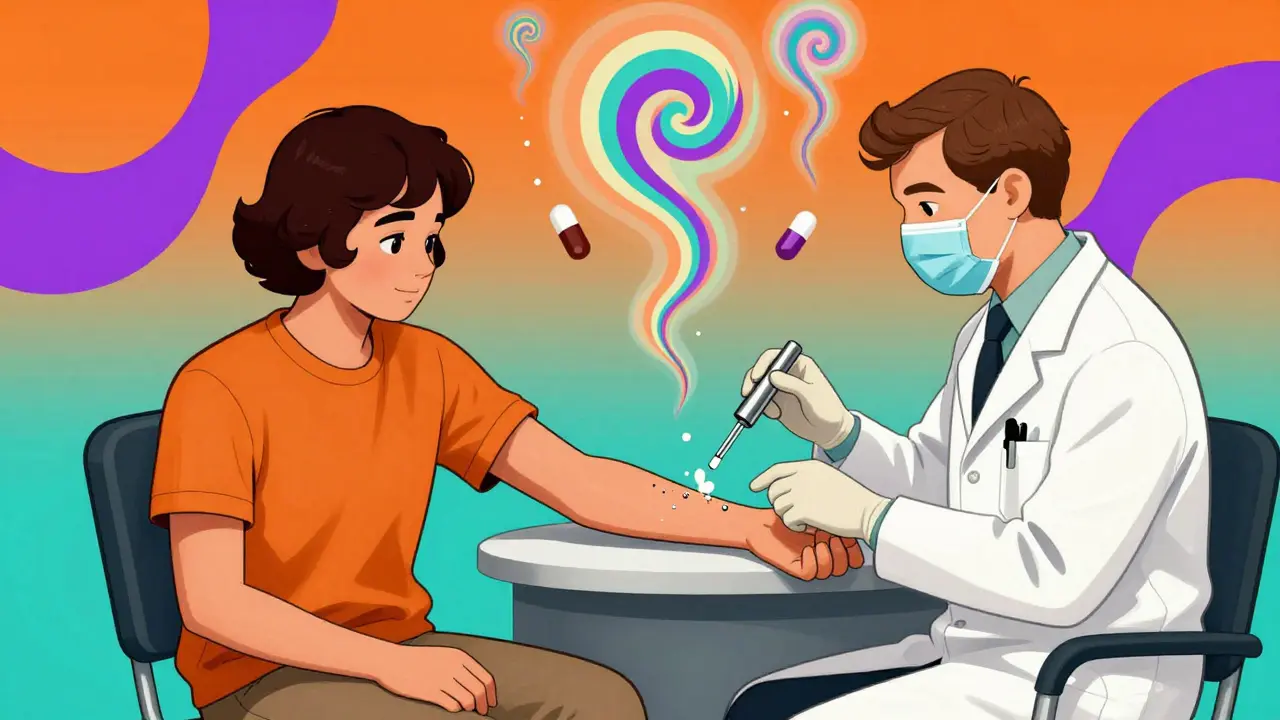
First comes the skin prick test. A tiny drop of penicillin reagent is placed on your skin, usually your forearm or back. A small plastic device lightly pricks the surface. It doesn’t draw blood or hurt much-most people say it feels like a mosquito bite. No reaction? Good. You move on.
If that’s negative, you get the intradermal test. A tiny needle injects a small amount of penicillin just under the skin. You’ll see a small bump, like a mosquito bite. After 15 minutes, the doctor checks for swelling or redness bigger than 3mm. That’s a positive result. If you’re still clear, you proceed.
The final step is the oral challenge. You swallow a small dose of the antibiotic-usually amoxicillin or penicillin. It’s not a shot. It’s a pill or liquid. You’re watched for 30 minutes. Then you get the full dose, and you’re monitored for another 60 minutes. This is the only way to be 100% sure you’re not allergic. About 10% of people have mild symptoms during this step-itching, nausea, a rash. Most are not true allergies. The risk of anaphylaxis? Just 0.06%.
What a Positive or Negative Result Means
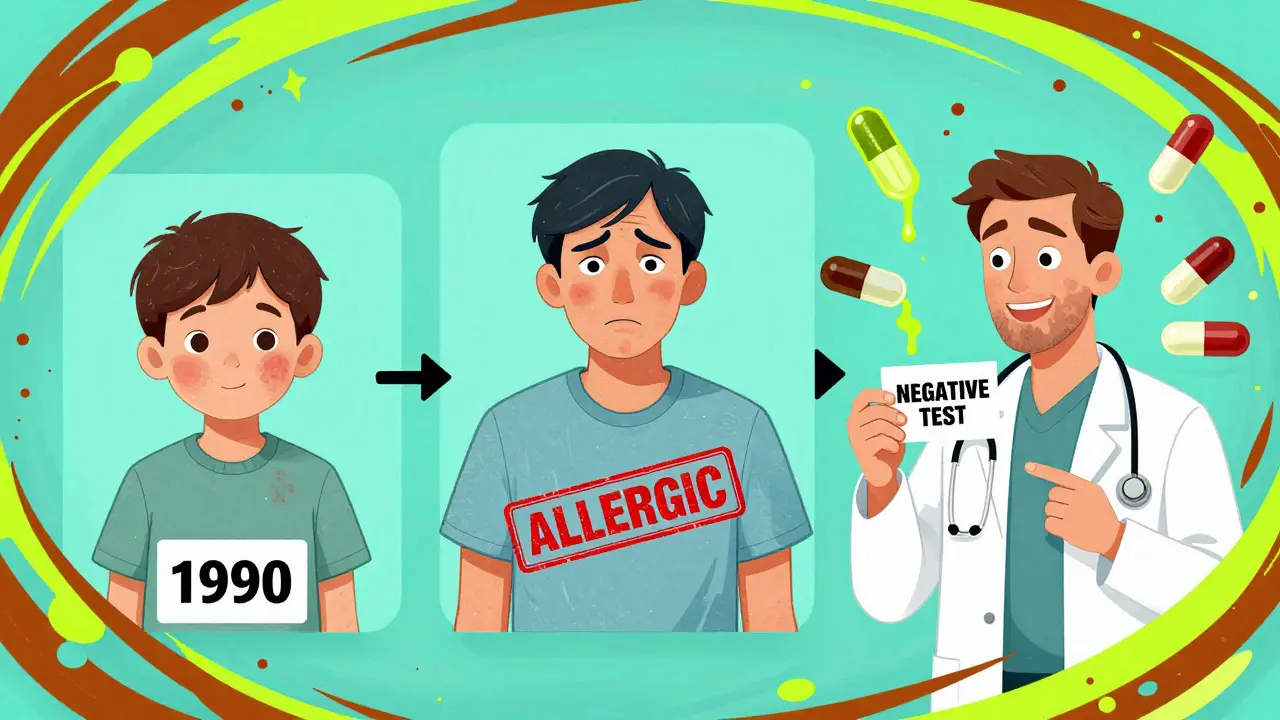
A positive skin test means you’re likely allergic. The accuracy is 95-98%. That’s as reliable as any allergy test gets. If you test positive, you’ll avoid penicillin and related drugs. But here’s the twist: allergies can fade. Half of people who had a serious reaction 5 years ago no longer react. Eighty percent lose it after 10 years. If you were labeled allergic as a child, retesting now could open up better treatment options.
A negative test means you’re not allergic. Not just “probably.” Not “likely.” You’re not allergic. That’s huge. You can now safely take penicillin, amoxicillin, or other beta-lactams. No more expensive alternatives. No more unnecessary side effects. You’ll get the best antibiotic for your infection, not the one that’s just safe on paper.
Some reactions during testing aren’t allergies. A little itching, mild nausea, or anxiety can happen. If there’s no swelling, no breathing trouble, no drop in blood pressure, it’s not an allergy. Your allergist will know the difference. Don’t panic if you feel odd-just tell them.
What to Expect After the Test
Most people feel fine. Some get a little redness or itching at the test site. That usually fades in a few hours. About 15% of patients develop delayed reactions-itchy skin or mild swelling 4 to 8 hours later. These are harmless and can be treated with over-the-counter hydrocortisone cream.
After a negative test, you’ll get a letter or card confirming you’re not allergic. Keep it. Show it to every doctor, dentist, or ER you visit. Many hospitals still flag you as allergic even after testing. A physical card or digital note in your phone can prevent that.
Some patients report life-changing outcomes. One man switched from $1,850-per-dose daptomycin to $12 penicillin for a bone infection. His annual antibiotic cost dropped from $67,525 to $4,380. That’s not just savings-it’s access to better, more effective treatment.
Why This Matters More Than You Think
Every time someone with a false penicillin allergy gets a broad-spectrum antibiotic, it adds to antibiotic resistance. These drugs kill more good bacteria, increase side effects, and cost the system $6,000 more per patient each year. Proper testing doesn’t just help you-it helps everyone.
Doctors who use testing see patients recover faster. Hospital stays drop by an average of 1.7 days. Infections are treated more effectively. And for every dollar spent on testing, the system saves $5.70.
Right now, only 17% of primary care providers follow testing guidelines. Rural areas have almost no allergists. But change is coming. Telemedicine trials show 95% success with supervised at-home challenges. By 2027, 75% of U.S. hospitals will have formal de-labeling programs. That means more access, more accuracy, and fewer people stuck with outdated labels.
If you’ve been told you’re allergic to penicillin or another antibiotic, don’t accept it as fact. Ask for testing. It’s safe. It’s accurate. And it could save you money, time, and maybe even your life.
Can I take antihistamines the day before my allergy test?
No. First-generation antihistamines like Benadryl must be stopped 72 hours before testing. Second-generation ones like Zyrtec or Claritin require a full 7-day break. Taking them even once during that window can block your body’s reaction and give you a false negative result.
Is the oral challenge dangerous?
The risk of a severe reaction during the oral challenge is very low-about 0.06%. Most people experience no reaction at all. Mild symptoms like itching or nausea happen in about 10% of cases, but these are usually not true allergies. The test is done in a controlled setting with epinephrine and other emergency tools ready.
Do I need to stop all my medications before testing?
No. You should continue taking essential medications like blood pressure drugs, insulin, or heart medications. Only antihistamines and certain antidepressants need to be stopped. Always tell your allergist what you’re taking-they’ll tell you what’s safe to keep and what to pause.
If I had a rash as a child, do I still have a penicillin allergy?
Probably not. About 50% of people who had a reaction 5 years ago lose their allergy. By 10 years, that number jumps to 80%. A childhood rash doesn’t mean you’re still allergic. Testing can confirm whether you’re safe to use penicillin now.
Can I get tested if I’m not near an allergist?
Yes. New telemedicine programs allow supervised at-home challenges for low-risk patients, with success rates above 94%. Your doctor can refer you to one of these programs. If you live in a rural area, this may be your best option for accurate testing without traveling far.



Kenzie Goode
February 26, 2026 AT 12:55I never realized how many people are just carrying around a false penicillin label like a scarlet letter. I was told I was allergic at 8 after a rash from amoxicillin, and I’ve spent 20 years avoiding it. Got tested last year - negative. My doctor switched me back to penicillin for a sinus infection and I saved over $1,200. And honestly? I felt better faster. Why isn’t this routine?
Also - I cried. Not because of the test. Because I realized I’d been scared of something that wasn’t even real.
Bhaskar Anand
February 26, 2026 AT 13:13William James
February 27, 2026 AT 08:05Just wanted to say - this is one of those rare pieces of medical advice that actually feels like a gift. Not just for you, but for your family, your community, even the planet. Every time we use a broad-spectrum drug unnecessarily, we’re contributing to a silent crisis. And yet, here’s this simple, safe, life-changing step that almost no one takes. I’ve shared this with my mom, my sister, my cousin who’s on doxepin. We all need to stop being passive about our health. You don’t need to be a doctor to ask, ‘What if I’m not allergic?’
It’s not just about medicine. It’s about reclaiming your body from assumptions.
Joanna Reyes
February 28, 2026 AT 00:24I’ve been an ER nurse for 14 years and I’ve seen this over and over - patients come in with a ‘penicillin allergy’ on their chart, and when we dig deeper, they had a stomachache at age 6, got a rash once, and never got tested. We give them vancomycin or clindamycin - both of which have higher rates of C. diff, longer hospital stays, and way more side effects. And the kicker? We don’t even ask if they’ve taken Zyrtec last week. It’s insane. The system is broken. We’re trained to check allergies, but not to question them. This article should be required reading for every medical student. And every patient. Please. If you’ve been told you’re allergic - get tested. It’s not a risk. It’s a reset.
Dinesh Dawn
March 2, 2026 AT 00:04Nick Hamby
March 3, 2026 AT 17:56It’s fascinating how a single diagnostic step - one skin prick, one oral challenge - can dismantle decades of misinformation. We live in a world where we trust labels over evidence. A label on a chart, a sticker on a wristband, a note in an EMR - all of it treated as gospel. But medicine isn’t about what’s written. It’s about what’s true. And truth, in this case, is testable. Accessible. Affordable. The real tragedy isn’t the false allergy. It’s the fact that so many providers still don’t offer testing. It’s not a niche procedure. It’s basic care. And if you’re reading this and you’ve been told you’re allergic - you have the right to ask. Demand it. You’re not being difficult. You’re being intelligent.
kirti juneja
March 4, 2026 AT 14:32OMG. I just got my test results back - negative! I’ve been avoiding penicillin since I was 7 because I got a rash after a tonsillectomy. My mom still says, ‘But what if it’s still in there?’ Like it’s a ghost. I told her this article and she said, ‘So you’re saying I raised you wrong?’ I laughed so hard I cried. Then I texted my doctor and asked for a letter. Now I’m going to start using penicillin for every infection. My wallet’s gonna thank me. My body’s gonna thank me. And my mom? She’s gonna start reading medical blogs. #PenicillinFreeAtLast
Haley Gumm
March 5, 2026 AT 02:09So… you’re saying the entire medical system is built on a myth? And we’re all just blindly following it? I mean, if 90% of people who think they’re allergic aren’t - why aren’t we doing mass screenings? Why isn’t this on TV? Why isn’t this in every pediatrician’s office? Why do we wait until someone’s in the ER on daptomycin at $1,850 per dose to realize we’ve been lied to? This isn’t science. This is negligence. And it’s profitable. Someone’s making money off your fear.
Gabrielle Conroy
March 5, 2026 AT 22:43YESSSS!! I got tested last month!! 🙌 I was terrified - I thought I’d die during the oral challenge 😭 But it was literally just swallowing a pill and sitting there for an hour. No reaction. My allergist gave me a card. I took a pic and put it in my wallet. Now when I go to urgent care, I show it. They always say, ‘Wait, really?’ Like I’m a unicorn. I’m not a unicorn. I’m just someone who asked a simple question. If you’re reading this and you think you’re allergic - DO IT. You’ll thank yourself. I’m telling all my friends. 💪❤️ #PenicillinAllergyMythBusted
Spenser Bickett
March 6, 2026 AT 02:28Christopher Wiedenhaupt
March 7, 2026 AT 13:29Thank you for this. I’ve been on doxepin for 8 years for anxiety. Never knew it interfered with allergy testing. I stopped it 14 days ago as advised. Got tested yesterday. Negative. I feel like I’ve been given back a part of my health I didn’t know I’d lost. I didn’t even realize how much I’d been avoiding antibiotics - I’d get sick, suffer, and just hope it passed. Now I can treat properly. I’m going to tell my therapist about this. And my doctor. And my sister. This matters.
John Smith
March 8, 2026 AT 11:19Natanya Green
March 8, 2026 AT 20:14Okay so I got tested and it was like a scene from a movie. The nurse said ‘This is the moment you find out if you’ve been living a lie’ and I started crying. I was 11 when I got my first rash. 20 years of fear. 20 years of ‘I can’t take that.’ And now? I’m going to take amoxicillin for my next ear infection. I’m gonna tell my kids. I’m gonna tell my coworkers. I’m gonna tell my dentist. This isn’t just a test. It’s a rebirth. I feel lighter. Like I’ve shed a skin I didn’t know I was wearing. Thank you. From the bottom of my heart.
Michael FItzpatrick
March 9, 2026 AT 04:21My aunt got tested after 40 years of ‘allergy’ - turns out she had a stomach virus at 3, got a rash, and got labeled. Now she’s on penicillin for pneumonia. Cost: $8. Recovery time: 3 days. Before? Vancomycin. Cost: $3,200. Recovery: 10 days. She says it’s the best decision she ever made. I’m getting tested next month. If you’ve been told you’re allergic - don’t just believe it. Test it. Your body will thank you. And your bank account will throw a party.