
One glass of grapefruit juice might seem like a healthy start to your day-rich in vitamin C, low in calories, and packed with antioxidants. But if you're taking an immunosuppressant after a transplant, that glass could be life-threatening. This isn't a myth or a warning from an overcautious doctor. It's a well-documented, clinically proven interaction that has sent patients to the hospital, raised drug levels to dangerous highs, and even led to kidney failure. The science behind it is clear, the risks are real, and the advice is simple: avoid grapefruit completely if you're on certain immunosuppressants.
Why Grapefruit Changes How Your Medication Works
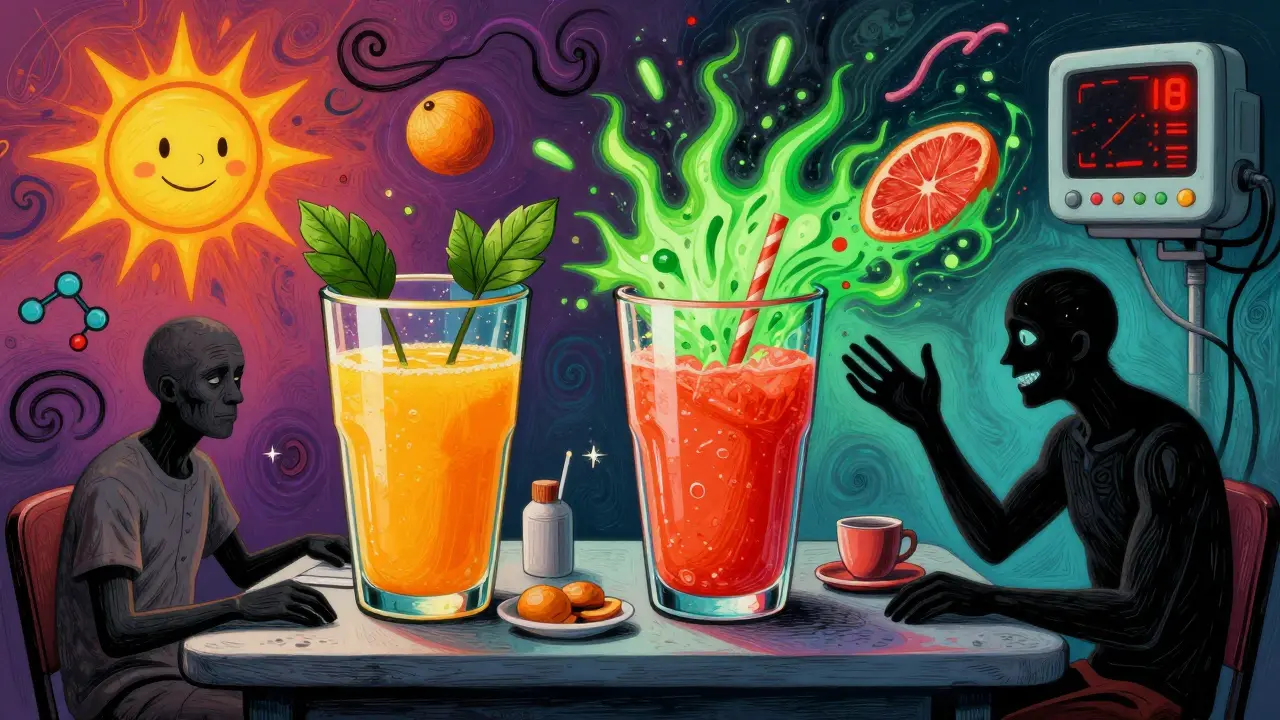
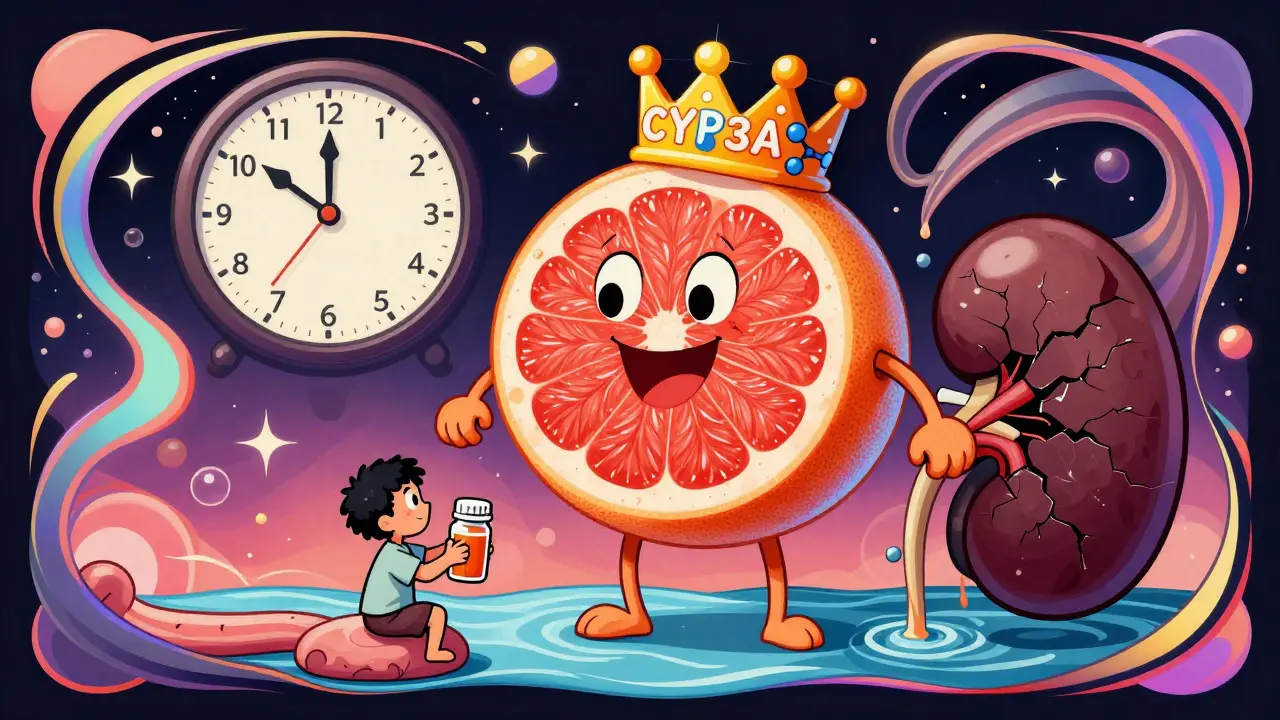
Your body doesn’t absorb all the drugs you swallow. Most oral medications pass through your gut, where enzymes-especially CYP3A4-break them down before they enter your bloodstream. This is called first-pass metabolism. It’s a natural filter that keeps drug levels from spiking too high. Grapefruit messes with this filter. Specifically, it contains chemicals called furanocoumarins, mainly 6',7'-dihydroxybergamottin and bergamottin. These compounds permanently disable CYP3A4 enzymes in your intestines. Once they’re shut down, your body can’t break down the drug properly. That means more of it gets absorbed. A lot more.Studies show that just one 8-ounce glass of grapefruit juice can increase blood levels of cyclosporine by 50-100%, tacrolimus by 30-50%, and sirolimus by 200-300%. These aren’t small changes. For drugs with a narrow therapeutic index-meaning the difference between a helpful dose and a toxic one is tiny-this is catastrophic. A tacrolimus level of 12 ng/mL might be perfect. A level of 24 ng/mL? That’s toxic. And grapefruit can push you there in less than 24 hours.
Which Immunosuppressants Are Most Affected?
Not all immunosuppressants react the same way. The ones that are most dangerous to mix with grapefruit share three key traits: they’re broken down heavily by CYP3A4, they’re poorly absorbed on their own, and their safe range is very narrow. These include:- Cyclosporine (Sandimmune, Neoral)
- Tacrolimus (Prograf, Envarsus XR, Astagraf XL)
- Sirolimus (Rapamune)
- Everolimus (Zortress) - added to the list in 2023
These are the drugs most transplant patients take to keep their new organ from being rejected. If you’re on any of them, grapefruit is off-limits. Even if you’ve been taking your medication for years without issues, one accidental glass can change everything. The interaction doesn’t care how long you’ve been stable. It only cares about whether your gut enzymes are still working.
How Long Does the Effect Last?
This is where most people get it wrong. They think, “I had grapefruit yesterday, but I took my pill today-should be fine.” It’s not. The inhibition of CYP3A4 isn’t temporary. Furanocoumarins bind to the enzyme in a way that destroys it. Your body has to make new enzymes to replace them, and that takes time. Research shows that after one glass of grapefruit juice:- At 24 hours: 47% of enzyme activity is still blocked
- At 48 hours: 35% blocked
- At 72 hours: 24% still inhibited
That means if you eat grapefruit on Monday, your system is still vulnerable on Thursday. The standard advice from the American Academy of Family Physicians and transplant centers worldwide is to stop grapefruit for at least 72 hours before starting any affected medication. But here’s the catch: if you’re already on the drug, you can’t just wait. You have to stop grapefruit now and keep stopping it forever.
What Counts as Grapefruit?
It’s not just the fruit. It’s not just the juice. It’s anything that comes from the grapefruit plant. That includes:- Fresh grapefruit (any color)
- Grapefruit juice (store-bought or homemade)
- Grapefruit extract or supplements
- Grapefruit-flavored sodas, candies, or teas
- Seville oranges (used in marmalade)
- Pomelos (a large citrus relative)
Regular oranges, tangerines, lemons, and limes are safe. They don’t contain the same furanocoumarins. But Seville oranges? They’re just as dangerous as grapefruit. Many people don’t realize that marmalade made from Seville oranges can trigger the same interaction. Always check labels. If it says “bitter orange” or “Seville orange,” avoid it.
What Happens If You Accidentally Eat It?
Symptoms of immunosuppressant toxicity aren’t always obvious at first. You might feel fine-or you might start experiencing:- Severe nausea or vomiting
- Tremors or shaking
- High blood pressure
- Swelling in your ankles or feet
- Unexplained fatigue or confusion
- Changes in urine output (too little or too much)
- High potassium levels (hyperkalemia), which can cause heart rhythm problems
One kidney transplant patient on Reddit reported his tacrolimus level jumped from 8.2 ng/mL to 24.7 ng/mL after eating grapefruit. He was hospitalized with acute kidney injury. That’s not rare. Transplant pharmacists at Mayo Clinic estimate that 15-20% of unexplained spikes in immunosuppressant levels are due to undisclosed grapefruit use. If you think you’ve consumed grapefruit, call your transplant team immediately. They’ll likely order a blood test and may reduce your dose by 25-50% until levels stabilize.
Why Do So Many People Ignore the Warning?
You’d think after 35 years of research, everyone would know. But a 2023 survey by the British Liver Trust found that 68% of transplant patients still don’t fully understand the risk. Why? Because the advice sounds extreme. “Just give up citrus?” “No juice at breakfast?” “But grapefruit is good for me!”It’s true-grapefruit has benefits. Half a grapefruit gives you 70% of your daily vitamin C, 5% of your potassium, and 2 grams of fiber. But those benefits don’t outweigh the risk. One study found that grapefruit interactions cause an estimated 5-7% of all hospitalizations due to immunosuppressant toxicity. Each incident costs an average of $18,500. And the cost isn’t just financial. It’s a second transplant. It’s a year on dialysis. It’s losing your new organ.
Another problem? Patients assume their doctor told them. But in busy clinics, warnings get lost in the noise. That’s why the British Liver Trust urges patients to check the medication leaflet or ask their pharmacist directly. Don’t rely on memory. Don’t assume. Always verify.
What Should You Do Instead?
You don’t have to give up citrus entirely. Swap grapefruit for:- Oranges (navel, blood, Valencia)
- Tangerines or clementines
- Lemons or limes (in water or dressings)
- Strawberries, kiwi, or papaya (for vitamin C)
- Blueberries or pomegranate (for antioxidants)
Many transplant centers now provide personalized food guides. Johns Hopkins launched a mobile app in January 2023 that scans your medication barcode and instantly flags grapefruit and other dangerous interactions. If your hospital doesn’t have one, ask your pharmacist for a printed list of safe alternatives.
Final Advice: When in Doubt, Skip It
This isn’t about being perfect. It’s about being safe. Even a tiny amount-200 milliliters of juice, less than a cup-can cause a dangerous spike. There’s no safe threshold. No “occasional” exception. No “I only had a little.” The science doesn’t allow for it. The FDA has mandated warning labels on cyclosporine and tacrolimus packaging since 2010. The label says it plainly: “CONCOMITANT USE WITH GRAPEFRUIT IS CONTRAINDICATED.” That’s medical code for: “Do not do this. Ever.”If you’ve been told to avoid grapefruit, you’re not being punished. You’re being protected. Your medication is keeping your new organ alive. Grapefruit is trying to sabotage that. Don’t let it win.
Can I have orange juice instead of grapefruit juice?
Yes, regular oranges, tangerines, lemons, and limes are safe. They don’t contain the furanocoumarins that block CYP3A4. Stick to sweet oranges like navel or Valencia. Avoid Seville oranges, which are used in marmalade and have the same dangerous compounds as grapefruit.
How long should I wait after eating grapefruit before taking my immunosuppressant?
You shouldn’t take your immunosuppressant at all if you’ve eaten grapefruit in the last 72 hours. The enzyme inhibition lasts up to three days. Waiting a few hours isn’t enough. The safest approach is to avoid grapefruit completely while on these medications. There’s no safe window.
What if I only had a small bite of grapefruit?
Even a small amount-like one wedge or a few spoonfuls of juice-can cause a dangerous rise in drug levels. Studies show that as little as 200mL (less than a cup) of juice is enough to trigger the interaction. There’s no safe minimum. If you had any grapefruit, assume it affected your medication and contact your transplant team.
Are there any new medications that don’t interact with grapefruit?
Some newer formulations, like Envarsus XR (a modified-release version of tacrolimus), reduce-but don’t eliminate-the interaction risk. No immunosuppressant on the market today is completely safe with grapefruit. The safest choice remains avoiding grapefruit entirely, regardless of the drug formulation.
Can I drink grapefruit juice if I take my medication at night?
No. The timing of your dose doesn’t matter. Grapefruit affects enzymes in your gut, not your liver or kidneys. The inhibition lasts for days, so whether you take your pill in the morning or at night, grapefruit consumed even 24 hours earlier can still cause a spike in drug levels. The only safe option is to avoid grapefruit completely.
Why do some people say they’ve eaten grapefruit and been fine?
Some people may have naturally higher levels of CYP3A4 enzymes or may metabolize the drug differently. But that doesn’t mean it’s safe for them-or for you. This interaction is unpredictable. One person might not show symptoms, while another with the same dose and same fruit ends up in the ICU. Relying on anecdotal experience is dangerous. The science says: avoid it.
What should I do if I accidentally eat grapefruit?
Call your transplant team or pharmacist immediately. Don’t wait for symptoms. They’ll likely check your blood drug levels within 24-48 hours and may lower your dose temporarily. Do not stop your medication on your own. The goal is to prevent toxicity, not to panic. Most cases can be managed quickly if caught early.

Nancy Kou
December 20, 2025 AT 11:22Just had my kidney transplant last year and this post saved my life. I used to drink grapefruit juice every morning like it was water. Now I drink orange juice and feel better than ever. Don't be that person who thinks 'it won't happen to me' - it already did to someone you know.
Ryan van Leent
December 20, 2025 AT 14:26people always overreact to food warnings like this
my uncle took tacrolimus for 12 years and ate grapefruit every day
he's fine
so stop scaring people
Hussien SLeiman
December 21, 2025 AT 16:50Oh here we go again with the fearmongering. You're telling me that after decades of medical research, the only solution is complete dietary abstinence? That’s not medicine, that’s religious dogma dressed in lab coats. My body isn’t a fragile porcelain doll. I’ve seen people on these drugs live perfectly normal lives - even with occasional citrus. The real issue is lazy pharmacists who don’t bother to explain individual metabolic differences. You’re not protecting people - you’re infantilizing them.
And let’s be real: if you’re taking immunosuppressants, your life is already a minefield. Do you really think eliminating grapefruit is the biggest threat? What about stress? Sleep deprivation? That 3 a.m. burger run? No one mentions those. But sure, blame the fruit.
And don’t even get me started on the ‘72-hour rule’. That’s not science - that’s a safety margin so wide it’s practically a suggestion. My pharmacist told me 48 hours was fine if I had a normal enzyme profile. But no, let’s just blanket ban everything because some people can’t read a label.
And yet, here we are. Another post screaming ‘AVOID CITRUS’ like it’s the second coming of the plague. Meanwhile, people are dying from opioid overdoses, vaping, and ignoring their meds entirely - but grapefruit? That’s the villain.
I get it. It’s easy to write a post like this. It makes you feel smart. It makes you feel responsible. But real medicine isn’t about fear. It’s about education. And if your doctor can’t explain why this matters in a way that doesn’t sound like a Sunday sermon, then the problem isn’t the grapefruit - it’s the communication.
So next time you want to warn someone, ask yourself: are you helping them live - or just making them paranoid?
Sajith Shams
December 21, 2025 AT 21:17U guys dont get it the enzyme inhibition is irreversible and lasts days not hours
you think its just one glass but its the cumulative effect
my cousin was on cyclosporine after liver transplant and had one grapefruit at brunch
he ended up in ICU with acute renal failure
they had to lower his dose by 40% for 2 weeks
he still has nightmares about it
its not a myth its biochemistry
your body cant make new CYP3A4 enzymes fast enough
if you think you're immune you're just lucky not dead yet
Adrienne Dagg
December 22, 2025 AT 08:35OMG I just realized I had a grapefruit yogurt cup last week 😱
my transplant doc is gonna kill me
im calling them right now
thank you for this post i literally just saved myself from a disaster 💔
Chris Davidson
December 23, 2025 AT 15:01It is a well established pharmacological interaction
There is no safe threshold
Even minimal exposure carries risk
Do not consume grapefruit in any form
It is not negotiable
Anna Sedervay
December 24, 2025 AT 13:27One must wonder whether the pharmaceutical industry has quietly lobbied for these draconian dietary restrictions - after all, if patients are forced to avoid cheap, natural citrus alternatives, they’re more likely to rely on expensive, patented, and patent-protected pharmaceuticals for every minor nutritional deficiency. And who benefits? The same corporations that manufacture both the immunosuppressants and the ‘safe’ replacement supplements. It’s not just grapefruit they’re banning - it’s autonomy. And let’s not forget: Seville oranges were cultivated in the Mediterranean for centuries before CYP3A4 was even named. Why now? Why this alarmism? The truth is rarely as simple as the label says.
And don’t get me started on the ‘FDA-mandated’ warnings - they’re written in legalese by committee, not by clinicians who’ve actually treated patients in the real world. I’ve seen patients who’ve eaten grapefruit for 15 years with no elevation in drug levels - but their doctors still threaten them with ‘noncompliance’ if they so much as smell a peel. This isn’t medicine. It’s institutionalized fear.
My grandfather, a transplant recipient from 1998, ate grapefruit daily. He lived to 89. He was also a retired chemist. He understood the mechanism. He monitored his levels. He didn’t need a pamphlet to tell him what to do. Maybe we should trust patients with a little more intelligence.
Matt Davies
December 25, 2025 AT 16:22Man I used to love grapefruit like it was my best friend
Then I got my lung transplant
Now I drink orange juice with a little honey and feel like I won the lottery
It’s not about giving up flavor - it’s about keeping your new organs alive
Trust me, the orange juice tastes better when you know you’re not risking it all
Mike Rengifo
December 26, 2025 AT 14:38Been on tacrolimus for 6 years. Never had grapefruit. Never will. But honestly? The hardest part isn’t the juice - it’s explaining to your family why you can’t have that one marmalade they made you for Christmas. That’s the real emotional toll.
Ashley Bliss
December 28, 2025 AT 05:08I used to think grapefruit was my soulmate
Then I became a transplant patient
Now I cry every time I see a pink wedge in the grocery store
It’s not just a fruit - it’s a ghost
A ghost that whispers ‘just one bite’
And if you listen? It kills you
I’ve seen two people lose their transplants because of this
One was 22. One was 68
They both thought they were special
They were wrong
bhushan telavane
December 29, 2025 AT 14:58in india we dont even have grapefruit much but we have pomelo
same thing right
my cousin in delhi got his liver transplant and ate pomelo thinking it was safe
he ended up in hospital
now we all know
any big citrus = danger
Kelly Mulder
December 31, 2025 AT 12:32It’s not just grapefruit - it’s the entire systemic failure of patient education
Why are we relying on patients to remember obscure drug interactions when the medical system could simply integrate this into electronic prescribing systems
Why aren’t pharmacies required to print a warning on every prescription bottle
Why are we burdening the patient with the responsibility of knowing CYP3A4 kinetics
This isn’t a dietary issue
This is a failure of infrastructure
And you’re blaming the fruit
When you should be blaming the system
mark shortus
December 31, 2025 AT 21:53MY MOM ATE GRAPEFRUIT AFTER HER KIDNEY TRANSPLANT AND SHE’S STILL ALIVE BUT SHE’S A TERRIBLE PERSON
AND NOW I HATE GRAPEFRUIT
NOT BECAUSE OF THE DRUGS
BUT BECAUSE SHE IGNORED EVERYTHING
AND NOW SHE THINKS SHE’S INVINCIBLE
AND I’M SCARED EVERY TIME SHE VISITS
Alex Curran
January 2, 2026 AT 05:34As a pharmacist I see this every day
Patients think ‘I only had a little’ or ‘I took my pill 12 hours later’
It doesn’t work that way
The enzymes in your gut are destroyed - not paused
It takes 3-5 days to regenerate
So if you ate grapefruit on Monday
And took your pill on Wednesday
You’re still at risk
And yes
Even a teaspoon of juice counts
It’s not about quantity
It’s about the chemical reaction
And no
There’s no safe workaround