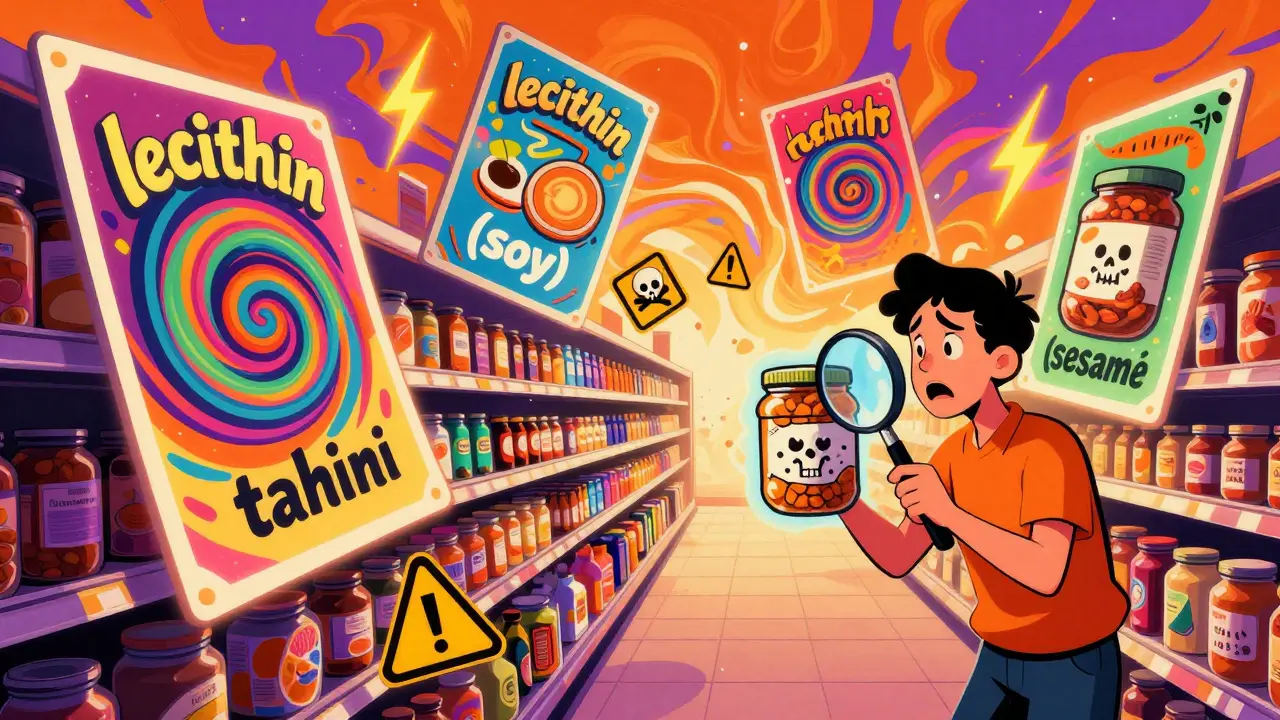
Reading a food label feels like second nature-until you or someone you love has a serious allergy. Then, every ingredient becomes a potential threat. The same goes for prescription medications, where hidden allergens lurk in inactive ingredients most people never think to question. Whether you're managing a peanut allergy, lactose intolerance, or a sesame reaction, knowing how to read labels isn’t just helpful-it’s life-saving.
What You Need to Know About Food Allergen Labels
In the U.S., nine major food allergens must be clearly labeled by law: milk, eggs, fish, crustacean shellfish, tree nuts, peanuts, wheat, soy, and sesame. Sesame became the ninth allergen in January 2023 after the FASTER Act passed. That means if you see "lecithin" on a label, you now have to ask: is it from soy or sesame? The answer matters.
By law, manufacturers must declare these allergens in one of two ways: either right in the ingredient list (like "whey (milk)" or "almond") or in a separate "Contains" statement right after the list. That "Contains" line is your first stop. Don’t skip it. Look for it before you even read the full ingredients. If it says "Contains: Milk, Soy, Tree Nuts," you know exactly what to avoid.
But here’s the catch: some labels still get it wrong. Smaller producers, especially local bakeries or imported goods, miss the mark 24% of the time. And it’s not just about obvious ingredients. "Natural flavors," "spices," or "emulsifiers" can hide allergens. In 2023, 18% of sesame-related recalls happened because sesame was listed as part of a spice blend-no mention of "sesame" anywhere. That’s why you can’t rely on guesswork.
Watch out for "may contain" statements. These are voluntary. They mean the product was made on shared equipment and might have trace amounts of an allergen. But 63% of people think "may contain" means the allergen was intentionally added. It doesn’t. It means there’s a risk of cross-contact. Still, if you’re highly sensitive, treat these warnings seriously. Many reactions happen because someone assumed "may contain" was just a legal disclaimer.
Prescription Labels Are a Different Game
Here’s where things get dangerous: prescription medications are not required to list allergens the way food is. You won’t find a "Contains" statement on your pill bottle. Instead, allergens like lactose, peanut oil, or soy lecithin are buried in the list of inactive ingredients-often called "excipients."
Lactose is the most common hidden allergen in pills. It’s derived from milk. If you’re allergic to milk proteins, even a tiny amount can trigger a reaction. Peanut oil is used in some injectables. Soy lecithin shows up in capsules and tablets. And none of it is bolded. None of it is highlighted. You have to dig for it.
The FDA doesn’t require drugmakers to label these allergens clearly. That means two identical generic drugs from different manufacturers might have completely different inactive ingredients. One might contain lactose. The other might not. You can’t assume safety based on past use.
Your pharmacist is your best ally here. Always ask: "What are the inactive ingredients in this medication?" Don’t wait until you’re at the counter. Call ahead. Bring your list of allergies. Some pharmacies offer printed sheets of inactive ingredients for common prescriptions. If they don’t, ask them to print it from the FDA’s database or the manufacturer’s prescribing information.
How to Read a Label Like a Pro
Follow this simple routine every time you pick up a new product-food or medicine:
- Start with the "Contains" statement (on food). If it’s there, read it first. If it’s missing, scan the ingredient list for allergens in parentheses.
- Look for hidden names. Milk = casein, whey, lactose. Peanut = arachis oil, groundnut. Soy = lecithin, textured vegetable protein, hydrolyzed plant protein. Wheat = gluten, modified food starch, malt. Sesame = tahini, gingelly oil, til.
- Check for "may contain". Don’t ignore it. If you’re highly sensitive, treat it like a red flag.
- For prescriptions, ask your pharmacist. Don’t rely on the bottle. Request the full inactive ingredient list. Save it in your phone or a notebook.
- Re-check every time. Formulations change. A product you’ve used for years might have switched suppliers. In 2022, FARE reported that 28% of accidental reactions came from products previously deemed safe.
Practice makes it faster. What used to take a minute now takes 15 seconds. But never rush it. One missed word can mean an emergency room visit.
What to Do When You’re Not Sure
If you’re staring at a label and can’t tell whether something’s safe, don’t guess. Use these steps:
- Search the product’s brand website. Most major companies have allergen guides or downloadable PDFs.
- Use apps like AllergyEats’ Scan feature (launched in early 2024). It uses your phone’s camera to read ingredient lists and flag allergens. Beta tests showed 92% accuracy.
- Call the manufacturer’s customer service line. Have the product name and lot number ready. They’re required to answer.
- For prescriptions, contact the pharmacy’s clinical team. Many have pharmacists trained in allergen identification.
Don’t trust online forums or anecdotal advice. Someone might say "this brand is safe," but their allergy profile isn’t yours. Stick to official sources.
Why This Matters More Than You Think
Food allergen mislabeling causes about 40% of all food recalls in the U.S. That’s not a small number. It’s the #1 reason products get pulled from shelves. In 2023, the FDA issued 147 warning letters to food companies for allergen labeling violations-a 22% jump from the year before.
And it’s not just food. A 2023 study in the Journal of Allergy and Clinical Immunology found that 4% of American adults have a documented allergy to a medication ingredient. Many don’t even know it. They blame their symptoms on something else-headaches, rashes, stomach issues-until a reaction gets severe.
For parents of children with allergies, this is especially critical. A 2023 study from Northwestern University found that 78% of allergic reactions in kids happened from foods their families thought were safe. That’s because labels changed. Or the child ate something new. Or the parent assumed the ingredient list hadn’t shifted.
There’s a reason the "free-from" food market hit $68.3 billion globally in 2023. People are paying more for clear, trustworthy labels. And they’re voting with their wallets. Products with clear allergen labeling average 4.7 stars on Amazon. Those with vague or missing info? 3.2 stars.
What’s Coming Next
The FDA is working on new rules to standardize allergen labeling even further. Proposed changes, published in May 2024, could require all allergen statements to use the same font size, placement, and formatting. They’re also considering adding mustard and celery as regulated allergens.
Internationally, things get trickier. Imported foods often don’t follow U.S. rules. A chocolate bar from Italy might list "lecithin" without saying it’s from soy. A supplement from China might use peanut oil as a binder and never mention it. Always check the country of origin-and when in doubt, avoid it.
For now, your best tools are awareness, patience, and asking questions. You don’t need to be a scientist. You just need to be consistent.
Are all food allergens required to be listed on labels?
Yes, the nine major allergens-milk, eggs, fish, crustacean shellfish, tree nuts, peanuts, wheat, soy, and sesame-are required by U.S. law to be clearly labeled on packaged foods. This includes both direct ingredients and those hidden in flavorings or additives. If a product contains any of these, it must be declared either in the ingredient list (e.g., "whey (milk)") or in a separate "Contains" statement.
Can medications contain allergens like milk or peanuts?
Yes. Many prescription and over-the-counter medications contain inactive ingredients derived from allergens like milk (lactose), peanuts (peanut oil), soy (soy lecithin), or wheat (modified starch). Unlike food, there’s no federal requirement to label these allergens on drug packaging. Always ask your pharmacist for the full list of inactive ingredients, especially if you have known allergies.
Why do allergens sometimes disappear from labels?
Manufacturers can change ingredients without rebranding the product. A company might switch suppliers, update a formula, or reduce costs-all without notifying consumers. That’s why you must check the label every time you buy a product, even if you’ve used it safely for years. About 28% of allergic reactions happen from previously safe products that changed their formulation.
What should I do if I react to a product with no allergen warning?
Report it immediately. Contact the manufacturer, your pharmacist, and the FDA’s MedWatch program for medications or the FDA’s reporting portal for food. Keep the product packaging and receipt. These reports help the FDA track patterns and trigger investigations. In 2023, over 1,200 allergen-related complaints led to recalls of products that had previously passed inspection.
Are "natural flavors" safe for people with allergies?
Not necessarily. "Natural flavors" can include derivatives of milk, soy, wheat, or even peanuts. The FDA allows this term to hide allergens unless they’re one of the nine major allergens. Even then, they don’t have to be named outright. Always assume "natural flavors" could contain allergens unless the manufacturer confirms otherwise in writing.
Next Steps for Safer Label Reading
Start today. Grab your phone and take a photo of your most-used prescription bottle. Look up the inactive ingredients online. Call your pharmacy and ask for a printed copy. Make a simple list: which allergens are you avoiding? Write them down. Keep it in your wallet or phone notes.
Teach your family. If you have kids, show them how to spot "Contains" statements. Let them help check labels at the grocery store. Make it a habit, not a chore.
And if you’re ever unsure-don’t take the risk. Call the manufacturer. Ask your pharmacist. Wait. It’s better to be safe than sorry. Your life depends on it.
Johanna Baxter
January 8, 2026 AT 23:54Just ate a snack labeled 'may contain nuts' and now I'm crying in the bathroom. This post is why I have anxiety about everything. I don't even trust my own tongue anymore. 😭
Pooja Kumari
January 9, 2026 AT 06:22Oh my god I’m so glad someone finally said this. In India, we don’t even have proper labeling laws, so when I moved to the US and saw that ‘Contains: Milk’ thing? I cried. Like, actually cried. I used to eat paneer tikka and then spend the next 12 hours wondering if my throat was closing. Now I scan every label like it’s a bomb defusal manual. And yes, I know lecithin could be sesame now - I’ve memorized the list. My mom still doesn’t get it. She says ‘but it’s just a little bit.’ A little bit almost killed me once. So now I carry an EpiPen in my purse, my shoe, my laptop bag. I’m not taking chances. If you’re reading this and you think ‘it’s probably fine’ - please don’t. It’s not. I’ve been there.
Patty Walters
January 10, 2026 AT 13:25Pharmacist here. Yes, lactose is everywhere. I’ve had patients show up with hives after taking a generic version of a med they’d taken for years. Why? Because the new maker used lactose instead of starch. I always print out the inactive ingredients for my high-risk patients. Pro tip: Google ‘FDA drug database inactive ingredients’ - it’s free and legit. Save it to your bookmarks. Also, ‘natural flavors’? Yeah, that’s a minefield. Don’t trust it. Always call the company. They’re required to answer.
tali murah
January 11, 2026 AT 02:31Of course the FDA doesn’t regulate meds like food. Because why would they protect people who can’t even read a label? It’s not like people with allergies are a demographic worth caring about. Let them suffer while Big Pharma makes billions off their ignorance. And don’t even get me started on ‘may contain’ - it’s a legal loophole dressed up as a warning. If you’re gonna say it, then fix it. Otherwise, stop pretending you care.
Phil Kemling
January 12, 2026 AT 20:30It’s funny how we treat labels like sacred texts. We’ve outsourced our trust to corporations and then panic when they fail us. But the real issue isn’t the label - it’s the belief that safety can be printed on a wrapper. We’re not just reading ingredients; we’re performing rituals of control in a world that’s fundamentally uncontrollable. What if the real allergen isn’t soy or lactose… but our need to believe we can be perfectly safe? Just a thought.
Diana Stoyanova
January 14, 2026 AT 16:35Y’all need to stop waiting for the system to fix this. Start a group. Make a shared Google Doc. List every brand that’s safe for your allergies. Share it. Post it on Reddit. Make a TikTok. I started one for my kid’s peanut allergy - now 3,000+ families use it. We found a cereal that’s safe? Add it. A med that changed? Flag it. This isn’t just about reading labels - it’s about building a community that actually protects each other. And yeah, I’m gonna keep posting until every parent knows they’re not alone. 💪❤️
Catherine Scutt
January 15, 2026 AT 06:45People who don’t check labels are why my kid has to eat alone at birthday parties. You think it’s ‘just a little bit’? No. It’s not. It’s your negligence. I’ve seen the ER reports. I’ve seen the panic. Stop being lazy. Stop assuming. Stop being the reason someone ends up on a ventilator. You’re not ‘being chill’ - you’re a liability.
Kiruthiga Udayakumar
January 16, 2026 AT 18:37My cousin in Delhi got hospitalized after eating a ‘gluten-free’ cookie. Turned out it had soy lecithin and he’s allergic to both. India has ZERO labeling rules. So when I came to the US and saw this post? I screamed. I cried. I hugged my grocery bag. But here’s the thing - we need global standards. Why should someone in the US be safer than someone in Nigeria or Bangladesh? This isn’t just a medical issue - it’s a human rights issue. Label your damn food. Or we’ll make you.
Jenci Spradlin
January 18, 2026 AT 07:32Biggest mistake I made? Trusting the bottle. Took a med called ‘Loratadine’ for years. Never had a problem. Then one day my face swelled. Turns out the new batch had gelatin from pork. I’m Muslim. I don’t eat pork. But I didn’t know it was in my allergy pill. Now I check every single med. Even if it’s the same name. Even if it’s the same color. I print the sheet. I save it. I show my pharmacist. Don’t be like me. Be smarter.
Darren McGuff
January 19, 2026 AT 20:20Just had a 78-year-old patient come in with a rash after taking a new statin. Turned out it had soy lecithin. She’d been on the same med for 15 years - same name, same dosage. But the manufacturer changed. She didn’t check. She assumed. I showed her how to look up inactive ingredients on DailyMed.gov. She cried. Said she felt stupid. I told her - you’re not stupid. You trusted a system that failed you. Now you know. That’s power. Keep asking. Keep checking. You’re not being paranoid. You’re being smart.
Gregory Clayton
January 21, 2026 AT 19:37Why do we even need all this? In my day, people just ate food and took pills. If you had an allergy, you died. That’s nature. Now we’ve turned everything into a lawsuit waiting to happen. You want to live? Stop being so fragile. You think your kid’s gonna survive if you coddle them like this? Wake up. America’s becoming a nation of panic-driven cowards.
Jerian Lewis
January 22, 2026 AT 01:41Gregory, you’re not helping. The fact that you think people should just ‘die if they’re allergic’ is why we need this post. People with allergies aren’t fragile. They’re the ones who’ve learned to survive in a world designed for people who don’t have to think twice about their lunch. Your attitude is dangerous. And ignorant.
Maggie Noe
January 23, 2026 AT 03:05My 8-year-old just told me she wants to be a ‘label detective’ when she grows up. 🕵️♀️🔍 She checks every snack before she eats it. I used to be scared for her. Now I’m proud. She’s not afraid. She’s armed. And that’s the real win here. Knowledge > fear. 🫶