Steroid-Induced Osteoporosis Risk Calculator
Enter Your Information
How This Works
This calculator uses clinical data to estimate your fracture risk based on:
- Dose of corticosteroids (1.4% bone density loss per mg/day)
- Duration of use (risk increases after 3 months)
- Age and gender (women over 50 are higher risk)
- Previous fracture history (significantly increases risk)
Note: This is for informational purposes only. Always consult your doctor for medical advice.
When you’re on long-term corticosteroids-whether for lupus, rheumatoid arthritis, asthma, or another chronic condition-you’re not just managing your main illness. You’re also quietly fighting a silent thief: osteoporosis. It doesn’t hurt. It doesn’t show up on X-rays until it’s too late. But it breaks bones. And it happens fast.
Why Steroids Eat Your Bones
Corticosteroids like prednisone don’t just calm inflammation. They mess with your bones at the cellular level. Within just three months of taking 2.5 mg or more daily, your bone-building cells (osteoblasts) start dying off. At the same time, your bone-destroying cells (osteoclasts) stay active longer, chewing up more bone than your body can replace. This isn’t slow aging-it’s accelerated bone loss. Studies show you can lose 5% to 15% of your bone density in the first year, especially in your spine, hips, and wrists.The numbers are startling. If you’re on daily steroids for more than three months, your risk of breaking a bone jumps by 70% to 100%. And it’s not just older people. Even young adults on long-term steroids see rapid bone thinning. Each extra milligram of prednisone per day? That’s another 1.4% drop in spine bone density every year.
It’s Not Just About Dose-It’s About Time
The biggest mistake? Waiting until you feel pain or break a bone before acting. Bone loss from steroids hits hardest in the first 3 to 6 months. That’s the window where you can still stop it. By the time your doctor orders a bone scan, you might already have lost 10% of your bone mass. That’s why guidelines now say: Start prevention on day one.Here’s what you need to know: if you’re on 2.5 mg of prednisone or more daily for longer than three months, you’re in the high-risk group. At 7.5 mg or higher, your fracture risk doubles. And here’s the kicker-many people don’t even know they’re at risk. One study found only 31% of steroid users had a bone density test, even though it’s recommended for everyone on long-term therapy.
Non-Drug Prevention: The Foundation
No pill or injection works without these basics. They’re not optional. They’re the bedrock.- Move your body: Weight-bearing exercise-walking, stair climbing, dancing, resistance training-should be at least 30 minutes on most days. Steroids blunt your bones’ response to movement, but exercise still helps. It’s not about lifting heavy. It’s about consistent impact. Studies show even light activity cuts bone loss by up to 25% compared to being sedentary.
- Stop smoking: Smoking alone increases fracture risk by 25% to 30%. Combine that with steroids? You’re stacking the odds against you. Quitting doesn’t just help your lungs-it rebuilds your bone’s ability to repair itself.
- Limit alcohol: More than three drinks a day speeds up bone breakdown. Stick to one or two, or skip it entirely. Alcohol also messes with vitamin D, which your body needs to absorb calcium.
These aren’t suggestions. They’re survival tools. Skip them, and even the best meds won’t fully protect you.
Calcium and Vitamin D: The Non-Negotiables
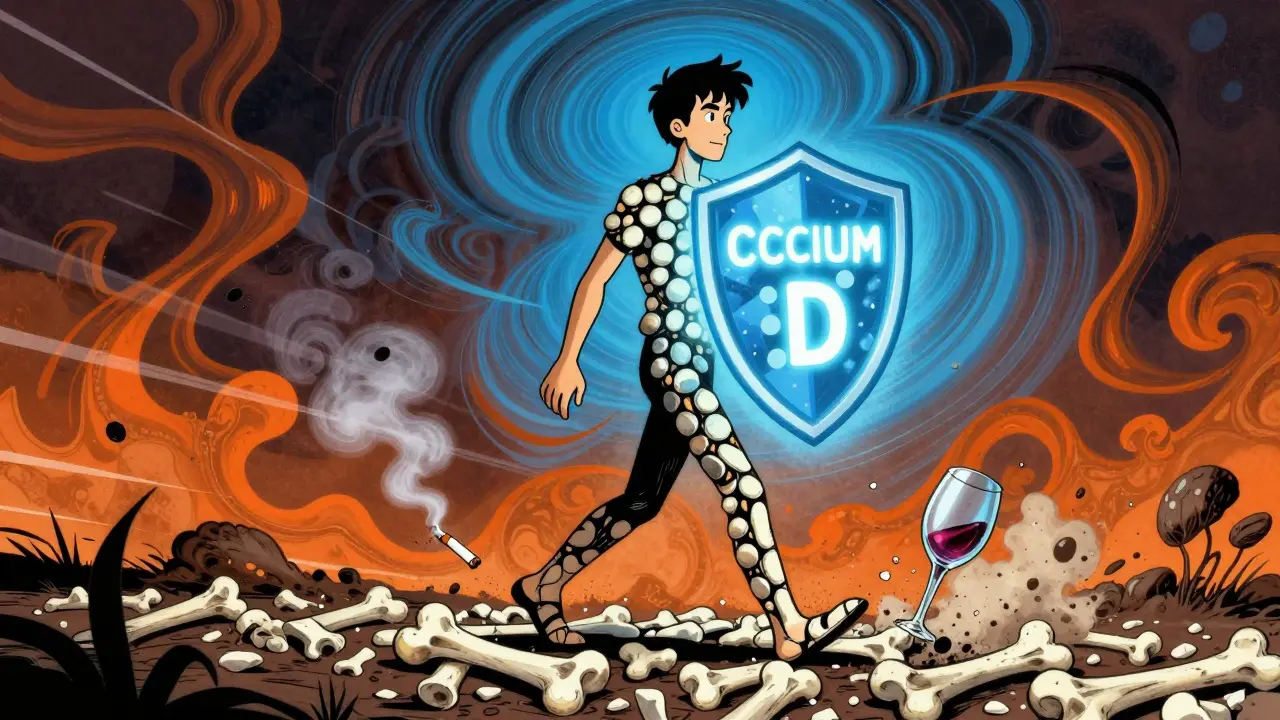
Your body needs calcium to build bone. But steroids make it harder to absorb. They reduce intestinal calcium uptake by 30% and cause your kidneys to flush out more of it. So you need more than normal.Target: 1,000 to 1,200 mg of calcium daily. Get as much as you can from food-yogurt, cheese, kale, broccoli, fortified plant milks. Then fill the gap with supplements. Don’t take it all at once. Split it into two doses (500 mg each) for better absorption.
Vitamin D? Aim for 800 to 1,000 IU daily. Many people think 600 IU is enough. But with steroids, your body needs more. Studies show that 500 IU of vitamin D plus 1,000 mg of calcium prevents spine bone loss by 0.72% per year. Without them? You lose 2% per year. That’s a 2.7% difference-enough to keep you from breaking a hip.
Get your blood level checked. The goal is at least 20 ng/mL, but many experts recommend 30 ng/mL or higher for steroid users. If you’re low, your doctor may prescribe a higher dose temporarily.
Medications That Actually Work
If you’re on steroids long-term, and especially if you’re over 50, have a history of fractures, or have low bone density, you need more than calcium and exercise.Bisphosphonates are the first-line treatment. Risedronate (5 mg daily or 35 mg weekly) cuts vertebral fracture risk by 70%. Alendronate works too. They’re pills, taken on an empty stomach with water, and you must stay upright for 30 minutes after. Side effects? Stomach upset in about 30% of people. But if you can’t tolerate them, there are other options.
Zoledronic acid is an IV drip given once a year. It boosts spine bone density by 4.5% in a year-far more than placebo. No daily pills. No stomach issues. Just one visit to the clinic.
Denosumab is a shot under the skin every six months. It increases spine bone density by 7% in a year. It’s great for people who can’t take bisphosphonates. But you can’t stop it suddenly-you need to switch to another bone drug or risk rapid bone loss.
Teriparatide is the most powerful option. It’s a daily injection that actually stimulates new bone growth. In high-risk steroid users, it increases spine density by 9.1% in 12 months-more than double what bisphosphonates do. It’s reserved for people with severe osteoporosis (T-score below -2.5) or those who’ve already broken a bone.
None of these drugs are magic. They work best when paired with calcium, vitamin D, and movement. And they’re only effective if you take them.
The Big Problem: Almost No One Gets Proper Care
Here’s the ugly truth: even though we’ve known how to prevent steroid-induced osteoporosis for decades, most people don’t get the care they need.A study found only 62% of steroid users received any form of prevention-counseling, a bone scan, or a prescription. Men were far less likely than women to be screened. Only 31% had a bone density test. Only 40% were on calcium. Only 37% on vitamin D.
Why? Because doctors assume patients know. Patients assume it’s just part of aging. And no one talks about it. One survey found 45% of steroid users think bone loss is unavoidable. It’s not. It’s preventable.
But change is possible. In the Veterans Affairs system, adding automatic alerts in electronic records-triggered when a patient gets a steroid prescription over 2.5 mg for 3 months-boosted prevention rates from 40% to 92%. Pharmacist-led education programs raised compliance from 35% to 85%. The tools exist. We just need to use them.
What You Can Do Right Now
You don’t have to wait for your doctor to bring it up. Take control.- Ask your doctor: "Am I at risk for steroid-induced osteoporosis?"
- Request a bone density test (DXA scan) if you’ve been on steroids for more than 3 months.
- Get your vitamin D level checked.
- Start taking 1,000-1,200 mg calcium and 800-1,000 IU vitamin D daily.
- Walk 30 minutes a day, five days a week. Add light weights if you can.
- Quit smoking. Cut back on alcohol.
- If your doctor says you need a bone drug, ask: "Which one, and why?"
Don’t let fear stop you. Steroids save lives. But you don’t have to trade your bones for them. With the right steps, you can stay strong, mobile, and fracture-free.
What Happens If You Do Nothing?
Half of all steroid-related fractures happen within the first year. A broken hip can mean months in rehab. A collapsed spine can shorten your height, cause chronic pain, and make it hard to breathe. And once you break one bone, your risk of breaking another skyrockets.This isn’t about living longer. It’s about living better. Keeping your bones strong means you can keep walking, climbing stairs, playing with your grandkids, and living independently.
Can I stop my steroids to protect my bones?
No. Stopping steroids suddenly can be life-threatening, especially if you’re using them for autoimmune or respiratory conditions. The goal isn’t to stop them-it’s to use the lowest effective dose for the shortest time possible, while protecting your bones at the same time. Work with your doctor to reduce your dose only when medically safe.
Do I need a bone scan if I’m young and healthy?
Yes. Steroid-induced bone loss doesn’t care how young or fit you are. Even healthy 30-year-olds on long-term prednisone can lose bone faster than a 70-year-old who’s never taken steroids. Guidelines recommend a bone density test at the start of long-term therapy, regardless of age.
Is walking enough exercise, or do I need to lift weights?
Walking helps, but adding resistance is better. Try bodyweight squats, wall push-ups, or light dumbbells two to three times a week. The key is loading your bones with force. If you’re unsure where to start, ask your doctor for a referral to a physical therapist who specializes in osteoporosis.
Can I get enough calcium from food alone?
It’s very hard. You’d need to eat 4 cups of yogurt, 3 cups of cooked kale, or 10 servings of fortified plant milk daily. Most people can’t do that consistently. Supplements are necessary to reach the 1,000-1,200 mg target. Take them in divided doses with meals for best absorption.
What if I can’t take bisphosphonates because of stomach issues?
There are alternatives. Zoledronic acid is a yearly IV infusion with no stomach side effects. Denosumab is a twice-yearly injection. Teriparatide is an injection that builds new bone. Talk to your doctor about your options. Don’t give up-there’s always a solution.
How long do I need to keep taking bone meds?
As long as you’re on steroids. If you stop steroids, your doctor may reassess your risk. Some people can stop bone meds after 3-5 years if their bone density improves and they’re no longer on steroids. But if you’re still on steroids, continuing treatment is critical. Bone protection is a long-term commitment.
Final Thought: You’re Not Powerless
Steroids are powerful. But so are you. You have more control over your bone health than you think. You can reduce your dose. You can move your body. You can take your supplements. You can ask for a bone scan. You can say no to smoking and yes to walking.Preventing steroid-induced osteoporosis isn’t about perfection. It’s about progress. One step at a time. The sooner you start, the stronger you’ll stay.
Tim Goodfellow
December 17, 2025 AT 18:06Just read this and my jaw dropped. I’ve been on 7.5mg prednisone for 18 months for my RA and no one ever mentioned bone loss until now. I thought my aching back was just ‘aging’-turns out it’s my skeleton screaming for help. Time to start walking, loading up on calcium, and begging my doc for a DXA scan. Thanks for the wake-up call.
Vicki Belcher
December 18, 2025 AT 10:43YES. 💪 I’m on steroids for lupus and I’ve been doing the 1200mg calcium + 1000IU D3 + daily walks for 2 years. My last scan showed +1.2% spine density. It’s not magic-it’s consistency. You can fight this. Don’t wait for the break to act. 🌱
Moses Odumbe
December 18, 2025 AT 12:55Let’s be real-most docs are asleep at the wheel. I got prescribed prednisone in 2020 and didn’t get a bone scan until 2023. By then, I’d lost 8% of my spine density. The VA system’s alert system? That’s the only reason I’m still standing. Why aren’t all EHRs doing this? 🤷♂️
Laura Hamill
December 19, 2025 AT 08:15They don’t want you to know this. Big Pharma doesn’t profit from walking and vitamin D. They profit from the $12,000/year IV drip. And don’t get me started on how the FDA ignores real prevention. They’re selling fear, not solutions. 💀
anthony funes gomez
December 21, 2025 AT 04:51It’s a bioenergetic cascade: glucocorticoid receptor overstimulation → osteoblast apoptosis → RANKL/OPG ratio dysregulation → unchecked osteoclastogenesis → accelerated bone resorption. The pharmacokinetics of prednisone exacerbate intestinal calcium malabsorption via VDR downregulation. The data is unequivocal. Yet, clinical inertia persists. Why?
Takeysha Turnquest
December 22, 2025 AT 11:40we are all just bones waiting to shatter
the pills fix nothing
the body remembers
the silence kills
you are not alone
Kevin Motta Top
December 23, 2025 AT 22:09As a physical therapist in Chicago, I see this every week. Young patients on steroids thinking ‘I’m too young for osteoporosis.’ Nope. Your bones don’t care about your age. Just 30 minutes of weight-bearing daily can cut your risk in half. Start now. Not tomorrow.
Kelly Mulder
December 24, 2025 AT 14:57One must question the very foundations of modern medical pedagogy when a patient must self-educate on a condition that is both preventable and clinically well-documented. The fact that only 31% receive a DEXA scan is not negligence-it is institutional epistemic failure. One is left to wonder whether the Hippocratic oath is still legible in the age of insurance-driven triage.
Emily P
December 26, 2025 AT 11:51Does anyone know if teriparatide is covered by insurance if you’re under 50? My doc said ‘maybe’ but didn’t give me a straight answer. I’m scared to ask again.
Aboobakar Muhammedali
December 26, 2025 AT 17:59same here i was scared to ask too but i just said ‘i need to know my options’ and they gave me a list
teriparatide is covered if you’ve had a fracture or t-score under -2.5
ask for the bone specialist not your gp
they know more
Alisa Silvia Bila
December 28, 2025 AT 03:08I’ve been on 5mg prednisone for 4 years. Started calcium and D3 after reading this. Walked 10 minutes a day. Did bodyweight squats. No fancy gear. My last scan? Stable. Not perfect-but not worse. Small steps matter. You’re not failing if you’re trying.
William Liu
December 28, 2025 AT 17:39This is the most helpful thing I’ve read in years. I’m not a doctor. I’m not a scientist. I’m just someone who didn’t want to end up in a wheelchair. Thank you for giving me a roadmap. I’m starting tomorrow.
Marsha Jentzsch
December 28, 2025 AT 19:32Wait… so you’re telling me the government knows about this but lets people suffer? And the pharma companies are hiding the truth? And my doctor didn’t tell me because he’s in on it? I’ve been lied to my whole life. I’m not taking any more pills. I’m going to live on kale and sunlight. 🌞🥬
Carolyn Benson
December 29, 2025 AT 18:16It’s not about the drugs. It’s about the power. Who gets to decide what’s ‘necessary’? The patient? The doctor? The insurance algorithm? Bone loss is just another symptom of a system that treats bodies like machines. You can’t supplement your way out of capitalism.
anthony funes gomez
December 30, 2025 AT 10:13…and yet, the very mechanisms of osteoblast suppression are mediated via Wnt/β-catenin inhibition-pathways that are evolutionarily conserved across vertebrates. This isn’t a ‘modern problem.’ It’s a physiological inevitability under exogenous glucocorticoid exposure. The only variable is whether we intervene-or become statistics.