Medication Timing Calculator
Understand Your Medication
Choose your medication to see how food timing affects absorption.
Your Breakfast Timing
For millions of people taking extended-release medications-especially for ADHD, thyroid conditions, or high blood pressure-the time you eat breakfast isn’t just about hunger. It’s about whether your medicine works as it should. Skip breakfast, eat it too early, or switch it up day to day, and you might not get the full benefit of your drug. Worse, you could end up with unpredictable symptoms, crashes in focus, or even side effects that make you want to quit taking it altogether.
Not All Extended-Release Medications Are Created Equal
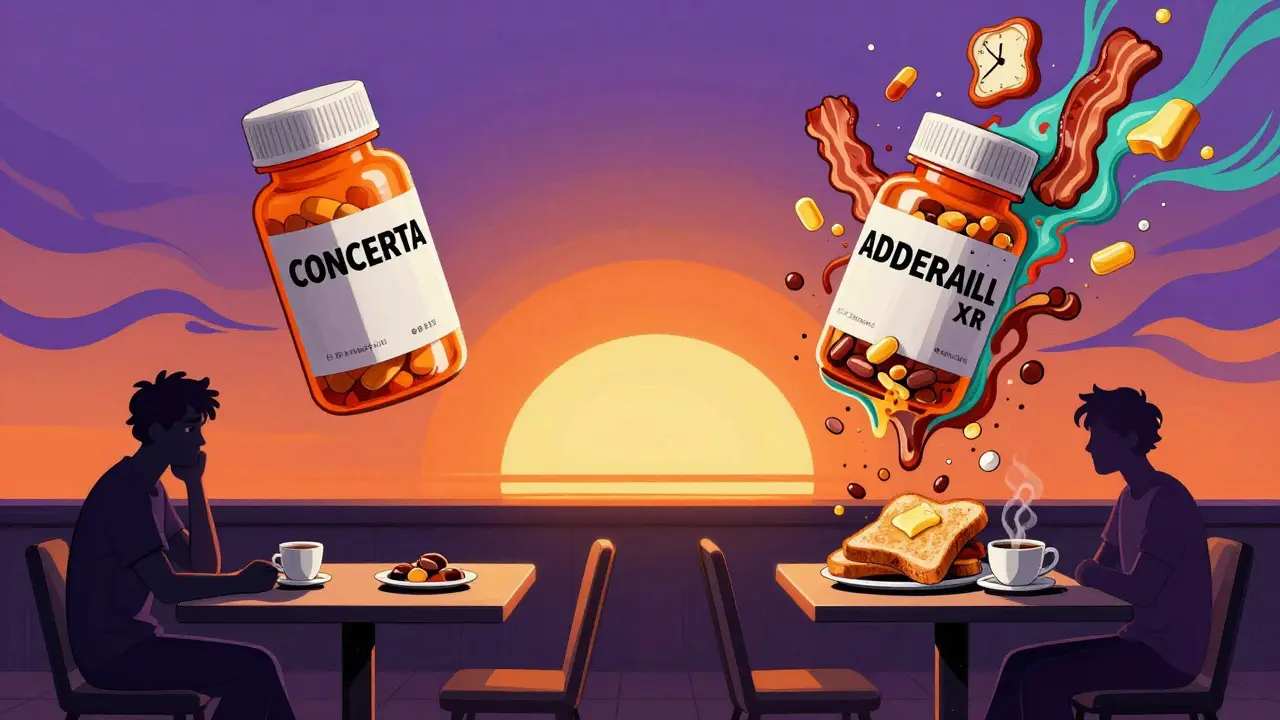
When you take a pill labeled "extended-release," you’re expecting it to release its medicine slowly over hours. But not all of them do this the same way. Two of the most common ADHD medications-CONCERTA and ADDERALL XR-look similar on the bottle, but they behave very differently when food enters the picture. CONCERTA uses something called OROS (Osmotic Release Oral System). Think of it like a tiny pump inside the pill that pushes the medicine out steadily, no matter what’s in your stomach. Studies show it doesn’t care if you take it with breakfast, after breakfast, or on an empty stomach. The amount of medicine in your blood stays within 5% of normal either way. ADDERALL XR, on the other hand, is made of tiny beads coated to dissolve at different times. But those beads are sensitive to what’s in your gut. If you eat a big, fatty breakfast before taking it, your body absorbs less of the medicine in the first few hours. One major 2002 study found that early drug levels dropped by 30-40% when ADDERALL XR was taken after a high-fat meal. That means if you’re a student or a teacher trying to focus from 8 a.m. to noon, you might feel fine at first… then suddenly crash by 10 a.m. because the medicine never kicked in properly.Why Breakfast Matters More Than You Think
Breakfast isn’t just a meal-it’s a trigger. When you eat, your stomach starts working. Blood flow shifts. Gastric emptying slows down. Bile and acids change. All of this affects how quickly a pill dissolves and where in your intestines it gets absorbed. For ADDERALL XR, eating before taking the dose delays absorption. The medicine doesn’t disappear-it just shows up later, unevenly. That’s why some people report great focus on weekends when they skip breakfast until noon, but struggle on school days when they eat at 7:30 a.m. It’s not laziness. It’s pharmacology. Even if you’re not on ADHD meds, this matters. Levothyroxine, a thyroid hormone replacement, loses up to half its effectiveness if taken with food. Statins like simvastatin work better at night because your liver makes more cholesterol while you sleep. But newer statins like atorvastatin don’t care when you take them. And GLP-1 drugs like semaglutide? You need to take them at least 30 minutes before your first bite of food, or you risk poor absorption and weight-loss results.Real People, Real Problems
You don’t need a lab study to see how this affects lives. Look at Reddit’s r/ADHD community. One user wrote: "I switched from ADDERALL XR to CONCERTA because my focus vanished every Monday morning. On weekends, I didn’t eat until noon and felt fine. But school days? I was useless by 10 a.m. My doctor never told me food could do that." Another user, a teacher, said: "I need to be sharp from the first bell. With CONCERTA, I eat my oatmeal and take my pill together. I know exactly what to expect. With ADDERALL XR, I was always guessing." On Drugs.com, 62% of people taking CONCERTA say it works consistently all day. Only 48% of ADDERALL XR users say the same. That’s not a small gap. That’s a difference in quality of life. A 2022 survey by CHADD found that 68% of patients with ADHD had better symptom control when they stuck to a consistent routine around meals and medication. Forty-two percent specifically said morning focus improved when they followed food timing rules.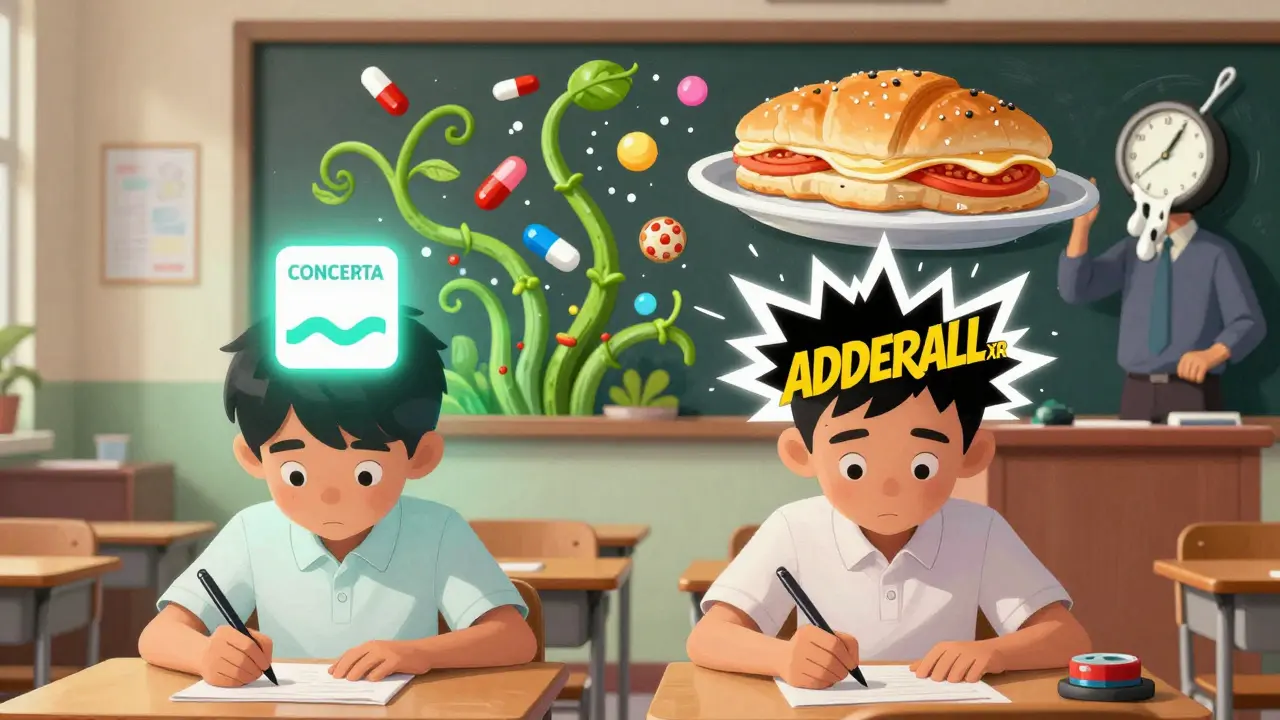
What Should You Do?
If you’re on an extended-release medication, here’s what you need to do:- Find out if your drug is affected by food. Check the label or ask your pharmacist. If it’s an ADHD stimulant, assume ADDERALL XR is sensitive. CONCERTA is not.
- Choose one routine and stick to it. Either always take it on an empty stomach (30-60 minutes before breakfast), or always take it with breakfast. Don’t switch back and forth.
- If you take ADDERALL XR and eat breakfast, wait at least 2 hours after eating. Or, if you prefer to eat first, take the pill 30 minutes before your meal. Just be consistent.
- If nausea is a problem on an empty stomach, try a small, low-fat snack. A banana, a few crackers, or a spoonful of yogurt won’t interfere like a full breakfast will.
- Track your symptoms. For one week, write down how you feel every 2 hours after taking your medicine. Note when you ate, what you ate, and how focused or tired you felt. You might spot a pattern your doctor missed.
Why Doctors Don’t Always Tell You This
Many prescribers assume patients know to take meds with or without food. But most patients don’t. A 2020 American Psychiatric Association report found that when doctors spent just 15-20 minutes explaining timing and food effects during the first visit, medication adherence jumped by 37%. The problem? Doctors are rushed. Pharmacies don’t always reinforce this. And patients assume their meds work the same no matter what. That’s not true. Even the FDA now says this matters. In its 2023 draft guidance on CNS stimulants, the agency explicitly recommends that doctors "counsel patients on the importance of consistent food timing relative to dose administration."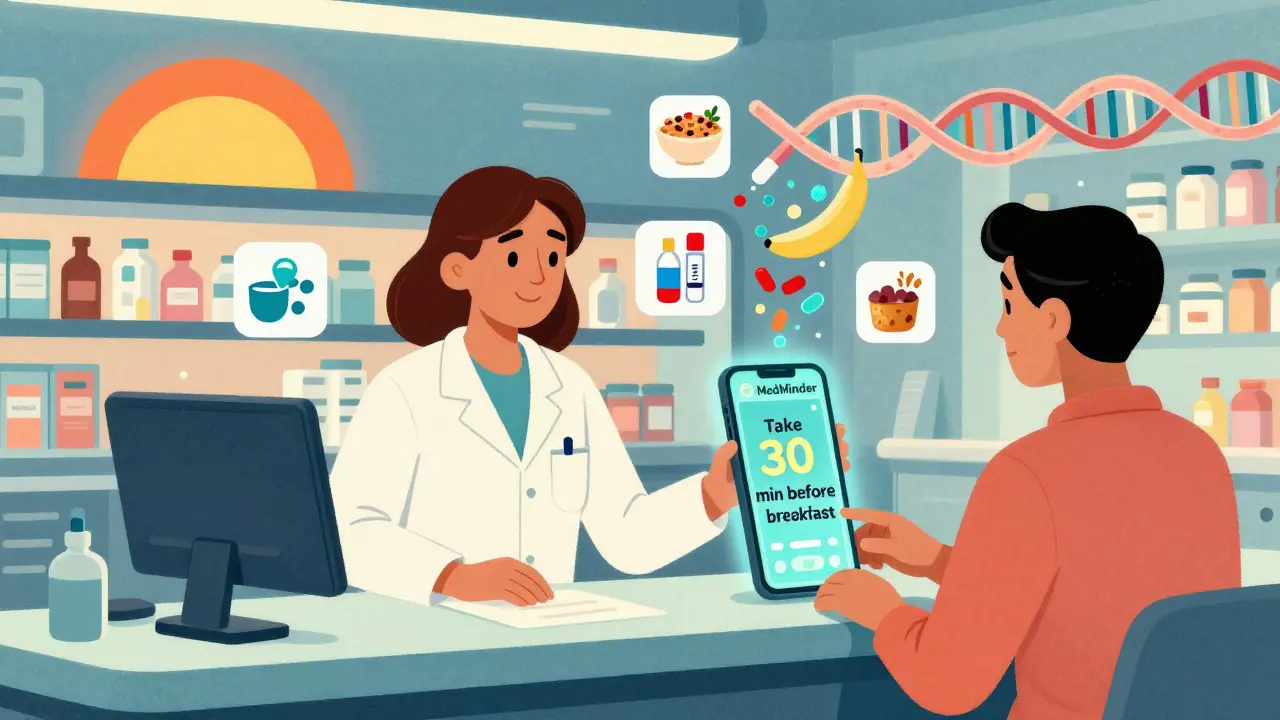
The Bigger Picture: What’s Changing in Medicine
The pharmaceutical industry is responding. New extended-release drugs are now required to prove they work the same with or without food. In 2022, 92% of new CNS extended-release drugs submitted to the FDA included food-effect data. That’s up from 47% a decade ago. That’s why CONCERTA has overtaken ADDERALL XR in pediatric ADHD prescriptions in the U.S.-not because it’s stronger, but because it’s more predictable. Families don’t want to guess if their child’s medication will work on a Monday morning after school breakfast. New tech is helping too. Apps like MedMinder now send reminders that say: "Take your pill 30 min before breakfast" or "Wait 2 hours after eating." Beta tests show 92% of users follow these tailored cues. And in the future, your genes might tell you how to time your meds. Early research suggests your body’s ability to process certain drugs (like those handled by the CYP2D6 enzyme) could influence how much food affects absorption. By 2026, personalized timing based on DNA may be a real option.Bottom Line: Consistency Beats Complexity
You don’t need to memorize pharmacokinetics. You don’t need to count calories or track bile flow. You just need to pick a routine and stick to it. If your medication is affected by food, treat it like brushing your teeth: same time, same way, every day. Don’t change it because you’re in a rush, or because you skipped breakfast one day. Your body-and your medicine-depend on predictability. For people on ADDERALL XR, that means choosing: either always before breakfast, or always after. No in-between. For CONCERTA, you have flexibility. But even then, consistency helps. Your brain doesn’t like surprises. Neither does your medicine. The best medication in the world won’t help if you’re taking it at random times with random meals. Your routine is part of the treatment. Treat it that way.Can I take ADDERALL XR with breakfast?
It’s not recommended. Taking ADDERALL XR with or right after a high-fat breakfast can reduce early drug absorption by 30-40%, leading to poor focus in the morning. If you eat breakfast, wait at least 2 hours before taking it. Or take it 30 minutes before eating-just be consistent every day.
Does CONCERTA work the same with or without food?
Yes. CONCERTA uses an osmotic delivery system that releases medication steadily regardless of food in the stomach. You can take it with breakfast, without breakfast, or even after a snack-your blood levels will stay consistent. That’s why many people switch to it from ADDERALL XR.
What if I feel sick taking my ADHD med on an empty stomach?
Try a small, low-fat snack like a banana, a few crackers, or a spoonful of yogurt. Avoid fatty or heavy foods-those interfere more. A 100-200 calorie snack is usually enough to reduce nausea without affecting absorption, especially for ADDERALL XR. For CONCERTA, even this isn’t usually needed.
Why does my medication work on weekends but not on school days?
This is common with food-sensitive meds like ADDERALL XR. On weekends, you may eat later or skip breakfast entirely, which allows better absorption. On school days, you eat early and rush-delaying the medicine’s peak effect. The result? Focus crashes by mid-morning. Switching to CONCERTA or sticking to a strict fasting routine before dosing can fix this.
Are there other medications besides ADHD drugs that are affected by breakfast?
Yes. Levothyroxine (for thyroid) loses up to 50% of its effect if taken with food. GLP-1 drugs like semaglutide must be taken at least 30 minutes before eating. Some statins work better at night. Always check the label or ask your pharmacist: "Does this medicine need to be taken with or without food?"
How long should I wait after eating before taking my medication?
For food-sensitive drugs like ADDERALL XR, wait at least 2 hours after a full meal. If you’re taking it before breakfast, wait 30-60 minutes after taking the pill before eating. For drugs like levothyroxine, wait 30-60 minutes after taking the pill before eating anything. When in doubt, follow the label or ask your pharmacist.




RAJAT KD
January 10, 2026 AT 08:37Stop making excuses. If your med doesn't work because you ate toast, that's not the drug's fault-it's yours. CONSISTENCY isn't optional. It's biology. Fix your routine or stop complaining.
CONCERTA works because it's engineered. ADDERALL XR? That's a lazy design. Switch or shut up.
Matthew Maxwell
January 11, 2026 AT 04:35It's profoundly irresponsible that so many patients are left to stumble through pharmacokinetics like it's a DIY project. The FDA’s 2023 guidance exists for a reason-and yet, primary care physicians still treat medication timing like a suggestion rather than a clinical imperative. This isn’t about preference-it’s about bioavailability, absorption kinetics, and the ethical obligation to inform. If you're not counseling patients on food effects, you're not practicing medicine. You're gambling.
And yes, I've read the original studies. The 30–40% drop in Cmax with ADDERALL XR and high-fat meals isn't anecdotal. It's statistically significant. Your ‘I feel fine’ is a placebo effect masking subtherapeutic dosing.
Drew Pearlman
January 11, 2026 AT 17:05I just want to say how much this post means to me. I’ve been on ADDERALL XR for 8 years and thought I was just ‘bad at mornings’-turns out, I was eating oatmeal right before my pill and wonder why I crashed by 10 a.m. Switched to taking it 45 minutes before breakfast, no snacks, and now I’m actually present in meetings. No more hiding in the bathroom pretending I’m ‘on a call.’
Also, my 12-year-old switched from ADDERALL XR to CONCERTA last month. We didn’t change the dose, just the timing and the pill-and now she finishes her homework without crying. I cried. Not because I’m emotional-I’m just so tired of watching my kid struggle because no one told us this stuff.
Thanks for writing this. I’m sharing it with every parent I know. You’ve made a real difference.
P.S. I used to think ‘medication timing’ was a myth. Now I know it’s the difference between functioning and surviving.
Chris Kauwe
January 13, 2026 AT 02:29The neoliberal fragmentation of healthcare has produced this exact epistemological crisis: patients are forced to become pharmacologists because the system outsources responsibility. The pharmaceutical-industrial complex manufactures complexity to justify profit margins-ADDERALL XR’s bead-based delivery isn’t innovation, it’s obfuscation. CONCERTA’s osmotic pump? That’s engineering. That’s integrity.
We’re not just talking about ADHD here-we’re talking about the commodification of cognitive enhancement. Your breakfast isn’t a meal. It’s a variable in a corporate algorithm designed to maximize adherence through confusion.
And yet, here we are-individuals scrambling to optimize our biochemistry because no one in white coats has the time to explain that a banana isn’t just fruit-it’s a pharmacokinetic modifier.
Capitalism doesn’t care if you focus. It just wants you to pay for the next bottle.
Ian Long
January 13, 2026 AT 02:30There’s so much truth here. I used to be the guy who’d take my pill at 7 a.m., then eat a bacon-egg-and-cheese sandwich at 7:15. Thought I was fine until I started zoning out during Zoom calls. Then I read this exact thread and tried waiting 2 hours. Holy crap. I went from ‘meh’ to ‘I can actually finish a report.’
And yeah, I get it-doctors are swamped. But I think the real issue is that we’ve normalized ‘kinda working’ as good enough. We don’t demand precision from our meds like we do from our phones or cars. But your brain deserves better.
Also, I switched to CONCERTA last year. Worth every penny. No more guessing. No more guilt. Just consistency.
Thanks for the clarity. This should be mandatory reading in med school.
Pooja Kumari
January 15, 2026 AT 00:02OMG I’m literally crying rn. I’ve been on levothyroxine for 5 years and I thought I was just ‘bad at taking pills’ because I kept feeling exhausted even though my TSH was ‘normal.’ Then I read somewhere that food kills it-so I started taking it at 5 a.m. before I even got out of bed. No coffee. No water with lemon. Just plain water. And now? I have energy. I can think. I can cry without being overwhelmed. I can laugh again.
My mom says I’m ‘too emotional’-but she doesn’t know that my thyroid was slowly killing me and no one told me how to save myself.
I’m telling my whole family. My sister’s on statins. My cousin’s on semaglutide. I’m sending this to everyone. This isn’t just info-it’s a lifeline.
Thank you. From the bottom of my heart.
❤️
Jacob Paterson
January 16, 2026 AT 06:59Wow. So let me get this straight-you’re saying if you don’t time your breakfast like a NASA engineer, your ADHD meds ‘don’t work’? That’s cute. Did you also memorize the exact pH of your stomach lining? Or are you just one more person who thinks biology is a spreadsheet?
People take ADDERALL XR with food and still function. Maybe you’re just lazy. Or maybe you’re addicted to the idea that your brain needs a magic pill to be human.
Next you’ll be telling us to align our sleep cycles with the lunar calendar.
Meanwhile, I take mine with a donut and still outwork you. Just saying.
Angela Stanton
January 18, 2026 AT 00:00Okay but let’s talk about the placebo effect in medication adherence 😅
Like, if you believe your pill works better at 8 a.m. vs 9 a.m., your brain releases dopamine in anticipation → you feel more focused → you attribute it to timing → but it’s actually the ritual. Same as wearing lucky socks. We’re just pattern-matching our anxiety.
Also, CONCERTA’s OROS system? Cool tech. But is it *really* food-independent? Let’s look at the 2021 JAMA study on gastric motility in fed vs fasted states-there’s still a 7% variance in Tmax.
TL;DR: consistency matters because your brain craves predictability, not because the pill is magic. But hey, if it helps you sleep at night, go for it 😘
Also-banana > yogurt for nausea. Trust me. I’m a pharmacist. 🍌💊
Jerian Lewis
January 19, 2026 AT 10:01I’ve been on CONCERTA for 3 years. Never had an issue. Never needed to think about food. Never had a crash. Just take it. Done.
People who struggle with ADDERALL XR? You’re not broken. You just got the wrong tool.
Switch. It’s not a failure. It’s science.
Kiruthiga Udayakumar
January 19, 2026 AT 20:17As an Indian mom of a teen with ADHD, I’m so tired of hearing ‘just take your pill.’ My son used to skip breakfast to avoid the crash-but then he’d get headaches and angry. We tried everything. Then I read this and switched him to CONCERTA. Now he eats paratha, takes his pill, and does his homework without screaming.
My sister says ‘why not just use Ritalin?’ But she doesn’t get it-this isn’t about speed. It’s about *staying*.
Thank you for writing this. I printed it and gave it to his school nurse. She didn’t know any of this either.
❤️ From Delhi with love.
Patty Walters
January 21, 2026 AT 13:01Just a quick note: if you're on levothyroxine and you're taking it with calcium or iron (even in a multivitamin), that's probably why it's not working. Those bind to the med and block absorption. Take it alone, 30-60 min before breakfast. And no coffee for at least an hour after. Seriously. I learned this the hard way after 2 years of ‘normal’ labs but still exhausted.
Also-yes, CONCERTA is way more chill. My kid switched last year and now we actually have family dinners without meltdowns. Worth it.
Matthew Maxwell
January 23, 2026 AT 07:12Let me be clear: the notion that ‘it’s all just placebo’ is not only scientifically inaccurate-it’s dangerous. Pharmacokinetic variability isn’t psychological. It’s measurable. The Cmax and AUC shifts with food are documented in FDA submissions. You can’t ‘believe’ your way into consistent drug absorption.
And while I appreciate the anecdotal comfort of rituals, reducing bioavailability to ‘lucky socks’ is the kind of thinking that leads to treatment failure, hospitalizations, and lost productivity.
Stop romanticizing ignorance. This isn’t spirituality. It’s physiology.