Every time you pick up a prescription and see a generic version instead of the brand-name drug, you’re seeing the result of the FDA’s Abbreviated New Drug Application (ANDA) process. It’s not just paperwork-it’s the backbone of affordable medicine in the U.S. Since 1984, this system has let generic drugmakers bring life-saving medications to market without repeating every single clinical trial. That’s how we get 90% of prescriptions filled with generics that cost, on average, just 15% of the brand-name price.
What Exactly Is an ANDA?
An ANDA is a streamlined application that generic drug companies submit to the FDA to prove their product is the same as an already approved brand-name drug-called the Reference Listed Drug (RLD). Think of it like this: the FDA already checked the original drug for safety and effectiveness. The generic maker doesn’t need to start from scratch. They just need to prove their version does the same job in the body.
To qualify, the generic must match the RLD in four key ways:
- Same active ingredient
- Same strength and dosage form (pill, injection, cream, etc.)
- Same route of administration (taken by mouth, injected, inhaled)
- Same conditions of use (same medical purpose)
Labeling must be nearly identical too, though minor differences are allowed if they don’t affect safety. The manufacturing must follow current Good Manufacturing Practices (cGMP), meaning the factory is clean, consistent, and reliable.
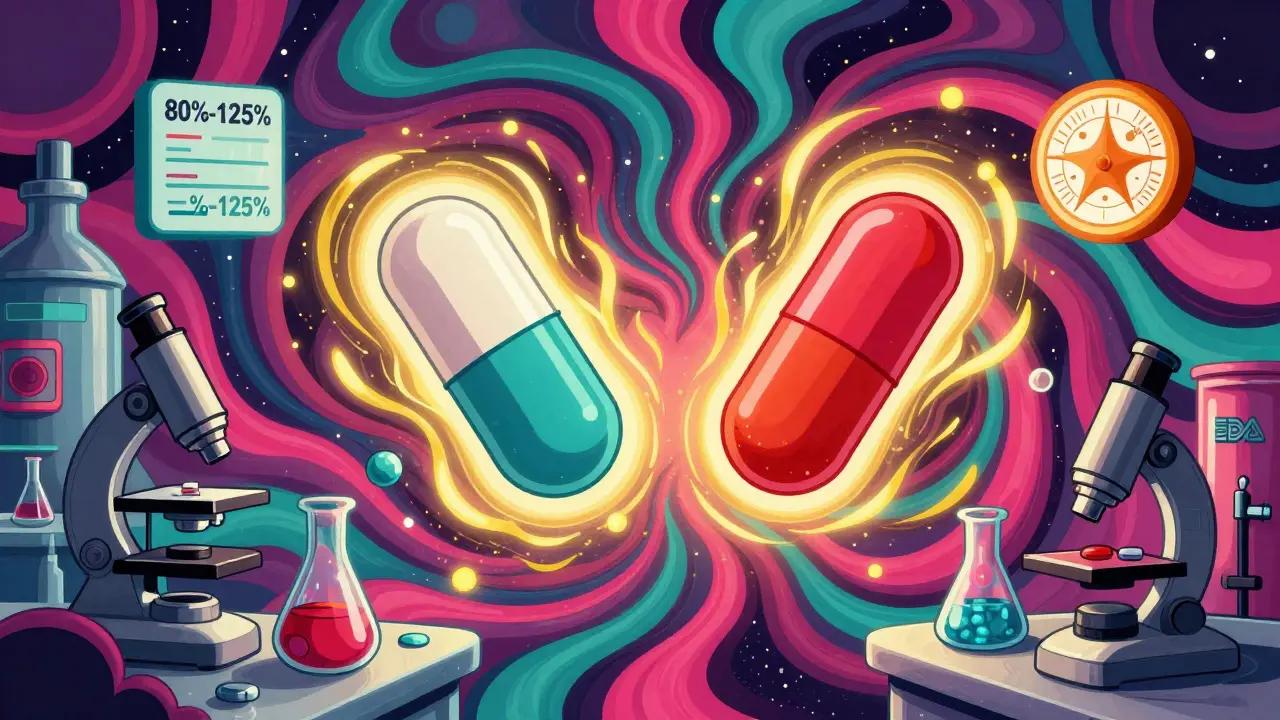
The real kicker? They don’t need to run full-scale clinical trials on thousands of patients. Instead, they run a bioequivalence study-usually on 24 to 36 healthy volunteers. These studies measure how fast and how much of the drug enters the bloodstream. If the generic’s levels are within 80% to 125% of the brand’s, it’s considered equivalent. That’s the science behind why a $5 generic can replace a $50 brand.
How the ANDA Process Works: Step by Step
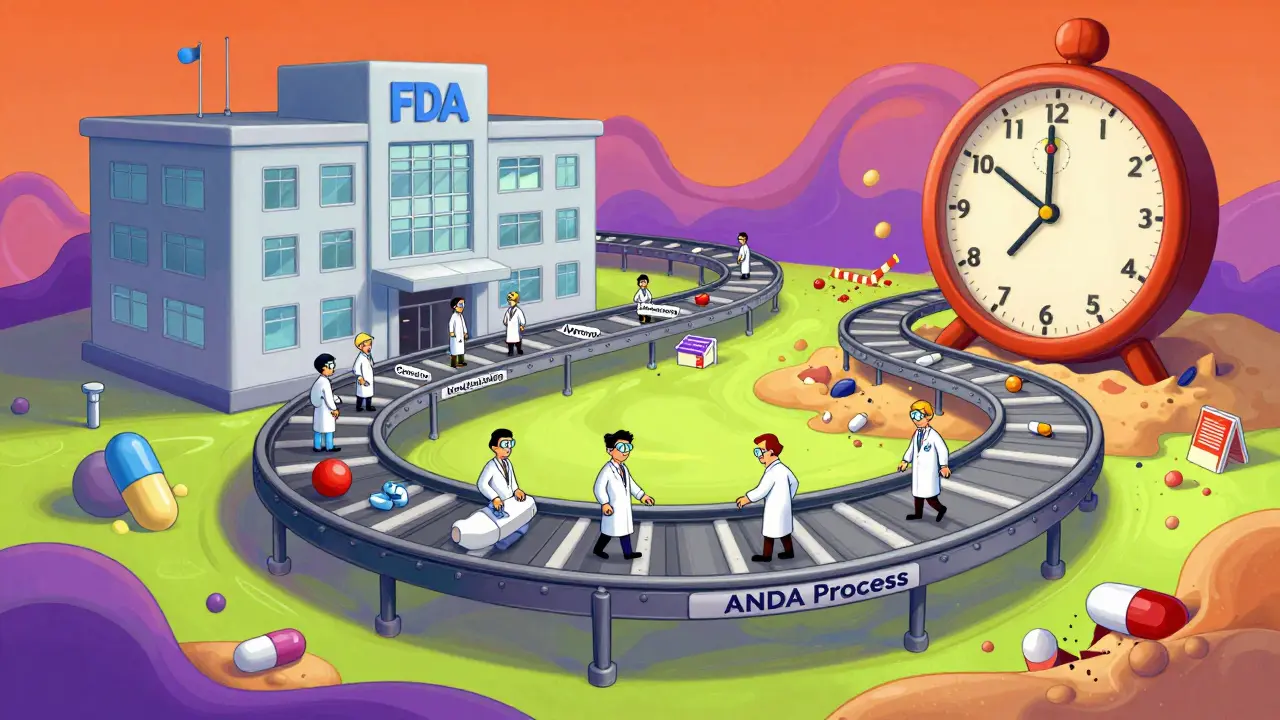
The ANDA journey isn’t quick, but it’s predictable. Here’s how it breaks down:
- Submission: The company files electronically through the FDA’s Electronic Submission Gateway. They include FDA-356h (the application form) and FDA-3674 (disclosing financial ties). Under GDUFA III, the FDA aims to complete its first review within 10 months.
- Filing Review: The FDA checks if the application is complete. If anything’s missing-like a required study or form-they’ll reject it. About 90% of submissions pass this first gate.
- Discipline Reviews: Teams of experts dig into every part: chemistry, manufacturing, bioequivalence, labeling, and microbiology. This is where most delays happen. One applicant told me they got 17 separate requests for more info, stretching their review time by over a year.
- Response and Re-review: The company answers each request. If they don’t satisfy the reviewers, they get a Complete Response Letter (CRL). Common reasons? Poor bioequivalence data (35% of CRLs), manufacturing issues (28%), or labeling errors (22%).
- Approval: If everything checks out and there are no legal blocks (like patents or exclusivity), the FDA grants Final Approval. If there’s a patent standing in the way, they issue a Tentative Approval. The drug can’t be sold yet, but once the patent expires, it goes live immediately.
On average, the whole process takes 30 months. But for drugs in short supply-like antibiotics or insulin-the FDA can fast-track them. Some get approved in under 12 months.
ANDA vs. NDA: Why Generics Don’t Cost $2 Billion
Brand-name drugs go through a New Drug Application (NDA) under Section 505(b)(1). That’s where companies spend $2.3 billion on preclinical studies, Phase I-III trials, and years of data collection. The FDA reviews every single piece of evidence.
ANDAs? They skip all that. They rely on the FDA’s prior findings. That’s why developing a generic costs between $1 million and $5 million-less than 0.2% of the cost of a new drug.
There’s also a middle path: the 505(b)(2) NDA. It’s for drugs that tweak an existing one-say, a new dose or delivery system. They can use some of the brand’s data but must add new studies. It’s faster than a full NDA but slower and pricier than an ANDA.
Who’s Behind the Generics?
The U.S. generic market is huge-$127.6 billion in 2022, and it’s expected to hit $189 billion by 2027. But it’s not dominated by dozens of small players. A few giants control most of it:
- Teva Pharmaceuticals: 22% market share
- Viatris (formerly Mylan): 15%
- Sandoz: 12%
Together, these three handle nearly half of all generic drugs in the U.S. And 75% of ANDAs come from companies that already have five or more approved products. Experience matters. One executive told me: “After our tenth ANDA, we cut our approval time in half.”
But there are thousands of smaller firms too. Many are based outside the U.S.-in India, China, and Eastern Europe. The FDA inspects over 1,000 foreign manufacturing sites every year. A single facility failure can delay dozens of generic approvals.
Why Some Generics Take Forever to Get Approved
Not all drugs are created equal. Simple pills? Easy. Complex products? Not so much.
Topical creams, inhalers, injectables, and nasal sprays are called “complex generics.” They’re harder to replicate because how the drug behaves in the body depends on more than just the chemical. The texture, the particle size, the delivery mechanism-all of it matters.
One company spent $1.2 million and three tries to prove their topical cream was bioequivalent. They had to use advanced imaging and patient absorption studies. That’s why 35% of pending ANDAs now involve complex products. The FDA is responding with over 450 new product-specific guidances in 2022 alone.
Patents are another hurdle. Even if a generic is ready to go, if the brand still has exclusivity or a patent, the FDA can’t approve it. Some companies file patents on minor changes just to delay generics-what’s called “patent thickets.” The FDA has tools to challenge this, but it’s slow.
What’s Changing in 2026?
The system isn’t stuck. It’s evolving.
GDUFA III, which started in October 2022, forces the FDA to meet strict timelines. They now aim to approve 90% of original ANDAs within 10 months. That’s a big jump from the 18-month average just five years ago.
AI is helping too. Over 78% of FDA chemistry reviewers now use AI tools to scan data for inconsistencies. Real-world evidence from electronic health records is being tested for complex generics. And the FDA is working with global regulators to harmonize standards through the International Council for Harmonisation (ICH).
Still, challenges remain. Facility inspections are delayed. Information Requests pile up. And for small companies, the cost of one failed ANDA can wipe out years of profit.
The Real Impact: $373 Billion in Savings
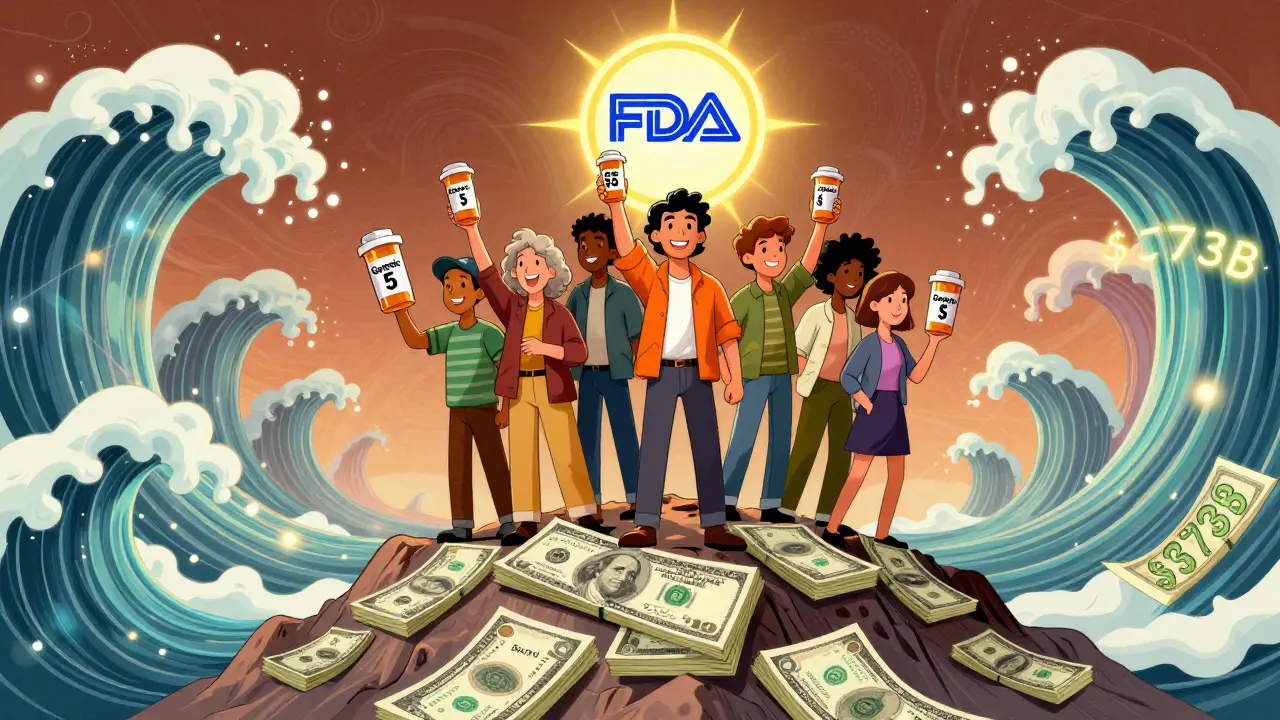
Let’s talk numbers. In 2023, generic drugs saved the U.S. healthcare system $373 billion. That’s more than the GDP of Austria. Without the ANDA process, most Americans couldn’t afford their prescriptions. A diabetes drug that costs $300 a month as a brand? The generic? $12. A heart medication? $500 down to $15.
These aren’t cheap knockoffs. They’re exact copies, verified by science. The FDA doesn’t approve a generic just because it looks the same. It approves it because the data proves it works the same.
And that’s the point. The ANDA process isn’t about cutting corners. It’s about removing unnecessary ones. It lets innovation in brand-name drugs continue while ensuring competition keeps prices low.
Every time you refill a generic, you’re part of a system that’s kept millions of people healthy without bankrupting them. That’s not just regulation. That’s public health in action.
What is the difference between an ANDA and an NDA?
An NDA (New Drug Application) is used for brand-name drugs and requires full clinical trial data proving safety and effectiveness. An ANDA (Abbreviated New Drug Application) is for generics and relies on the FDA’s prior approval of the brand-name drug, requiring only bioequivalence data to prove the generic works the same way in the body.
Why do some generic drugs take longer to get approved than others?
Complex generics-like inhalers, topical creams, or injectables-are harder to replicate because their effectiveness depends on more than just the active ingredient. Factors like particle size, formulation, and delivery method matter. These require more complex studies, leading to longer reviews. Also, patent disputes or facility inspection delays can hold up approval.
Can a generic drug be different from the brand-name version?
Yes, but only in inactive ingredients-like fillers, dyes, or preservatives. The active ingredient, strength, dosage form, route of administration, and how the drug works in the body must be identical. The FDA requires bioequivalence testing to ensure these differences don’t affect safety or effectiveness.
What is Tentative Approval?
Tentative Approval means the FDA has found the generic drug scientifically equivalent to the brand-name version, but it can’t be sold yet because of patent or exclusivity protections on the original drug. Once those protections expire, the approval becomes final and the generic can be marketed immediately.
How does the ANDA process save money for patients?
By allowing generics to enter the market without repeating costly clinical trials, the ANDA process reduces development costs by over 99%. This drives competition, and within a year of generic entry, prices typically drop to 15% of the brand-name price. In 2023 alone, generics saved the U.S. healthcare system $373 billion.
What Comes Next?
If you’re a patient, keep choosing generics. They’re safe, effective, and save you money. If you’re in the industry, focus on mastering the science of complex products and building strong relationships with FDA reviewers. Pre-ANDA meetings-used by 78% of successful applicants-are one of the best tools to avoid costly mistakes.
The ANDA process isn’t perfect. But it’s the most powerful tool we have to make medicine affordable. And as long as the FDA keeps refining it-with better guidelines, faster reviews, and smarter science-it will keep working for millions of people who need drugs, not bills.

Liam Crean
February 19, 2026 AT 17:10Never thought much about how generics get approved until I read this. Turns out, it’s not just about saving money-it’s about smart science. The FDA doesn’t cut corners; they just skip the stuff that’s already been proven. Bioequivalence studies on 24 people? Wild. That’s less than a single Phase I trial for brand drugs. Makes sense, but still blows my mind.
Greg Scott
February 21, 2026 AT 06:43My pharmacist told me once that 80-125% bioequivalence range is basically the FDA’s way of saying ‘close enough.’ And honestly? It works. I’ve been on the same generic for 6 years. No issues. No weird side effects. Just cheaper pills.
madison winter
February 22, 2026 AT 10:15So let me get this straight-we’re okay with a drug being 20% less effective or 25% more potent and calling it ‘the same’? That’s not science, that’s a compromise. And don’t get me started on the fact that most generics are made overseas. Who’s really inspecting those factories? I’d bet half of them are running on duct tape and hope.
Also, why are we okay with Teva and Sandoz owning half the market? That’s not competition, that’s a cartel with FDA stamps.
Robert Shiu
February 24, 2026 AT 06:40This is one of those topics that doesn’t get enough attention, but it’s literally saving lives. Imagine telling someone they can’t afford their insulin-then showing them the $12 generic. That’s not a policy win, that’s a moral win. And the fact that AI is now helping reviewers spot inconsistencies? Huge step forward. The system’s not perfect, but it’s getting better. Keep pushing for transparency, keep choosing generics, and keep supporting the FDA’s work. They’re doing heavy lifting so we don’t have to.
Caleb Sciannella
February 25, 2026 AT 17:18The structural efficiency of the ANDA framework represents a paradigmatic shift in pharmaceutical regulatory economics, wherein the principle of evidentiary reliance upon prior FDA determinations obviates redundant clinical trial expenditures. This is not merely cost reduction-it is epistemological streamlining. The 99% reduction in development costs is not an artifact of diminished rigor, but rather a reflection of ontological continuity between the reference listed drug and its bioequivalent counterpart. Furthermore, the GDUFA III timelines signify a maturation of administrative capacity, aligning regulatory throughput with the scale of public health demand.
One must also acknowledge the geopolitical dimension: over 75% of active pharmaceutical ingredients originate from non-OECD nations, necessitating a transnational regulatory architecture that harmonizes standards through ICH guidelines. This is not merely national policy-it is global governance in action.
Davis teo
February 26, 2026 AT 02:17Okay but have you heard about the guy who took a generic version of his blood pressure med and his heart started racing? He sued. The company settled. They said it was ‘within bioequivalence range’-but he still ended up in the ER. So yeah, ‘same’ doesn’t always mean ‘safe.’ And what about the guy whose generic antidepressant made him cry for three weeks straight? No one talks about that. The FDA says ‘it’s equivalent’-but your body doesn’t read the study. It just reacts.
And don’t even get me started on the dye in the pills. I have a sensitivity. I asked my pharmacist. She said, ‘It’s the same as the brand.’ But the brand uses one dye, and the generic uses another. Different chemical. Different reaction. And the FDA doesn’t care. Because ‘active ingredient’ is all that matters. What a joke.
Michaela Jorstad
February 27, 2026 AT 05:18I just want to say thank you to everyone who works on the ANDA process. Seriously. It’s easy to complain about bureaucracy, but this system? It’s quiet, it’s detailed, and it’s saving millions of people from financial ruin. I’ve been on a generic for my thyroid for 8 years. No issues. No price hikes. Just consistent, reliable care. And it’s because of these reviewers who dig into every single batch, every single study, every single lab report. They’re not glamorous, but they’re essential. Thank you.
Chris Beeley
February 28, 2026 AT 05:03You Americans think your FDA is some kind of gold standard? Please. I’ve worked in pharma in India for 12 years. The same factories that make your ‘FDA-approved’ generics also make the drugs you import from Bangladesh and Nigeria. The standards? They’re negotiated, not enforced. The FDA inspects 1,000 sites a year? That’s less than 1% of the global manufacturing footprint. The rest? They rely on ‘mutual recognition agreements’-which are basically handshakes over Zoom.
And let’s not pretend that ‘bioequivalence’ means anything when you’re dealing with complex inhalers. The particle size distribution? The viscosity of the propellant? The exact humidity during manufacturing? None of that is standardized globally. So when you say ‘it’s the same,’ you’re lying to yourself. The truth? The FDA approves generics because it’s cheaper than fighting the pharmaceutical lobby. Not because it’s perfect. It’s political. It’s pragmatic. And frankly? It’s dangerous.
James Roberts
March 1, 2026 AT 07:06Wow. So the FDA approves a drug based on 24 people taking it, and we’re supposed to trust it? Meanwhile, my dog’s vet prescribed a generic that made him throw up for three days. But hey-‘bioequivalent’! I guess that means ‘equivalent enough to not get sued.’
And let’s not forget: 78% of FDA reviewers use AI now. So the guy who used to spend 6 months reading your chemistry data? He’s now just clicking ‘approve’ because the algorithm said ‘green.’ How’s that for progress? I’m just glad I don’t need a heart transplant. Or a brain. Or a liver. Because if I did? I’d be dead. Or rich. Or both.