
Managing prescription costs doesn’t mean you have to pick between convenience and savings. You can have both-by using your mail-order pharmacy and your local pharmacy together the right way. Most people don’t realize this is even an option. They either stick with their neighborhood drugstore out of habit or sign up for mail-order and never look back. But smart coordination can cut your annual medication costs by hundreds of dollars without sacrificing access or safety.
Understand How Your Insurance Rewards Mail-Order
Insurance companies don’t push mail-order because they’re being nice. They save money when you get 90-day supplies instead of three separate 30-day fills. And they pass some of those savings to you-in the form of lower copays. For example, if your plan charges $15 for a 30-day supply of a generic blood pressure pill at a local pharmacy, it might only charge $12 for the same 90-day supply through mail-order. That’s $3 saved every month, or $36 a year, just on one medication.But here’s the catch: not all plans treat every drug the same. Your insurance puts medications into tiers. Tier 1 is usually generic, Tier 2 is preferred brand, Tier 3 is non-preferred brand, and sometimes there’s a Tier 4 for specialty drugs. Mail-order often gives you the biggest discount on Tier 2 and Tier 3 medications when you choose the 90-day option. Check your plan’s formulary online or call your insurer. Ask: "What’s my copay for a 90-day supply of [medication name] through mail-order versus a 30-day supply at a retail pharmacy?" Don’t assume. Numbers vary wildly.
Match the Pharmacy to the Medication Type
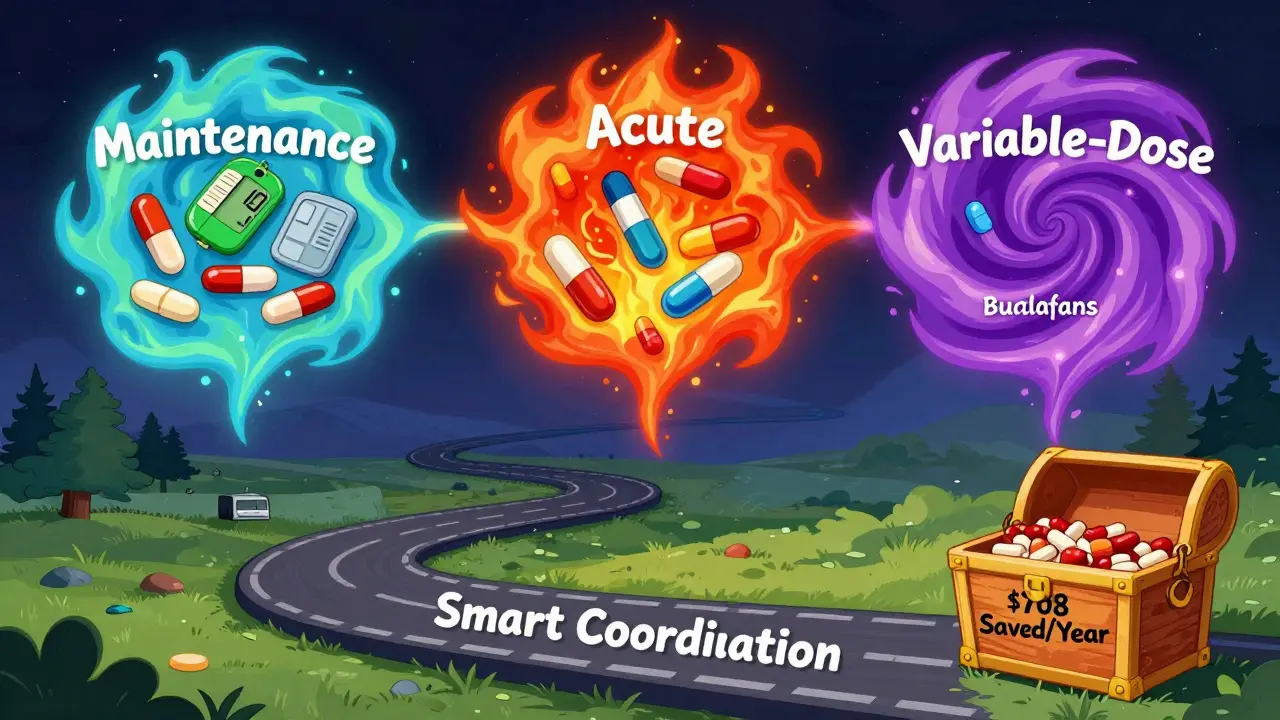
Not all meds are created equal. Split them into three groups:- Maintenance meds: These are drugs you take every day, long-term-like statins, blood pressure pills, thyroid medicine, or diabetes drugs. These are perfect for mail-order. You don’t need them right now; you need them consistently. Mail-order saves money and reduces trips to the pharmacy.
- Acute meds: Antibiotics, painkillers after surgery, or short-term steroids. These are time-sensitive. You need them today or tomorrow. Mail-order takes 7-14 days. That’s too slow. Use your local pharmacy.
- Variable-dose meds: Things like antidepressants or seizure meds where your doctor might adjust the dose often. If your prescription changes, mail-order might send you the wrong strength for weeks. Stick with local pharmacies until the dose stabilizes.
One user on Reddit saved $427 a year by switching their amlodipine (a blood pressure drug) to mail-order and keeping their albuterol inhaler local. They set a calendar reminder 10 days before running out. No gaps. No rush. Just savings.
Local Pharmacies Can Match Mail-Order Prices-Sometimes Better
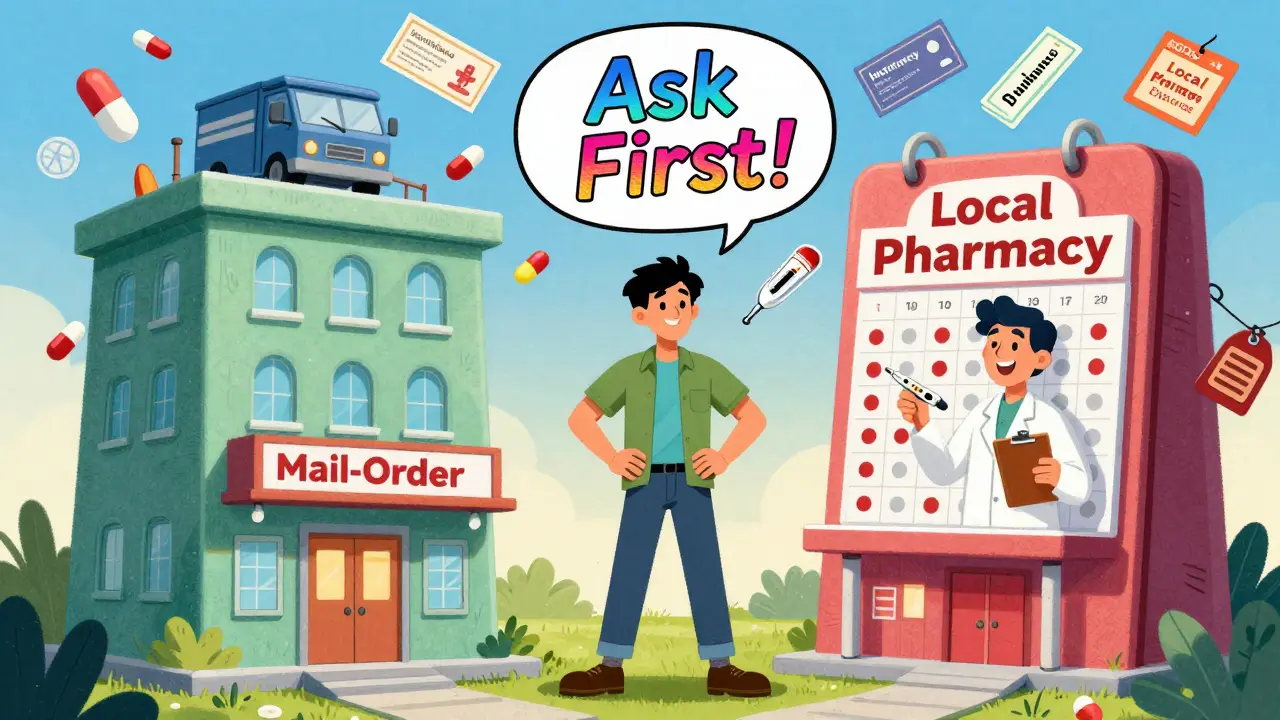
Many people think mail-order is the only way to get low prices on 90-day supplies. That’s not true. Big pharmacy chains like Walmart, Kroger, and CVS offer their own generic drug programs. Walmart’s $10 for 90-day generic program doesn’t even require insurance. CVS has a $4/$10/$25 program for select generics. And here’s the kicker: many insurance plans let you get a 90-day fill at a local pharmacy for the same price as mail-order.You just have to ask. Call your local pharmacy and say: "My insurance allows 90-day fills. Can you process this as a 90-day supply through my plan, and what’s my copay?" Some pharmacists don’t know this option exists, so you might need to call your insurer first to confirm it’s allowed. Then go back and tell the local pharmacy: "My plan says I can get this at retail for the mail-order price. Can you do it?" It works more often than you think.
Mail-Order Has Limits-And Risks
Mail-order is great for stability. But it’s not great for change. If your doctor changes your dose, switches your medication, or adds a new one, mail-order systems don’t always update fast. One person on HealthUnlocked got the wrong antidepressant strength for two months because the mail-order pharmacy didn’t sync with their electronic health record. They ended up wasting $65 in pills they couldn’t use.Temperature-sensitive drugs are another issue. Insulin, certain biologics, and some liquid medications can degrade if shipped in extreme heat or cold. Mail-order pharmacies use insulated packaging, but it’s not foolproof. If you live in a place with harsh winters or scorching summers, local pharmacies handle these meds in climate-controlled environments. You walk out with them in your hand-no shipping risk.
Also, mail-order usually doesn’t offer face-to-face consultations. Your local pharmacist can answer quick questions, check for interactions, or help you understand side effects. That’s worth something. One study found 78% of patients preferred talking to a pharmacist in person rather than over the phone.
Set Up a System-Don’t Wing It
Saving money this way isn’t magic. It’s a system. Here’s how to build it:- Make a list of every medication you take. Note the purpose, dosage, and how often you refill.
- Categorize each one: maintenance, acute, or variable-dose.
- Call your insurer and ask for the exact copay for 30-day and 90-day supplies for each drug, both through mail-order and local pharmacy.
- Set reminders for mail-order refills 10-14 days before you run out. Use your phone calendar or a free app like Medisafe. Don’t wait until you’re out.
- Build a relationship with one local pharmacy. Go in once a month-even if you don’t need a refill. Get to know the pharmacist. They’ll remember your meds and catch errors before they happen.
It takes 2-3 refill cycles to get the rhythm. But once you do, you’ll stop overpaying.
Watch for Plan Changes
Insurance plans change every year. What saved you $100 last year might cost more this year. Medicare Part D plans are adjusting their 90-day pricing. Some commercial plans are reducing mail-order incentives. In 2023, 43% of Medicare Advantage plans cut back on mail-order discounts.Check your annual benefits statement. Look for changes in copay amounts, formulary tiers, or pharmacy network rules. If your mail-order copay went up, ask your local pharmacy if they can match it. Don’t assume the old deal still stands.
What You’ll Save
A GoodRx survey of 1,200 people found that 68% who coordinated their pharmacy use saved at least $150 a year. The top 32% saved over $300. For someone taking five maintenance medications, that’s easy. Let’s say:- Amlodipine: $15 → $12/month (mail-order)
- Metformin: $10 → $8/month (mail-order)
- Atorvastatin: $12 → $9/month (mail-order)
- Levothyroxine: $8 → $6/month (mail-order)
- Losartan: $14 → $11/month (mail-order)
That’s $59 saved per month. $708 per year. And you’re still using your local pharmacy for antibiotics, pain meds, or anything new. No compromise. Just smarter choices.
What’s Coming Next
The system is getting smarter. UnitedHealthcare’s Optum Perks now links mail-order and local pharmacies under one refill schedule. Epic Systems launched a tool in late 2023 that automatically suggests whether you should get a med via mail or local based on your plan, drug type, and history. By 2025, two-thirds of commercial plans are expected to have integrated systems like this.But until then, you’re still in control. You don’t need to wait for the system to catch up. You can start saving today-just by asking the right questions, knowing your meds, and using both pharmacies on purpose.
Can I get a 90-day supply of my medication at my local pharmacy instead of using mail-order?
Yes, many insurance plans allow you to get a 90-day supply at a local pharmacy for the same price as mail-order. You just need to ask. Call your insurer to confirm it’s allowed, then take that info to your pharmacy and ask them to process it as a 90-day fill. Chains like CVS, Walmart, and Kroger often have programs that make this easy-even without insurance.
What if my mail-order pharmacy sends me the wrong medication?
If you get the wrong drug or dose, stop taking it immediately. Call the mail-order pharmacy and your doctor. Then visit your local pharmacy-they can usually provide a temporary supply while the issue is resolved. Keep the incorrect pills in case you need to return them. Many mail-order pharmacies will cover the cost of a replacement, but it can take weeks. Having a local pharmacy as a backup prevents gaps in treatment.
Are there medications that should never go through mail-order?
Yes. Medications that are temperature-sensitive-like insulin, certain biologics, or liquid antibiotics-should be picked up locally if possible. Also, any new prescription where your doctor might change the dose, or any drug you’ve never taken before, should be filled at a local pharmacy first. This lets you check for side effects and confirm it works before committing to a 90-day supply.
How do I know if my insurance plan even offers mail-order?
Check your plan’s member portal or call the customer service number on your insurance card. Ask: "Do you offer a mail-order pharmacy benefit?" and "What’s the copay for a 90-day supply of [medication name]?" If you’re on Medicare Part D, use the Medicare Plan Finder tool to compare costs. Most employer plans offer it, but you have to opt in-some don’t enroll you automatically.
Should I use mail-order if I travel often?
If you travel frequently or live in a place with unreliable mail service, mail-order can be risky. Delays happen. Packages get lost. For people who are on the move, it’s better to use a local pharmacy and refill every 30 days-even if it costs a bit more. You can still save by using discount programs like GoodRx or Walmart’s $10 generics. Stability matters more than savings if you can’t predict when you’ll need your meds.
Can I switch from mail-order to local pharmacy mid-cycle?
Yes, but you might pay more. If you’ve already ordered a 90-day supply through mail-order, you usually can’t cancel it. But once that supply runs out, you can switch to local pharmacy for your next refill. Just make sure your doctor hasn’t placed any restrictions. Some plans require you to use mail-order for certain drugs unless you get a medical exception. Always check with your insurer before switching.
Beth Cooper
January 30, 2026 AT 21:21Okay but have you ever heard of the pharmaceutical-industrial complex? They *want* you to think mail-order saves money so they can track your habits, sell your data, and slowly replace all pharmacists with AI chatbots. I got my insulin shipped in a box that smelled like burnt plastic-turns out it was exposed to 110°F in Texas for three days. My doctor didn’t even know. They just signed the e-prescription and moved on. This whole system is rigged. You think you’re saving? You’re just being prepped for the next phase.
Donna Fleetwood
January 31, 2026 AT 07:08This is actually such a great breakdown! I started doing this last year after my dad had a bad experience with a delayed mail-order refill during chemo. Now we use mail-order for his blood pressure and cholesterol meds, and keep his pain meds and antibiotics local. It’s been a game-changer-no more panic runs at 8 PM when the pharmacy’s closed. Seriously, if you’re on multiple meds, this is low-effort high-reward stuff. You’ve got this!
Melissa Cogswell
February 1, 2026 AT 14:13Just wanted to add a practical tip: if you’re on Medicare Part D, use the Plan Finder tool on medicare.gov and filter by ‘mail-order pharmacy’ under ‘pharmacy benefits.’ Some plans list the 90-day copay separately from retail. I found out my plan charged $0 for a 90-day fill of metformin through mail-order but $15 at CVS. Zero. Like, free. I didn’t even know to look for that. Also, if your local pharmacy says they can’t do 90-day fills, ask them to call the insurer’s pharmacy benefits manager directly-sometimes the rep can override it on the spot.
Diana Dougan
February 1, 2026 AT 21:48LMAO so you’re telling me I need to CALL my pharmacy and ASK questions? Like a human? And maybe-gasp-use my brain? Wow. I thought I was just supposed to let the algorithm pick my meds like a Netflix recommendation. Next you’ll tell me to read the label. Who even *is* this person? I’m just here for the free pills, not the 5-step life coach seminar.
Bobbi Van Riet
February 2, 2026 AT 10:47I’ve been doing this for three years now and I can’t believe how much I didn’t know before. I used to just refill everything at CVS because it was easy, but once I started categorizing my meds, I realized I was paying $20 extra every month on my thyroid med alone. I switched to mail-order, set up a calendar reminder, and started going to my local pharmacy just to say hi every time I picked up my antibiotics. The pharmacist now remembers my name, knows I’m allergic to sulfa, and once caught a duplicate prescription before I even took it. That human connection? Priceless. Also, I started using Medisafe and it sends me alerts when my refill window opens. No more running out at 2 AM. I wish I’d known this sooner.
Holly Robin
February 3, 2026 AT 12:02THEY’RE WATCHING YOU. EVERY TIME YOU ORDER MAIL-ORDER, THEY LOG IT. THEY KNOW WHEN YOU’RE SICK. THEY KNOW WHEN YOU’RE TRAVELING. THEY KNOW WHEN YOU SKIP A Dose. THEY’RE BUILDING A PROFILE. AND THEN-BAM-YOUR INSURANCE RATES GO UP BECAUSE YOU’RE ‘HIGH RISK.’ I DID THIS FOR A YEAR AND THEN GOT A LETTER SAYING MY PREMIUMS WERE INCREASING BECAUSE I ‘OVERUSED MAIL-ORDER.’ I DIDN’T EVEN USE IT THAT MUCH. IT WAS A TRAP. THEY WANT YOU DEPENDENT. THEY WANT YOU CONTROLLED. DON’T BE A SHEEP.
Shubham Dixit
February 3, 2026 AT 17:55In India, we don’t have mail-order pharmacies like this. We have local chemists who know your family, your history, your allergies. They give you medicine in a paper bag with a smile and sometimes even a free vitamin. You walk in, they ask how you’re feeling, they adjust the dose if needed, they remember your kid’s name. Why would you want some faceless warehouse in Ohio shipping your pills in a box with a barcode? This whole system is designed for Americans who don’t know how to talk to people. Here, the pharmacist is your friend. Not a corporate algorithm.
KATHRYN JOHNSON
February 4, 2026 AT 15:04While the premise of this article is technically accurate, it fails to address the systemic failure of insurance companies to standardize 90-day refill protocols across pharmacy networks. The burden of research and administrative labor falls entirely on the patient. This is not ‘smart coordination’-it is a workaround for broken infrastructure. Patients should not need to become pharmacists to access affordable care.
Sazzy De
February 6, 2026 AT 01:49Been doing this for years. Mail-order for the daily stuff, local for the ‘oh crap I need this now’ meds. Set a reminder on my phone for 10 days out. Done. No drama. My pharmacist knows me by name now. She even gave me a lollipop once. Small wins.
Blair Kelly
February 7, 2026 AT 13:23This is the most irresponsible advice I’ve seen all year. You’re telling people to play phone tag with their insurer and gamble with their life-saving meds? What if your mail-order package gets lost? What if your local pharmacy runs out? What if your doctor changes your dose and the system doesn’t sync? This isn’t a hack-it’s a ticking time bomb. And you’re encouraging people to treat their health like a budget spreadsheet. I’ve seen people die because they trusted a ‘cost-saving system’ over professional oversight. Shame on you for normalizing this.
Rohit Kumar
February 8, 2026 AT 10:40In many Eastern traditions, health is not a transaction but a relationship. The act of walking into a pharmacy, speaking to the person behind the counter, sharing a moment of vulnerability-it is not ancillary to healing, it is part of it. The Western model reduces medicine to logistics: speed, cost, efficiency. But what about dignity? What about the quiet reassurance of a human voice saying, ‘I’ve seen this before, you’ll be okay’? The mail-order system may save money, but it steals the soul of care. We must not confuse convenience with compassion.
Lily Steele
February 9, 2026 AT 18:19My mom’s on 7 meds. We did this exact system last year. Mail-order for 5 of them, local for the two that change often. She’s been stable since. The only thing I’d add? Always keep a 7-day backup at home. Just in case. And yes, the local pharmacist is your secret weapon. She caught a dangerous interaction between two of my mom’s pills that the computer missed. Never underestimate a good pharmacist.
Gaurav Meena
February 10, 2026 AT 00:38As someone who helps elderly patients in rural India navigate their medications, I can say this: the core idea here-matching the pharmacy to the need-is universal. In our villages, we don’t have mail-order, but we do have community health workers who deliver monthly meds. The principle remains: stability for routine, immediacy for urgent. And always, always, the human touch matters. A smile, a check-in, a reminder-they’re not extras. They’re medicine too. Thank you for highlighting this balance.