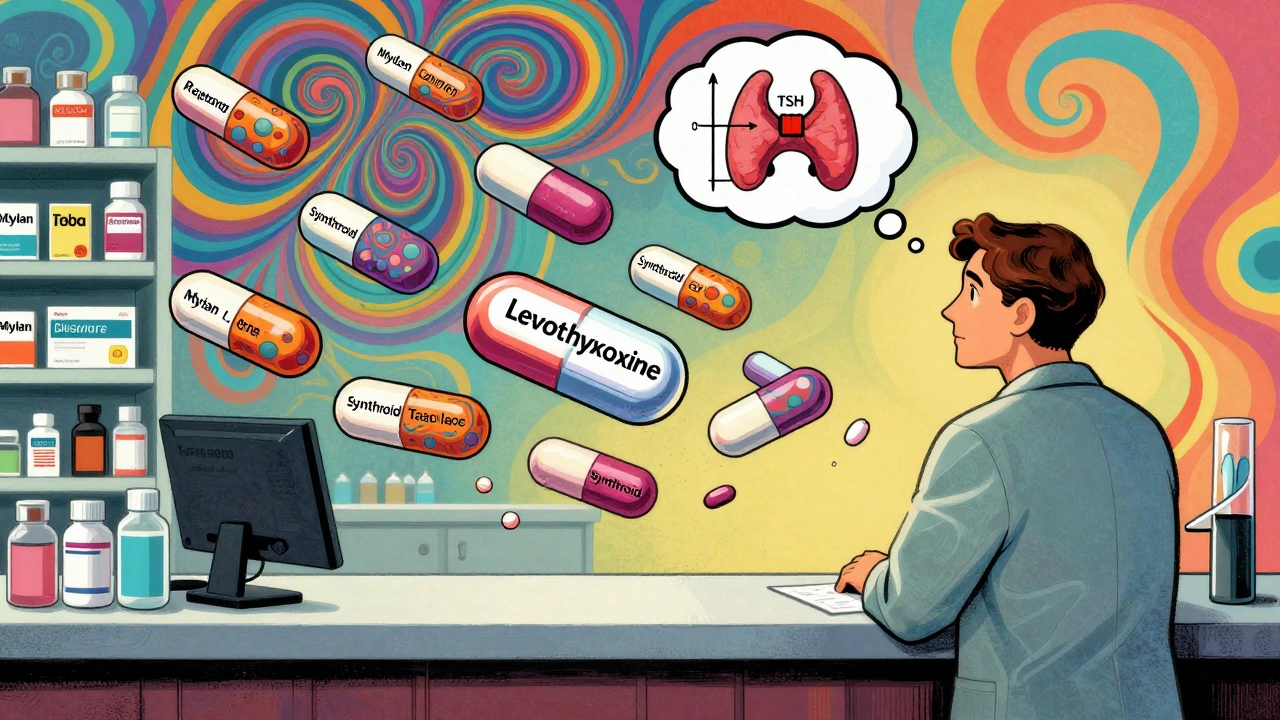
Switching from one brand of levothyroxine to another-whether it’s Mylan to Teva, or a generic to Synthroid-sounds simple. Same drug, same dose, right? But for millions of people managing hypothyroidism, that switch can trigger confusion, anxiety, and even real symptoms: fatigue, heart palpitations, unexplained weight gain. The question isn’t whether generics work-it’s when you need to check your TSH after switching.
Why This Matters More Than You Think
Levothyroxine isn’t like taking an ibuprofen or a vitamin. It’s a narrow therapeutic index (NTI) drug, meaning tiny changes in blood levels can throw your whole system off. Too little? You feel sluggish, cold, and gain weight. Too much? Your heart races, you lose weight, and your bones weaken. Your TSH level-the hormone your pituitary gland releases to tell your thyroid to produce more-is the most reliable way to know if your dose is right. And when you switch levothyroxine products, even if they’re both labeled “100 mcg,” your TSH might shift.The FDA Says: It’s Fine. Doctors Say: Maybe Not.
The FDA insists approved generics are interchangeable. They require bioequivalence testing: the new version must deliver between 80% and 125% of the original drug’s absorption. That’s the standard for most medications. But levothyroxine isn’t most medications. Its window for safety is narrow. For years, endocrinologists followed guidelines from the American Thyroid Association (ATA) and the American Association of Clinical Endocrinologists (AACE), which said: Always check TSH six weeks after switching. Then came the 2022 JAMA Internal Medicine study-analyzing over 15,000 patients. The results? No meaningful difference in TSH levels between those who switched generics and those who didn’t. Average TSH? 2.7 mIU/L in both groups. No spike. No crash. The FDA took notice. By January 2024, they updated the levothyroxine label to say: For most patients, switching doesn’t require extra TSH monitoring. But here’s the catch: most isn’t all.Who Really Needs a TSH Check After Switching?
Not everyone reacts the same. Some people are sensitive. Here are the groups where monitoring is still strongly recommended:- Thyroid cancer survivors - They often need to keep TSH suppressed below 0.1 mIU/L. Even a 0.2 shift can matter.
- Pregnant women - Thyroid needs jump 30-50% during pregnancy. Stability is critical for fetal brain development.
- People with heart disease - Too much thyroid hormone can trigger arrhythmias or angina.
- Those with a history of TSH instability - If your levels bounced around before, you’re more likely to react to a switch.
- Patients on high doses (>100 mcg/day) - Dutch research found 63% of these patients had abnormal TSH after switching, compared to 24% on lower doses.
What About the Rest of Us?
If you’re healthy, stable, and your TSH has been in range for over a year? The evidence says you’re probably fine. Kaiser Permanente’s internal review of 18,432 patients showed no reason to routinely test after switching. The same goes for the American Association of Clinical Endocrinologists’ 2023 update-they now say routine monitoring isn’t needed for average-risk patients. Still, listen to your body. If you start feeling off-more tired than usual, heart pounding, sudden weight gain or loss-don’t wait for your next scheduled blood test. Call your doctor. Get a TSH check. It’s simple, cheap, and could prevent months of discomfort.Why Do Some People React at All?
If generics are bioequivalent, why do some patients report symptoms? It’s not the active ingredient. It’s the fillers. Levothyroxine tablets contain inactive ingredients like lactose, corn starch, or dyes. A small percentage of people (about 1.7%, according to a 2022 BMJ Open study) are sensitive to these excipients. One patient switched from a generic with lactose to one with mannitol and suddenly felt better. Another switched to a tablet with a different dye and developed a rash. There’s also emerging science on genetics. About 0.8% of people have a variant in the DIO2 gene, which affects how their body converts T4 to the active T3 hormone. For them, even small changes in absorption can matter. Research is still early, but personalized medicine might one day identify these patients before they ever switch.
What’s the Real-World Experience?
Patient stories tell a mixed picture. On Reddit’s r/Hypothyroid, people share both horror stories and relief. One user, ThyroidWarrior89, wrote: “Switched from Mylan to Teva. My TSH jumped from 1.8 to 7.2 in eight weeks. I had to increase my dose by 12.5 mcg.” Another, HypoNoMore, said: “Switched between three different generics in two years. No TSH changes. My doctor says I’m in the 70% who don’t react.” The UK’s Medicines and Healthcare products Regulatory Agency (MHRA) tracked over 1,200 reports of symptoms after switches. Fatigue was #1 (327 cases), then palpitations (289), then weight changes (215). But that’s out of millions of switches. That’s about 0.01% of users reporting issues.What Should You Do?
Here’s a clear, practical guide:- If you’re in a high-risk group (cancer, pregnancy, heart disease, unstable TSH, or on high doses)-get your TSH checked 6-8 weeks after switching.
- If you’re low-risk and stable, no routine test is needed.
- If you feel worse after switching-get tested, even if you’re not in a high-risk group.
- If you’ve had a reaction before, ask your doctor to prescribe a specific brand or generic by name. Many pharmacies can honor this.
- Don’t assume all generics are the same. If you switch and feel fine, great. If you don’t, it’s not “all in your head.” It’s real, and it’s documented.
The Bottom Line
The era of automatic TSH testing after every levothyroxine switch is ending. Science is catching up to real-world data. For most people, switching generics is safe and saves money-billions of dollars in the U.S. alone. But medicine isn’t one-size-fits-all. If you’re one of the 8-12% who are sensitive, your doctor should know. Don’t let cost-cutting policies silence your symptoms. If your TSH was stable before, and you feel fine after switching? You’re probably in the majority. But if something feels off? Test it. It takes 10 minutes and costs less than a coffee. Your thyroid doesn’t care about pharmacy contracts. It only cares about the right dose.Do I need to check my TSH every time I switch levothyroxine generics?
No-not for most people. If you’re healthy, stable, and not in a high-risk group (like thyroid cancer, pregnancy, or heart disease), routine TSH testing after switching generics isn’t needed. Large studies show no significant change in TSH levels for the majority. But if you feel worse-fatigued, shaky, gaining weight-get tested. Your body might be telling you it needs adjustment.
Why do some people have problems switching generics if they’re supposed to be the same?
The active ingredient (levothyroxine) is identical. But the fillers-like lactose, corn starch, or dyes-can differ between brands. A small number of people (about 1.7%) are sensitive to these inactive ingredients, which can affect absorption or trigger mild reactions. Also, genetic differences in how your body converts T4 to T3 (like DIO2 gene variants) can make you more sensitive to small changes in dose delivery.
Can I ask my pharmacist to always give me the same generic brand?
Yes. You can request a specific generic manufacturer (like Teva or Mylan) by name. Many pharmacies will honor this, especially if you’ve had a reaction before. Your doctor can write “Dispense as Written” or “Do Not Substitute” on the prescription. It’s your right to ask for consistency, especially if you’ve found a product that works for you.
Is Synthroid better than generics?
For most people, no. Synthroid is more expensive-about 10 times the cost of generics-but studies show no consistent advantage in TSH control. The FDA considers all approved generics therapeutically equivalent. However, if you’ve had a reaction to multiple generics and feel better on Synthroid, it’s reasonable to stay on it. Your comfort and stability matter more than cost savings.
How long after switching should I get my TSH checked?
If you’re in a high-risk group or feel unwell, get tested 6 to 8 weeks after switching. That’s how long it takes for your body to fully adjust to the new formulation. For low-risk, stable patients, no extra test is needed unless symptoms appear. Routine annual checks are still recommended for all hypothyroid patients, regardless of switches.



Sheryl Lynn
December 2, 2025 AT 15:42Oh honey, let me tell you - switching generics is like changing your therapist mid-crisis. You think it’s the same person, but suddenly they’re using different pillows and whispering in a different accent. I went from Mylan to Teva and my TSH went from ‘ chillin’ with Buddha’ to ‘running from a bear.’ No, the FDA doesn’t care. But my thyroid? It remembers everything. And it’s holding a grudge.
Paul Santos
December 2, 2025 AT 18:24Interesting. The FDA’s bioequivalence threshold (80–125%) is essentially a statistical mirage when applied to NTI drugs like levothyroxine. It’s like saying two pianos are ‘equivalent’ because both hit A4 at 440Hz - but one’s tuned to just intonation and the other to equal temperament. The harmonic consequences? Catastrophic for sensitive systems. We’re not talking pharmacokinetics here - we’re talking epigenetic resonance.
Also 🤷♂️
Eddy Kimani
December 2, 2025 AT 19:34Wait - so if someone’s DIO2 gene variant makes them inefficient at converting T4 to T3, wouldn’t even a 5% absorption difference matter more than it does for someone with normal conversion? That’s huge. Has anyone looked at whether certain generics have better bioavailability in people with that SNP? Maybe we need pharmacogenomic labeling on these pills. Like ‘May cause fatigue in 0.8% of population with rs225014’.
Chelsea Moore
December 2, 2025 AT 21:18HOW DARE THEY?!?!? They’re just… just… CHANGING THE FORMULA and acting like it’s nothing?!?!?! I cried in the pharmacy aisle because my new generic had LACTOSE and I’ve been avoiding it since 2018 and now I’m bloated and tired and my hair is falling out and MY DOCTOR JUST LAUGHED AND SAID ‘IT’S THE SAME DRUG’ - WELL IT’S NOT THE SAME DRUG IF IT MAKES YOU FEEL LIKE A ZOMBIE!!
John Biesecker
December 4, 2025 AT 11:34so like… i get it. the science says most people are fine. but what if you’re not most people? 🤔
my body doesn’t care about FDA guidelines. it just knows: yesterday i felt like a human. today i feel like a wet sock.
if your thyroid’s mad? listen to it. not the algorithm.
also i think we’re all just trying to not die while being managed by a system that treats us like a spreadsheet.
Genesis Rubi
December 5, 2025 AT 14:33USA made the best levothyroxine. All these foreign generics? They’re cutting corners. My cousin in Mexico took some and ended up in the ER. Why are we letting China and India control our thyroid supply? This isn’t about money - it’s about national security. Synthroid is American. The rest? Suspicious.
Doug Hawk
December 6, 2025 AT 03:41the 2022 jama study is solid but i think we’re missing the human variable
people who report symptoms aren’t wrong even if their tsh is normal
their body is signaling something - maybe excipient sensitivity or gut absorption issues
the system wants to reduce cost but we’re paying in quality of life
just because it’s statistically insignificant doesn’t mean it’s not real for the individual
trust the patient. always.
John Morrow
December 7, 2025 AT 05:00Let’s be brutally honest: the entire narrative around levothyroxine switching is a product of pharmaceutical consolidation and Medicare cost-control initiatives masquerading as evidence-based medicine. The 15,000-patient study? Underpowered for subpopulations. The MHRA’s 0.01% adverse event rate? Self-reported and undercoded. And let’s not forget the 2018 study showing that 37% of patients on generics had suboptimal T4 levels despite ‘normal’ TSH - because TSH is a lagging indicator, not a real-time biomarker. We’re treating a chronic endocrine condition like we’re swapping out printer ink.
Kristen Yates
December 9, 2025 AT 04:29I switched from Synthroid to a generic last year. No change. I feel fine. I’m not looking for drama. I just want to take my pill and live my life. If it works, don’t fix it. If it doesn’t, talk to your doctor. Simple.
Saurabh Tiwari
December 9, 2025 AT 22:32in india we get generics all the time and no one checks tsh
most people just take it and live
if you feel bad you go to doctor
no big deal
but i like how detailed this post is
very informative
👍
Michael Campbell
December 10, 2025 AT 05:58they’re hiding something. why do the same pills make some people sick and others fine? it’s not the fillers. it’s the chip. the microchip they put in every pill to track you. the government knows who’s sensitive. they just don’t care.
Girish Padia
December 10, 2025 AT 08:33why do you care so much about what brand you take
it's medicine
it works
stop being dramatic
your thyroid doesn't need to be pampered
just take it and shut up