
When you’re facing a cancer diagnosis that requires surgery, one of the most important decisions isn’t about the operation itself-it’s about when to give the drugs. Should treatment come before surgery to shrink the tumor? Or after, to clean up what’s left? This isn’t just a technical detail. It’s a life-altering choice that affects survival, side effects, and even your peace of mind.
What’s the Difference Between Neoadjuvant and Adjuvant Therapy?
Neoadjuvant therapy means giving chemotherapy, immunotherapy, or radiation before surgery. The goal? Shrink the tumor so it’s easier to remove, kill hidden cancer cells early, and see how your body responds to treatment before cutting into you.
Adjuvant therapy happens after surgery. It’s like a cleanup crew-targeting any stray cancer cells that might have slipped away during the operation. This approach has been standard for decades, especially in breast and colon cancer.
At first glance, they sound like two paths to the same destination. But the timing changes everything.
Why Timing Matters: The Real Advantage of Neoadjuvant Therapy
Here’s what most people don’t realize: neoadjuvant therapy gives you a real-time look at how your cancer reacts to treatment.
In breast cancer, for example, if a patient gets chemo before surgery and the tumor disappears completely in the removed tissue-that’s called a pathologic complete response, or pCR. Patients who hit pCR have significantly better long-term survival than those who still have cancer left behind. It’s not just a hopeful sign-it’s a powerful predictor.
In lung cancer, the CheckMate 816 trial showed that patients given nivolumab (an immunotherapy) plus chemo before surgery had a 24% pCR rate. Those who got chemo alone? Just 2.2%. And those who achieved pCR lived longer without their cancer coming back.
Neoadjuvant therapy also helps surgeons. A tumor that’s too big or wrapped around a major blood vessel might be inoperable at first. After a few rounds of treatment, it shrinks enough to be removed safely. That’s a game-changer for patients who were told they couldn’t have surgery.
When Adjuvant Therapy Still Makes Sense
Adjuvant therapy isn’t outdated. It’s still the standard for many patients, especially when the cancer is caught early and surgery removes everything cleanly.
For some, avoiding delays is critical. If you’re worried about cancer spreading while waiting for treatment, starting chemo after surgery gives you a sense of control. You’ve already had the operation. The tumor’s out. Now you’re fighting the invisible remnants.
Also, not everyone can tolerate neoadjuvant therapy. Some patients develop side effects-fatigue, low blood counts, immune-related inflammation-that delay surgery. About 10-15% of people need to postpone their operation because of toxicity. For those patients, adjuvant therapy avoids that risk entirely.
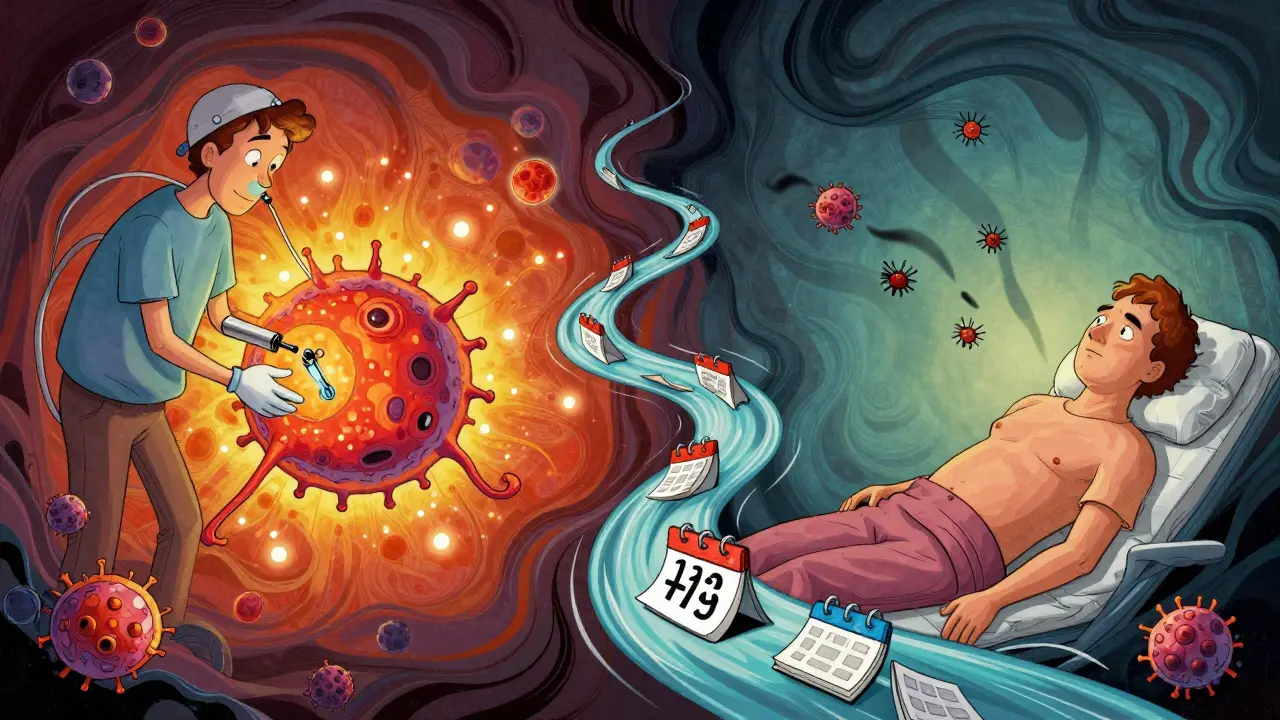
The Big Shift: Immunotherapy Changed the Rules
Before 2022, neoadjuvant and adjuvant therapy were seen as mostly equivalent in survival outcomes. But then came immunotherapy-and everything shifted.
The CheckMate 816 trial didn’t just show better pCR rates. It showed a 37% improvement in event-free survival for patients who got nivolumab plus chemo before surgery. That’s not a small win. That’s a new standard.
Because of this, the FDA approved neoadjuvant nivolumab with chemotherapy for resectable non-small cell lung cancer in March 2022. The European Medicines Agency followed suit. This wasn’t just a tweak-it was a paradigm shift.
Now, doctors are asking: Do we even need to keep giving immunotherapy after surgery?
A January 2024 meta-analysis of over 3,200 patients found no survival benefit from adding adjuvant immunotherapy after neoadjuvant treatment. But it did find more serious side effects-nearly 30% of patients on the combo approach had grade 3 or higher toxicities, compared to under 18% with neoadjuvant-only.
Dr. Mark Awad from Dana-Farber put it bluntly: “The neoadjuvant-only approach may represent the optimal sequencing strategy for early-stage NSCLC.”
Breast Cancer: Similar Survival, Different Strategy
In breast cancer, the story is more nuanced. For triple-negative or HER2-positive types, neoadjuvant therapy is now routine. Why? Because response to treatment tells you so much about prognosis.
Patients with triple-negative breast cancer who achieve pCR have a 70-80% chance of surviving five years without recurrence. Those who don’t? That number drops to under 50%.
But here’s the twist: studies comparing neoadjuvant and adjuvant chemo show nearly identical overall survival. So why bother with neoadjuvant?
Because it’s not just about survival-it’s about personalization. If your tumor doesn’t respond, your oncologist can switch drugs before surgery. You get a second chance to find something that works. That’s not possible with adjuvant therapy.
Dr. Lajos Pusztai from Yale says it best: “Neoadjuvant therapy helps us identify patients with worse prognosis.” That insight lets doctors tailor follow-up care-maybe adding more aggressive treatment for those who didn’t respond.
Who Gets Which Treatment? Guidelines in 2026
Current guidelines from the NCCN and ASCO help doctors decide:
- For non-small cell lung cancer (NSCLC): Neoadjuvant chemoimmunotherapy is recommended for stage IB (tumor ≥4 cm) to IIIA. PD-L1 expression ≥1% increases the chance of benefit.
- For breast cancer: Neoadjuvant therapy is standard for triple-negative, HER2-positive, or large hormone-receptor-positive tumors. It’s also used if the patient wants breast-conserving surgery instead of a mastectomy.
- For rectal cancer: Neoadjuvant chemoradiation is standard before surgery to shrink tumors and reduce recurrence.
But not every hospital can do this. Only 58% of community hospitals have formal neoadjuvant pathways. Academic centers? Nearly 92%. That gap means your access depends on where you live and who your doctor works with.

What Patients Are Saying
On cancer forums, patients describe the emotional weight of this decision.
One NSCLC patient said: “My oncologist recommended neoadjuvant chemo and immunotherapy because it gave us a chance to see if the treatment worked before surgery. Turns out I had a major pathologic response-over 90% of the tumor was gone. That gave me hope.”
Another, with breast cancer, shared: “I chose adjuvant chemo because I didn’t want to wait. But later, I learned I might have benefited from knowing how my tumor responded before surgery.”
A 2023 survey found 62% of NSCLC patients on neoadjuvant therapy felt anxious about their cancer progressing during the 8-12 weeks before surgery. That’s real stress. Adjuvant therapy avoids that-but it also removes the chance to see if the drugs work.
The Future: Biomarkers and ctDNA Are Changing the Game
The next frontier isn’t just about timing-it’s about personalizing timing.
Doctors are now using circulating tumor DNA (ctDNA) to detect microscopic cancer cells after surgery. If ctDNA is still present, it means the cancer is hiding. Those patients get adjuvant therapy. If it’s gone? They might skip it entirely.
Trials like NeoADAURA (testing osimertinib for EGFR-mutant lung cancer) and KEYNOTE-867 (comparing neoadjuvant-only vs. neoadjuvant-plus-adjuvant) are expected to deliver results by 2025. These studies could make treatment decisions even more precise.
Dr. Roy Herbst predicts: “Within five years, biomarker-driven neoadjuvant approaches will become standard for 70% of early-stage NSCLC cases.”
The goal? Not just to treat more-but to treat smarter. To avoid giving toxic drugs to people who don’t need them. To spare patients unnecessary surgery complications. To improve survival without sacrificing quality of life.
Bottom Line: It’s Not One Size Fits All
Neoadjuvant therapy isn’t better than adjuvant therapy. It’s different. And the right choice depends on your cancer type, stage, biomarkers, and personal priorities.
If you want to know if your tumor responds to treatment before surgery-neoadjuvant gives you that insight.
If you want to get surgery done first and then follow up with treatment-adjuvant is still valid.
For many, the future is clear: start with neoadjuvant chemoimmunotherapy, check the response, and then decide whether more treatment is needed. That’s the new standard for lung cancer. And it’s spreading fast.
The key is to ask: What will this treatment tell me? And how will it change what happens next?
Is neoadjuvant therapy better than adjuvant therapy for survival?
For most cancers, overall survival is similar between neoadjuvant and adjuvant therapy. But neoadjuvant therapy offers a critical advantage: it shows whether the treatment is working before surgery. Patients who achieve a pathologic complete response (pCR) have significantly better long-term outcomes. In lung cancer, neoadjuvant immunotherapy plus chemo improved event-free survival by 37% compared to chemo alone.
Can I skip adjuvant therapy after neoadjuvant treatment?
Yes, in some cases. A 2024 meta-analysis found no survival benefit from adding adjuvant immunotherapy after neoadjuvant treatment in lung cancer-but it did increase serious side effects. For patients who achieve a strong response (like pCR), stopping after neoadjuvant therapy is now considered a safe and effective option by many oncologists.
Why do some doctors still recommend adjuvant therapy?
Adjuvant therapy avoids delays in surgery and is less risky for patients who can’t tolerate pre-op treatment. It’s also the standard for cancers where neoadjuvant therapy hasn’t been proven to add benefit-like early-stage hormone-positive breast cancer. For patients who want surgery done first, adjuvant therapy offers a clear, well-established path.
How long does neoadjuvant therapy last before surgery?
Typically, neoadjuvant therapy lasts 3 to 4 cycles over 9 to 12 weeks. For lung cancer with immunotherapy and chemo, it’s usually 3 cycles (about 9 weeks), followed by surgery 3 to 6 weeks later. Timing matters-too soon and your body hasn’t recovered; too late and cancer might grow again.
What if my tumor doesn’t shrink with neoadjuvant therapy?
That’s actually valuable information. If the tumor doesn’t respond, your oncologist can switch to a different treatment after surgery. You’ve already learned what doesn’t work-which helps guide your next steps. In some cases, you may be enrolled in a clinical trial for new drugs. Not responding doesn’t mean you’ve run out of options-it means you’ve gained critical data.
Are there risks to choosing neoadjuvant therapy?
Yes. About 10-15% of patients experience side effects severe enough to delay surgery. In lung cancer, 5-10% of patients may see their cancer progress during neoadjuvant treatment. Immunotherapy can cause immune-related side effects like colitis or lung inflammation. But these risks are weighed against the benefit of knowing whether treatment works before cutting into you.




Harry Henderson
January 26, 2026 AT 11:25Neoadjuvant therapy isn’t just smart-it’s the only way forward if you want real data before cutting someone open. Why gamble on surgery first when you can see if the drugs work? The CheckMate 816 data alone should shut down the old-school adjuvant crowd. This isn’t evolution-it’s revolution.
Andrew Clausen
January 26, 2026 AT 18:55You’re oversimplifying. Survival rates are statistically identical in most cancers. The only advantage of neoadjuvant is tumor shrinkage-which doesn’t always translate to longer life. You’re mistaking radiographic response for clinical benefit. The FDA approval was based on surrogate endpoints, not overall survival. Don’t confuse hype with science.
Anjula Jyala
January 28, 2026 AT 12:17Pathologic complete response is the only meaningful endpoint in oncology. If you’re not achieving pCR in TNBC or NSCLC you’re just wasting cycles. Adjuvant is a relic of the chemo-only era. Immunotherapy changed the game. If your hospital doesn’t offer neoadjuvant chemoimmunotherapy for stage IB-IIIA NSCLC you’re practicing 2015 medicine
suhail ahmed
January 29, 2026 AT 22:08Look I get it-neoadjuvant sounds sexy with all the pCR stats and shiny immunotherapy wins. But let’s not forget the folks who can’t tolerate the toxicity. I’ve seen patients crash with colitis or pneumonitis waiting for surgery. Adjuvant isn’t backup-it’s lifeline. And for those in rural clinics without oncology teams? They need the simpler path. Not everyone gets a Dana-Farber care team.
Candice Hartley
January 30, 2026 AT 15:29This is so emotional to read. I had neoadjuvant for triple-negative and got pCR. It felt like a miracle. But I also cried for 3 weeks waiting for surgery wondering if it was working. 😔 Thank you for explaining why this matters-not just clinically but emotionally too.
astrid cook
February 1, 2026 AT 13:55They’re pushing neoadjuvant because Big Pharma wants to sell more immunotherapy. Did you notice how the trials always exclude the frail elderly? Of course they do. Who’s going to pay for this if grandma can’t even walk to the infusion chair? This isn’t medicine-it’s a revenue stream dressed in white coats.
Kathy McDaniel
February 2, 2026 AT 11:19im still confused like why cant we just do both? like why is it an either/or thing? i feel like i need a flowchart or something
Paul Taylor
February 3, 2026 AT 12:28Let’s talk about the real issue here. Neoadjuvant therapy requires coordination between oncology, surgery, radiology, pathology-all of which need to be in sync. In community hospitals? Most don’t have dedicated tumor boards or ctDNA testing. So when we push neoadjuvant as standard, we’re not just changing treatment-we’re demanding infrastructure upgrades. And who pays for that? Medicare? Medicaid? The system isn’t ready. We’re telling patients to get cutting-edge care while the hospital can’t even get their EHR to talk to the lab.
Desaundrea Morton-Pusey
February 4, 2026 AT 05:22So now we’re supposed to believe that American oncology is leading the world? What about Europe? China? India? They’re doing this differently. This whole narrative feels like American exceptionalism wrapped in clinical trial jargon. Neoadjuvant isn’t better-it’s just the trend du jour.
Murphy Game
February 5, 2026 AT 18:33Did you know the CheckMate 816 trial was funded by Bristol Myers Squibb? And that Dr. Awad consulted for them? And that the FDA approved this before long-term survival data was in? This isn’t science. It’s a corporate takeover of cancer care. They want you to believe neoadjuvant is the only way so they can lock you into multi-year immunotherapy regimens. Wake up.
John O'Brien
February 7, 2026 AT 03:22Andrew’s right about the stats being similar-but he’s ignoring the fact that neoadjuvant gives you a chance to adjust. If my tumor doesn’t shrink, I know to switch drugs before surgery. That’s not just a bonus-it’s a game-changer for people with aggressive cancers. Adjuvant is like locking the barn after the horse is gone. Neoadjuvant is trying to stop the horse from leaving in the first place.
Kegan Powell
February 8, 2026 AT 05:25At the end of the day this isn’t about which therapy is better-it’s about what kind of relationship we want with our bodies and our illness. Do we want to be passive recipients of a pre-set protocol? Or do we want to see, in real time, whether the treatment is working? Neoadjuvant turns cancer from a sentence into a conversation. And that’s not just medical-it’s human. We’re not just treating tumors. We’re trying to give people agency. That’s worth fighting for.