
What Those Tiny Stickers on Your Prescription Bottle Actually Mean
You pick up your prescription, glance at the label, and see a red sticker that says "Do not drink alcohol". Another one says "Take on empty stomach". Maybe there’s a yellow one with "May cause drowsiness". You nod, tuck the bottle in your bag, and forget about it-until you feel dizzy after dinner or your stomach starts churning. That’s when you realize: you didn’t understand what those stickers were trying to tell you.
Those little stickers aren’t just bureaucratic clutter. They’re your last line of defense against dangerous mistakes. The U.S. Food and Drug Administration (FDA) requires them because, every year, medication errors cause over 1.3 million injuries and 7,000 deaths in the U.S. alone. And a shocking number of those errors happen because patients misread or ignored the warnings on their bottles.
Here’s the truth: most people don’t know what those labels really mean. Not because they’re careless-but because the system is broken. The warnings are written for doctors, not patients. They use medical jargon, confusing symbols, and tiny fonts. And when you’re tired, stressed, or in pain, you’re not going to stop and read them carefully.
Red, Yellow, White: The Hidden Color Code
Not all warning stickers are the same. Colors matter more than you think. A red sticker? That’s the FDA’s signal for serious risk. Think: life-threatening reactions, dangerous interactions, or irreversible damage. If your bottle has a red sticker saying "Black Box Warning: Risk of Liver Failure", this isn’t a suggestion-it’s a red alert. About 40% of new drugs approved between 2013 and 2017 carried one of these.
Yellow stickers? They’re caution signs. Not emergencies, but still important. "May cause dizziness", "Avoid sunlight", or "Do not operate heavy machinery" fall here. These are the warnings people ignore because they don’t seem urgent. But if you’re driving, working with tools, or just walking down the stairs, even mild dizziness can lead to a fall-or worse.
White or blue stickers? These are usually instructions, not warnings. Things like "Take with food" or "Refrigerate". They’re easy to overlook, but skipping them can make your medicine less effective-or even harmful. Some pills are designed to dissolve slowly. If you crush them because you think "swallow whole" means "don’t swallow it at all," you could overdose.
Here’s the kicker: studies show patients understand red stickers 85% of the time. But blue ones? Only 45%. That’s why pharmacists are pushing for standardized colors. If you see red, stop. Read it. Ask questions.
"Swallow Whole" vs. "Do Not Crush"-The Confusion Trap
One of the most common-and dangerous-misunderstandings happens with the phrase "Do not crush, chew, or break". In a study by U.S. Pharmacist, nearly 30% of patients thought it meant "chew it up so it dissolves faster." That’s the opposite of what it says.
Many medications are made with special coatings or time-release systems. Crushing them can release the entire dose at once. Take a painkiller like OxyContin or a blood pressure med like Verapamil. Crush it, and you could overdose. You might not feel it right away. But in an hour, your heart could slow down. Your breathing could stop.
Same with "Take on empty stomach". That doesn’t mean skip breakfast. It means take it at least one hour before or two hours after eating. Food can block absorption. For antibiotics like tetracycline, eating dairy right before or after can make the drug useless. You think you’re taking it correctly-but you’re just wasting money and risking infection.
And don’t assume "for external use only" means "safe if you accidentally swallow a little." That phrase is on creams, ointments, and eye drops. One patient in a Reddit thread said she used a topical antifungal cream on her lips because she thought it was for "skin irritation." She ended up in the ER with chemical burns.
Why Symbols Don’t Work-And What Does
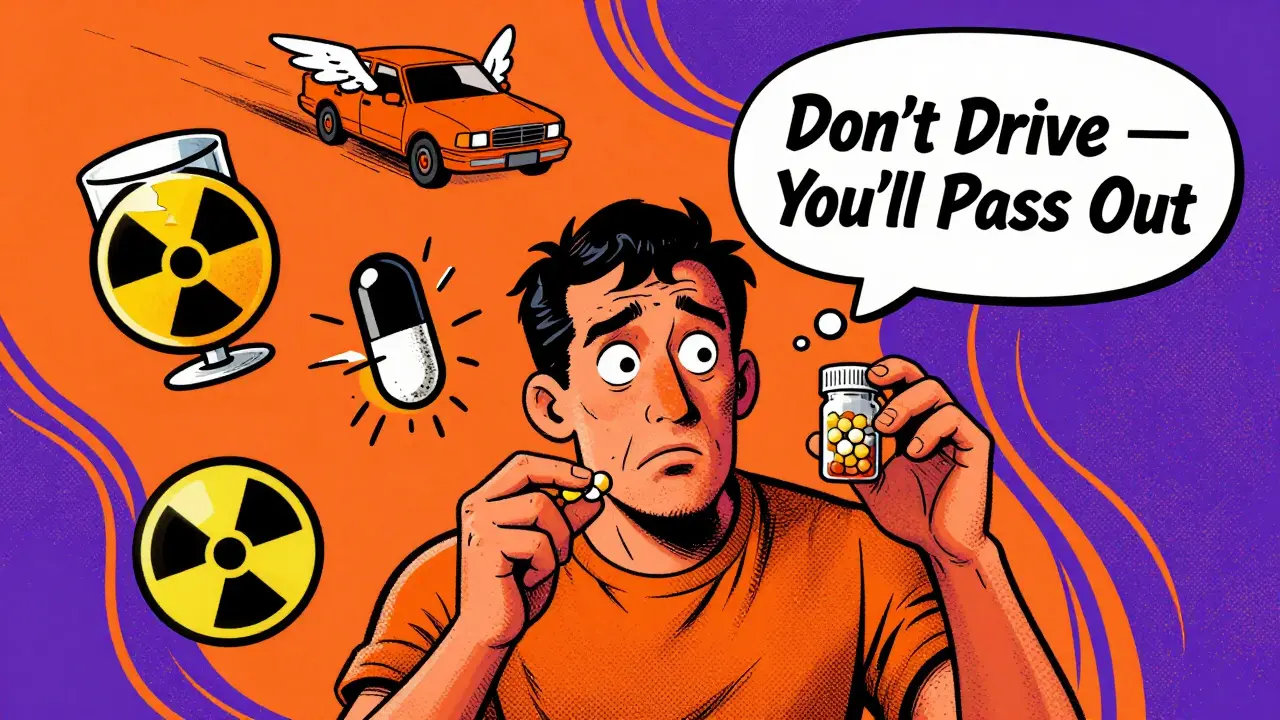
Some pharmacies try to make labels simpler by using icons: a glass with a slash through it for "no alcohol," a car for "don’t drive." Sounds smart, right? But research shows it backfires.
A 2017 study found that 32% of people thought the "external use only" symbol meant "radioactive." Another 28% thought it meant "shaking or chills." Only 12% got it right. Symbols are culturally ambiguous. A red circle with a line through it means "no" in some places-but in others, it just looks like a mistake.
What works? Simple words, spoken out loud. The FDA and the Institute for Safe Medication Practices agree: the best warning system combines printed labels with a pharmacist saying it in plain English.
At Kaiser Permanente, they tested a new system: big, bold text. No medical terms. Just: "This medicine makes you sleepy. Don’t drive." Patient comprehension jumped from 55% to 89%. That’s not magic-it’s clarity.
Ask your pharmacist: "Can you explain this sticker to me like I’m 12?" Most will. And if they don’t, find one who will.
The Paper You Threw Away? It Was Your Safety Net
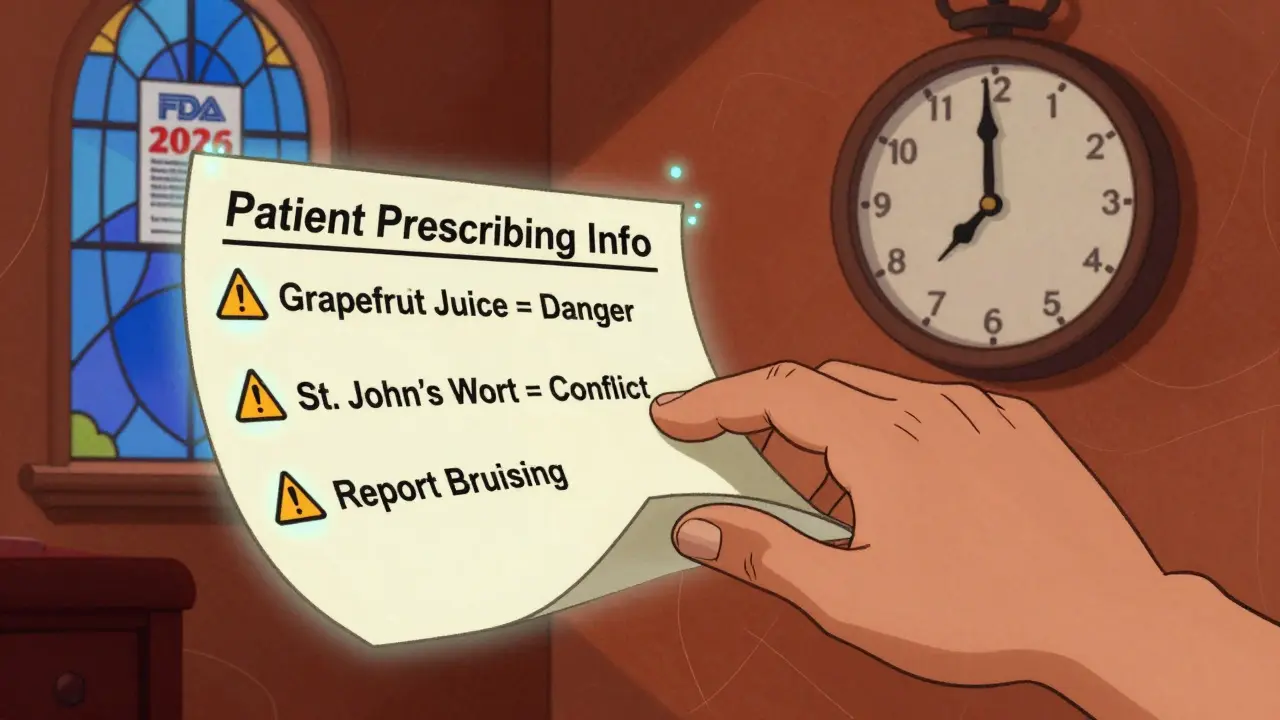
That little folded sheet that comes with your pill bottle? The one with tiny print and a heading like "Patient Prescribing Information"? You probably tossed it. You’re not alone. 68% of patients do.
But that paper? It’s where the real warnings live. Not just "take with food"-but details like: "Do not use if pregnant," "May interact with St. John’s Wort," or "Report unusual bruising immediately." These aren’t just fine print. They’re critical.
One woman on Drugs.com said she threw away the warning about grapefruit juice with her blood pressure pill. Three days later, she collapsed. Her blood pressure dropped so low, she needed emergency treatment. The warning was on that paper. She never read it.
Don’t throw it away. Keep it in a drawer with your other meds. Or take a photo of it with your phone. At least read it once. You don’t need to memorize it-but you need to know what’s in it.
What You Can Do Right Now
You don’t have to wait for the system to fix itself. Here’s what you can do today:
- Stop and read every sticker. Don’t assume you know what it means. Red means danger. Yellow means caution. White means instruction.
- Ask your pharmacist: "What’s the most important thing I need to know about this?" They’re trained to tell you what matters.
- Use the "teach-back" method. After they explain, say: "So if I understand right, I shouldn’t drink alcohol because it could make me pass out?" If they say yes, you got it. If they correct you, you just saved your life.
- Keep the paper insert. Store it with your meds. Or take a photo. You’ll thank yourself when you’re reading it at 2 a.m. with a stomach ache.
- Check for new labels. By June 2025, the FDA will require simplified labels for 20 high-risk drugs. Look for big text, simple icons, and clear language. If you don’t see it yet, ask your pharmacy if they’ve switched.
Medication errors don’t happen because people are stupid. They happen because the system assumes you’re a doctor. You’re not. And that’s okay. You just need to know how to ask for help.
What’s Changing-and When
The good news? Things are getting better. In February 2023, the FDA approved the first universal symbol for "do not crush"-a pill with a slash through it. In testing, it reduced misinterpretation from 31% to just 8%.
Some pharmacies are testing QR codes on labels. Scan it, and a 30-second video plays explaining the warning in plain English. Mayo Clinic trials showed this boosted understanding by over 50%.
By 2026, most U.S. pharmacies will be required to use these simplified labels. But until then, you’re still the last line of defense. Don’t rely on the sticker alone. Ask. Read. Repeat. Your life depends on it.


Beth Cooper
January 31, 2026 AT 02:04Melissa Cogswell
February 1, 2026 AT 16:23Diana Dougan
February 2, 2026 AT 20:52Bobbi Van Riet
February 4, 2026 AT 16:06Holly Robin
February 5, 2026 AT 11:13Shubham Dixit
February 6, 2026 AT 06:16KATHRYN JOHNSON
February 7, 2026 AT 06:25Blair Kelly
February 8, 2026 AT 22:59Rohit Kumar
February 9, 2026 AT 21:28Lily Steele
February 11, 2026 AT 12:52Eliana Botelho
February 12, 2026 AT 10:48Lisa McCluskey
February 14, 2026 AT 08:46owori patrick
February 15, 2026 AT 16:14Darren Gormley
February 16, 2026 AT 18:21