
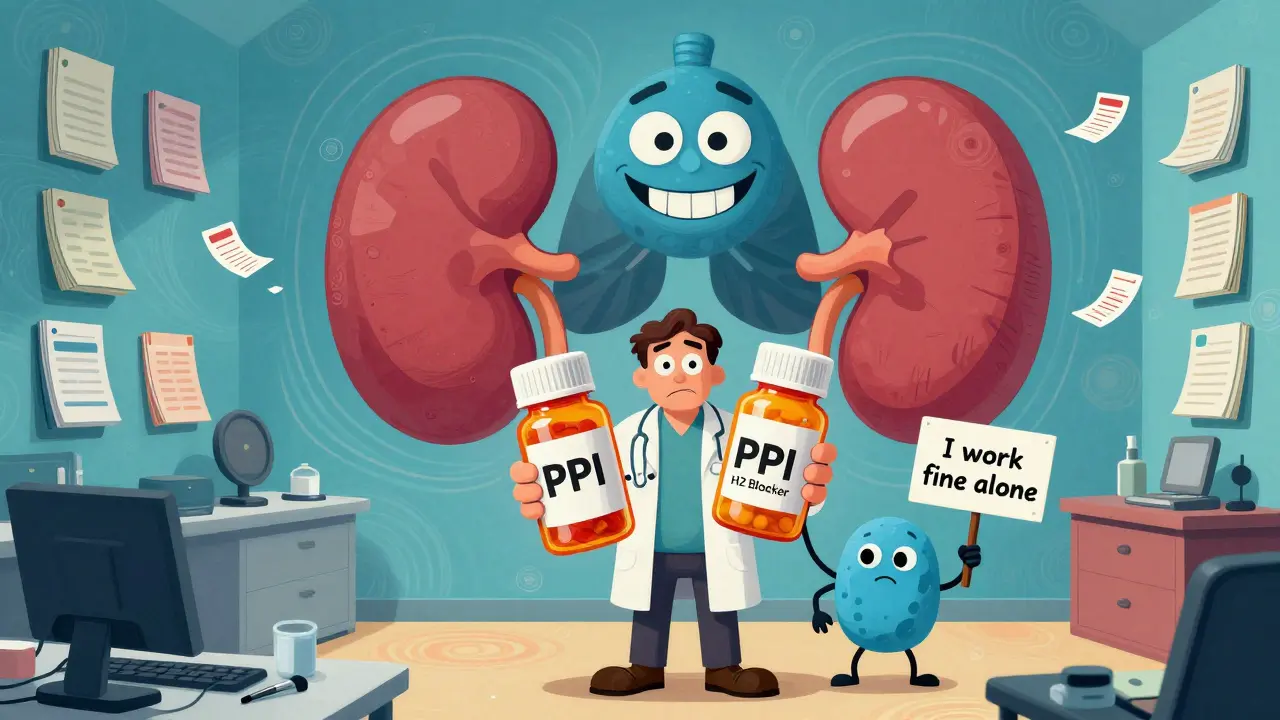
Many people take acid-suppressing meds like omeprazole or famotidine without knowing why - or whether they even need both. If you’re on a proton pump inhibitor (PPI) and your doctor added an H2 blocker, you’re not alone. About 1 in 5 hospitalized patients get both. But here’s the problem: for most people, this combo doesn’t help - and might actually hurt.
How H2 Blockers and PPIs Work (And Why They Don’t Play Well Together)
H2 blockers like famotidine (Pepcid) and ranitidine (Zantac) work by blocking histamine from telling stomach cells to make acid. They kick in fast - within an hour - but their effect fades after 6 to 12 hours. That’s why some people take them at night to fight heartburn that comes back after dinner.
PPIs like omeprazole (Prilosec) or esomeprazole (Nexium) work differently. They shut down the actual acid pumps in stomach cells. This is a deeper, longer-lasting block. But they take days to reach full power. Once they do, they reduce acid by 90-98%. That’s powerful. Too powerful, sometimes.
Here’s the catch: H2 blockers need some acid activity to work. If a PPI has already turned off nearly all the acid pumps, there’s little left for the H2 blocker to block. A 2022 study in the Journal of Clinical Gastroenterology found that adding ranitidine to omeprazole only cut nighttime acid by 5% - barely anything. And that tiny gain came with more cost, more pills, and more risk.
The Hidden Dangers of Stacking Acid Meds
For years, doctors thought more acid suppression meant better protection. But research has flipped that idea. A major 2014 study in JAMA Internal Medicine looked at nearly 80,000 ICU patients. Those on PPIs had a 30% higher chance of getting pneumonia and a 32% higher risk of Clostridium difficile infection - a dangerous gut bug that causes severe diarrhea. H2 blockers? Lower risk.
Even stranger: PPIs were linked to a 22% higher risk of gastrointestinal bleeding than H2 blockers. That’s the opposite of what you’d expect. If acid causes ulcers, shouldn’t blocking it more help? Not always. Your stomach needs some acid to kill bad bacteria and digest food. Over-suppressing it throws off your whole system.
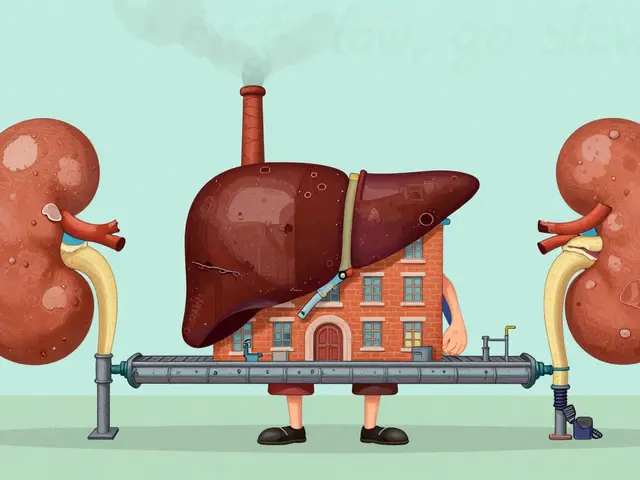
Another red flag: kidney damage. A 2021 study of over 3,600 people with chronic kidney disease found those on PPIs were 28% more likely to reach end-stage kidney disease than those on H2 blockers. The exact reason isn’t clear, but chronic acid suppression seems to trigger inflammation in the kidneys over time.
Who Might Still Need Both?
There’s one real exception: nocturnal acid breakthrough.
Some people - usually those with severe GERD - still get heartburn between midnight and 6 a.m., even on twice-daily PPIs. This isn’t common. But if it happens, and it’s confirmed by a 24-hour pH monitor showing stomach pH below 4 for over an hour during those hours, then adding an H2 blocker at bedtime might help.
Even then, it’s temporary. The American College of Gastroenterology says to try the H2 blocker for only 4 to 8 weeks. If symptoms don’t improve, stop it. No point keeping a drug that doesn’t work - and might be doing harm.
Side Effects You’re Probably Not Aware Of
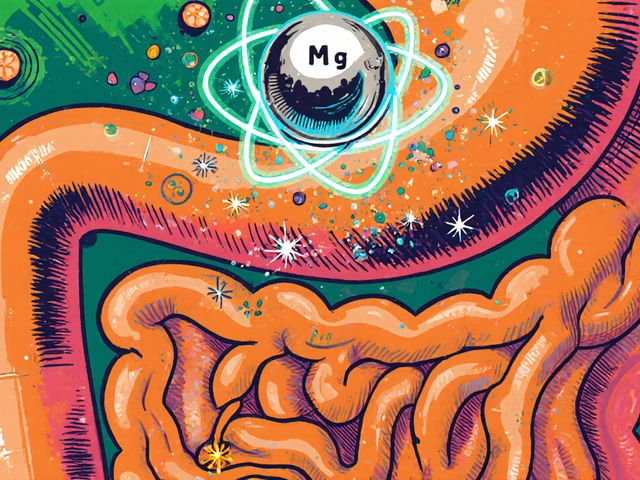
PPIs come with a long list of underreported side effects. According to patient reviews on Drugs.com, 68% of users report problems. The most common? Headaches (23%), diarrhea (18%), and low levels of magnesium, vitamin B12, or calcium (12%). Long-term use can lead to bone fractures, because your body can’t absorb calcium properly without enough acid.
And then there’s dependency. On Reddit’s r/GERD community, 42% of users say they can’t quit PPIs without rebound heartburn. That’s not addiction - it’s physiology. When you suppress acid for months, your stomach overcompensates by making more acid-producing cells. When you stop, it floods the system. That’s why many people think they need the drug forever. They don’t. They just need to taper off slowly, with support.
Why Doctors Still Prescribe This Combo
It’s not always medical. Sometimes, it’s habit. Or confusion. A 2022 survey by the American College of Gastroenterology found that 31% of patients on both drugs didn’t know why they were taking them. Another 64% couldn’t name a single side effect.
Pharmaceutical marketing plays a role too. PPIs dominate the market - 78% of acid-suppressing prescriptions in the U.S. in 2022 were for PPIs. H2 blockers are cheaper, safer for kidneys, and just as good for mild cases. But they’re not promoted as aggressively.
There’s also a lack of follow-up. Many patients start a PPI in the ER for chest pain, then keep it for years. No one checks if it’s still needed. The Department of Veterans Affairs now requires doctors to do a “PPI time-out” every 90 days - a simple question: Is this still helping? If not, taper off.

What You Should Do Right Now
If you’re on both an H2 blocker and a PPI, ask yourself:
- Was this combo prescribed for a specific reason - like nighttime symptoms confirmed by testing?
- Have I been on these drugs for more than 3 months?
- Do I still have symptoms, or am I just taking them out of habit?
Don’t stop cold turkey. Talk to your doctor about a plan. For most people, stepping down from a PPI to an H2 blocker - or even stopping both - is safer and just as effective.
Try this: Cut your PPI dose in half for a week. Then, skip it every other day. If heartburn returns, try taking an H2 blocker at bedtime instead. Most people find relief this way - without the long-term risks.
The Bigger Picture: Less Is More
Medicine is moving toward deprescribing - removing drugs that don’t help. The American Gastroenterological Association now lists “don’t prescribe H2 blockers with PPIs for routine GERD” as a top recommendation. Medicare is starting to penalize hospitals that overprescribe this combo.
It’s not about being anti-medication. It’s about using the right tool for the job. If you have occasional heartburn after spicy food, an H2 blocker at night does the job. If you have severe reflux confirmed by endoscopy, a low-dose PPI might be right. But stacking both? That’s not treatment. It’s overkill.
Ask for a review. Ask for alternatives. Ask what happens if you stop. You have the right to know why you’re taking something - and whether it’s still worth it.
Can I take an H2 blocker and PPI together safely?
Only in rare cases - like documented nocturnal acid breakthrough despite twice-daily PPI use. Even then, it should be temporary. For most people, the risks - including pneumonia, kidney damage, and nutrient deficiencies - outweigh the tiny benefit. Always consult your doctor before combining them.
Which is safer: H2 blockers or PPIs?
For long-term use, H2 blockers like famotidine are generally safer. Studies show lower risks of kidney damage, pneumonia, and C. diff infection compared to PPIs. PPIs are stronger, but that strength comes with more side effects over time. Use the least powerful option that works.
Why do I get worse heartburn when I stop my PPI?
This is called rebound acid hypersecretion. When you suppress acid for months, your stomach makes more cells to produce it. When you stop suddenly, those cells go into overdrive. The fix? Taper off slowly - reduce the dose over weeks, not days. Switching to an H2 blocker during the taper can help manage symptoms.
Are H2 blockers still effective today?
Yes. H2 blockers like famotidine are still effective for mild to moderate heartburn, especially at night. They work faster than PPIs and have fewer long-term risks. Many people don’t need PPIs at all - an H2 blocker is enough. They’re also cheaper and available over the counter.
Can H2 blockers cause kidney problems?
Unlike PPIs, H2 blockers are not linked to chronic kidney damage. In fact, studies show patients on H2 blockers have a lower risk of progressing to end-stage kidney disease compared to those on PPIs. For people with kidney issues, H2 blockers are often the preferred choice for acid control.
Is there a natural alternative to acid-suppressing drugs?
Lifestyle changes often work better than drugs. Avoid late-night meals, reduce caffeine and alcohol, lose excess weight, and elevate the head of your bed. Many people with GERD find relief without any medication. If you still need something, an H2 blocker at night is a safer first step than a PPI.
Aditya Kumar
December 16, 2025 AT 21:12I’ve been on PPIs for 5 years. Stopped cold turkey last year. Ended up in ER with heartburn so bad I thought I was having a heart attack. Turned out it was just rebound. Took 3 months to stabilize. Now I use famotidine at night. No more pills. No more fear. Just chill.
Randolph Rickman
December 17, 2025 AT 16:27This is the kind of post that should be mandatory reading for every doctor who writes prescriptions without follow-up. I’m a nurse in a VA hospital and we’ve been doing PPI time-outs for two years now. The drop in kidney issues and C. diff cases? Massive. Patients are shocked when they realize they’ve been on a drug they didn’t need since 2018. Education > prescriptions. And yeah, H2 blockers are still totally valid. They’re the quiet hero of acid control.
Dave Alponvyr
December 18, 2025 AT 07:57So you’re telling me the drug company ads lied to me again? Shocking. Next you’ll say aspirin doesn’t cure cancer.
Kim Hines
December 19, 2025 AT 06:03I switched from omeprazole to Pepcid last year after reading this exact study. My headaches stopped. My energy came back. I didn’t even miss the PPI. Funny how the body fixes itself when you stop overmedicating.
Joanna Ebizie
December 20, 2025 AT 11:37People are still taking these combos? Like… what even is your doctor doing? Are they just printing prescriptions on autopilot? You wouldn’t stack two painkillers without thinking. Why is acid different?
Billy Poling
December 21, 2025 AT 17:52It is imperative to underscore the profound clinical implications of polypharmacy in the context of gastrointestinal pharmacotherapy. The concomitant administration of proton pump inhibitors and histamine H2 receptor antagonists constitutes a pharmacokinetic redundancy that may precipitate iatrogenic complications, including but not limited to hypomagnesemia, increased susceptibility to nosocomial infections, and potential renal tubulointerstitial injury. The literature, particularly the 2021 cohort analysis by the National Kidney Foundation, provides robust evidence that such regimens should be avoided unless under strict pH monitoring protocols. Moreover, the absence of longitudinal patient education regarding deprescribing protocols exacerbates therapeutic inertia. It is therefore incumbent upon clinicians to initiate structured medication reviews at quarterly intervals, especially in elderly and comorbid populations.
sue spark
December 22, 2025 AT 22:20I never knew H2 blockers were still a thing. I thought they were old school. Turns out they’re the smarter choice. I’ve been on famotidine for 6 months now. No side effects. No rebound. Just quiet relief. Why did no one tell me this sooner
Tiffany Machelski
December 23, 2025 AT 03:13so i just found out i was on both for 3 years 😳 i thought it was normal… my doc just said "take both" and never asked again… i’m gonna ask for a taper plan now
SHAMSHEER SHAIKH
December 24, 2025 AT 17:00Esteemed colleagues and fellow seekers of physiological harmony, I must express my profound gratitude for this meticulously researched exposition. In the Indian subcontinent, where polypharmacy is rampant due to over-the-counter accessibility and fragmented healthcare, the wisdom herein is nothing short of a lifeline. The data presented - particularly the 28% increased risk of end-stage renal disease - is not merely statistical; it is a moral imperative. Let us not forget that the stomach is not a problem to be eradicated, but a delicate ecosystem to be respected. H2 blockers, humble yet potent, remain the faithful sentinels of gastric equilibrium. May we all, as patients and practitioners, embrace the virtue of minimal intervention.
James Rayner
December 25, 2025 AT 06:29It’s wild how we’ve been taught to equate "more suppression" with "better health." Like if we just silence the stomach completely, everything will be fine. But nature doesn’t work that way. Acid isn’t the enemy. It’s the messenger. The real problem is we’re ignoring why it’s there in the first place. Maybe it’s stress. Maybe it’s food. Maybe it’s just… too much. We reach for a pill instead of listening. And then we wonder why we feel worse. 🤔
Souhardya Paul
December 26, 2025 AT 16:44My dad was on PPIs for 10 years. He finally stopped after reading this. Started with H2 blocker at night, cut back slowly. Now he eats spicy food without fear. No more bloating. No more weird muscle cramps. He says he feels like he’s 50 again. I showed this to my mom and she’s asking her doctor to review her meds too. Small wins, right?
Josias Ariel Mahlangu
December 28, 2025 AT 05:15People who take these drugs without understanding them are a danger to themselves and society. This isn't medicine. It's laziness disguised as care. You think your body needs chemical suppression because you eat pizza at midnight? No. You need discipline. You need to stop eating like a teenager with no regard for consequences. The drugs are just covering up your poor choices. Fix your life first.